

Young stunnas deconstructed
Like in many of my previous writings, I enjoy holding the old up against the new—what we consumed, what we wore, how we spoke, how we moved through public spaces, and how all these quietly announced who we were—out of curiosity more than nostalgia.
Each generation naïvely believes it invented rebellion, style, and self-expression, only to find out that it’s merely another version of the same old thing. Bell-bottoms gave way to acid wash, which gave way to low-rise jeans, which we all swore would never return, until TikTok resurrected them and made them trendy again (just ask The Holderness Family). Even “coolness” travels in circles, much like vinyl records, film and digital cameras, brooches, and Adidas Sambas.
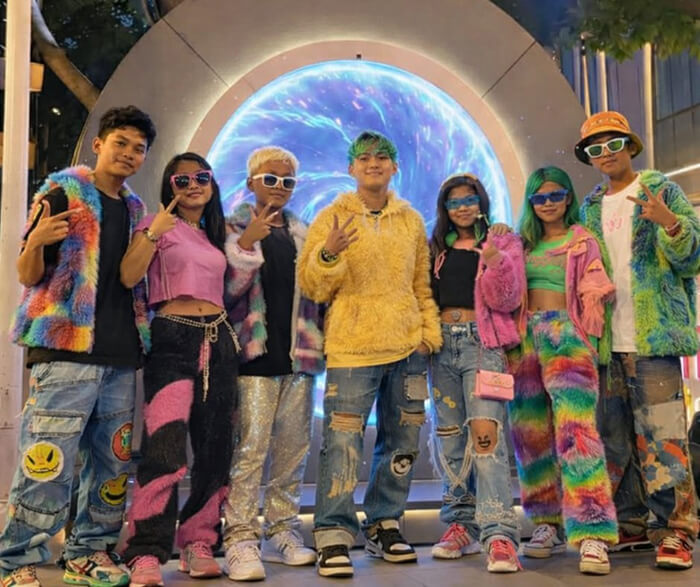
So, when the so-called “young stunnas” incident in BGC made the news, I was intrigued, even if I initially struggled to connect the dots between dressing down, GMRC, activism, and freedom of choice. The associations felt oddly compressed, as if an oversized NBA or NHL jersey could suddenly carry the moral weight of a manifesto.
For those still scratching their heads: young stunnas are a new generation defined by clean streetwear, local rap slang, and massive confidence. The look started in global hip-hop but blew up locally via TikTok. It’s a Pinoy style that values looking and acting like you’ve made it, regardless of where you came from.
In BGC, what seemed to unsettle people was not the ensemble itself but the attitude attached to it—the posture, the slang, the unapologetic presence.
CONTINUE READING BELOW

But why BGC? Why not neighboring Makati, long the enclave of the rich and powerful, where power dressing was perfected decades ago as a sign of having “moved up”? Why not QC, where activists have been bred in the halls and classrooms of UP for generations, fueled by photocopied readings and principled anger? Why not Pasig, with its hip millennial mayor as the poster boy of progressive governance? Why not Parañaque, with its casinos, neon lights, and excess that feel closer to Bugsy than Street Fighter II?
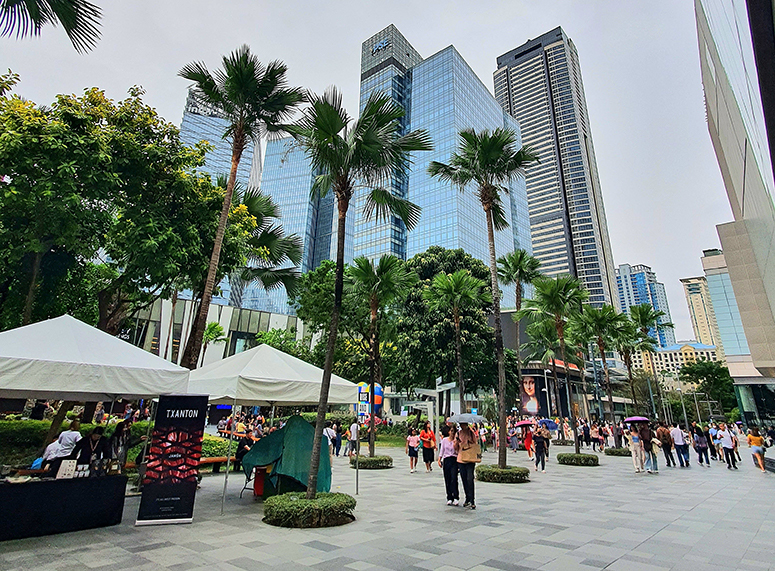
Perhaps the answer lies in what BGC represents. It is less a financial or commercial district than one large, meticulously planned gated community—a city within a city, like Sandton in Johannesburg. Entry is technically open—no exorbitantly priced car stickers are required—but to stay and “belong,” you must be willing to spend in mostly expensive stores and act as if you matter, as if you already know the rules.
I have seen BGC evolve from a military fort (duh, it’s still in Fort Bonifacio) into a half-finished promise of urban order, into a polished stage where finance, leisure, and aspiration coexist in carefully zoned harmony. People here linger, but not too long. They express themselves, but not too loudly. The rules are invisible, yet firmly felt.
Perhaps this is why the sight of a cohort of young people taking up space, blocking walkways, speaking in a language as familiar to onlookers as Klingon, Elvish, or Dothraki, and treating the district less like a showroom and more like a hangout struck a nerve. It disrupted the illusion that public space, when sufficiently enhanced, becomes neutral.
The backlash follows a tired script: when influencers pose in BGC, it’s “content”; when local kids do it, it’s a “problem.” This friction is the essence of dialectics, the idea that meaning is born from the collision of opposing forces.
Streetwear thrives on this tension. Take the high-low dialectic pioneered by Virgil Abloh at Louis Vuitton: the fit only works because it pairs the polished with the gritty. Remove the street codes, and it’s boring; remove the luxury, and it’s invisible to the mainstream.
Then there is the street-corporate dialectic. BGC represents glass-tower discipline, yet “stunnas” move through it with the abrasive posture of the sidewalk. It is the energy of Demna at Balenciaga—oversized, “ugly” silhouettes purposefully clashing against high-rent backdrops. The vibe exists precisely because these elements shouldn’t coexist.
Ultimately, this is a thesis-antithesis-synthesis loop. The thesis is traditional luxury, old money, quiet, inherited authority. The antithesis is street rebellion, the come-up narrative, loudness as survival and visibility. The synthesis is the young stunna—not fully accepted by either world, unsettling yet borrowing from both, asserting a new kind of authority rooted less in pedigree and more in presence.
Pop culture has played this game before. Hip-hop was once dismissed as a fad before becoming a billion-dollar industry. Punk was mocked for looking “dirty” before ending up in museum exhibitions. Even The Breakfast Club, now a nostalgic comfort film, was once a mild scandal about teenagers refusing to behave properly in detention. Fittingly, the film’s closing anthem—Don’t You (Forget About Me) by Simple Minds—is itself a plea for recognition in an age where so many are being ignored.
What happened in BGC was not a sudden rupture but a moment of visibility. A group of young people, armed with phones, loud voices, and a vocabulary of their own, briefly punctured the idea that some spaces are above friction. To some, it was a nuisance. To others, a provocation. To anyone who has watched youth cultures come and go, it was simply another reminder that even the snootiest cities eventually have to make room for people who do not seem to “fit in”—those who insist on showing up, boldly dressed, unapologetically present, and very much of their time.
Some realities we have to learn to live with are that trends mature, slang evolves, fashion cycles back, and the young will always find ways to be seen and heard. Another truism? Today’s young stunnas will eventually grow into something else—maybe even designers, creatives, professionals, or parents—who will one day complain about the next generation blocking sidewalks for holographic selfies.
For now, let them pose. Let them speak their lingo. Let them figure it out.
Matsalove.

WATCH: Is Gen Z too soft? (Generations Ep. 23)
September 30, 2026