

I do, I don’t, I don’t know… maybe later?
Life was simpler back in the day. We went to school, had a relationship, got a job, married, and raised kids, though not necessarily in that order.
In this age of TikTok and Instagram, Parokya ni Edgar’s iconic question "Uso pa ba ang harana?" has evolved into "Uso pa ba ang kasalan?"
Is marriage still a thing?
“It depends” is the likely answer. Relationships we thought would have a fairy-tale ending never reach the checkered tape like winded runners. Others surreptitiously hook up or simply tie the knot without fanfare.

For celebrities, it must be extremely difficult to pull it off in this age of self-promotion and mobile phone paparazzi. But the wedding of Millie Bobby Brown and Jake Bongiovi was a masterful exercise in planned secrecy, while Crash Landing on You co-stars Hyun Bin and Son Ye-jin swapped the scripted drama of their hit show for an actual secluded union far from the cameras.
Filipino fans share a collective obsession with romance, that kilig moment they want to experience not just vicariously but in real life. However, weddings are wearing a different veil these days.
CONTINUE READING BELOW

Gen Zs and Millennials are looking at their bank accounts, travel plans, career trajectories, and a median marrying age hovering in the low to mid-thirties.
Data from the Philippine Statistics Authority reveal that registered marriages dropped by over 10% in the last year alone. Over the past two decades, they have plummeted by 36%. Gone are the days when getting married by twenty-five was the gold standard—or as today’s young people prefer to call it, a life goal. Gen Zs and Millennials are looking at their bank accounts, travel plans, career trajectories, and a median marrying age hovering in the low to mid-thirties.
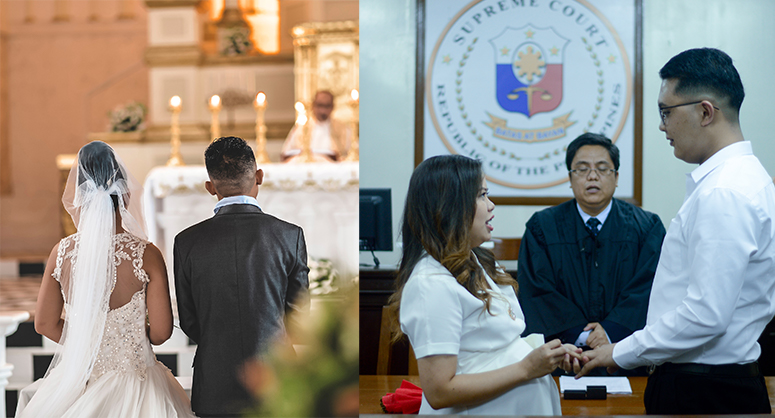
Even saying “I do” has somewhat shifted. Civil ceremonies are quietly overtaking grand church weddings. Practicality has entered the picture, where e-vites include QR codes and “in lieu of gifts” suggestions—like a cash registry or honeymoon fund—to “Help us on our next great adventure.” It may be a bit unsophisticated, but it still beats getting duplicate toasters, rice cookers, or rechargeable lamps.
Despite old-fashioned perceptions of marriage, in an era of persistent inflation, a city hall “quickie” followed by a thoughtfully selected dinner seems to make more sense than a traditional ritual that could easily run up to half a million pesos. (Some wedding gowns cost more than this.)
But try booking a church or a reception venue, and you’ll find yourself on a waiting list so long it’ll test not just your patience but, perhaps, the relationship itself. Recent weddings I’ve attended have been outside Metro Manila. I can’t tell if the demand is simply greater than the supply or if it’s a sneaky “non-invite” tactic to keep a conservative attendees list while maintaining protocol.
Fiction and pop culture continue to sell the dream. Films like Rewind remind us of the emotional stakes of marriage, while K-dramas such as Queen of Tears explore not just falling in love, but staying in love.
Off-screen, cohabitation has silently become the modern “trial period.” The number of women in common-law arrangements has quadrupled, and more children are now being born to parents who have opted out of formal unions than to those who saw it through.

Pamamanhikan—which is literally an ascent to the home of the female to formally ask the blessing of her parents for the union—has become as uncommon as harana, with consenting adults deciding to quietly “move in” and live together, even without their parents’ consent or knowledge. “Shotgun marriages” due to unplanned pregnancy, once an ironic truism in Philippine society, are considered archaic these days.
One of the reasons cited by my young, unmarried friends is the lack of divorce in this country, a notion that gains traction with every passing generation. I remember warning some clients asking about marriage and property regimes that annulments could be similarly expensive, stressful, and demanding. I did it as a matter of courtesy because I’ve had increasingly more cases involving separation of property and annulment.
Naturally, this brings to mind the great debate between “sunk cost” and “soulmate.”
The sunk cost idea is simple enough: people tend to stick with something because they’ve already invested time, effort, money, or emotion in it, even when it may no longer be viable. It’s staying in a relationship not out of love, but out of history, pride, reputation, or the oft-repeated excuse of keeping the family intact. Sometimes, it’s financial dependence, as when a woman gives up a promising career to raise the family.
The alternative, of course, is the soulmate route, i.e., holding on to that person because you’ve convinced yourself that you were destined for each other. It’s the “cord of communion” that Jane Eyre believes links her heart to Mr. Rochester’s, or the “twist” behind many K-dramas where love is predetermined from childhood. It pierces time itself, as illustrated in The Lake House, or Guardian: The Lonely and Great God.
Increasingly, people are choosing a third option: neither rushing in nor stubbornly staying put, but redefining the terms altogether. The younger generations have come to realize that entering relationships and getting married are individual choices that are no longer dictated by family, society, or even by a partner.

This is not to say that marriage is “out” or “un-hip”; it’s just being rebranded. We are moving away from marriage as a societal “checkpoint” and toward it as a conscious choice. It might mean fewer ceremonies, but perhaps it will also lead to stronger unions.
What’s truly important is for the friendship and courtship to continue long after the wedding so that the kids won’t just see marriage as a contract or a cost, but rather a home worth building.

WATCH: How to experience Bangkok and Kanchanaburi in one trip
October 21, 2026
WATCH: Is Philippine cinema still thriving? (Generations Ep. 19)
September 2, 2026
WATCH: Is Gen Z too soft? (Generations Ep. 23)
September 30, 2026