

How beauty queen Anna Valencia trained smart for Hyrox
With so much news swirling about a Hyrox Philippines race in 2027 and Hyrox training clubs sprouting all over the archipelago, it wasn’t surprising to see beauty queen Anna Valencia Lakrini join the trend.
Proud of her mixed heritage, she has successfully represented both the Philippines and Germany on the international beauty stage. As Bb. Pilipinas Globe 2023, she represented the country at The Miss Globe 2023 and finished second runner-up. She then represented Germany in Miss Supranational 2025 and finished first runner-up.
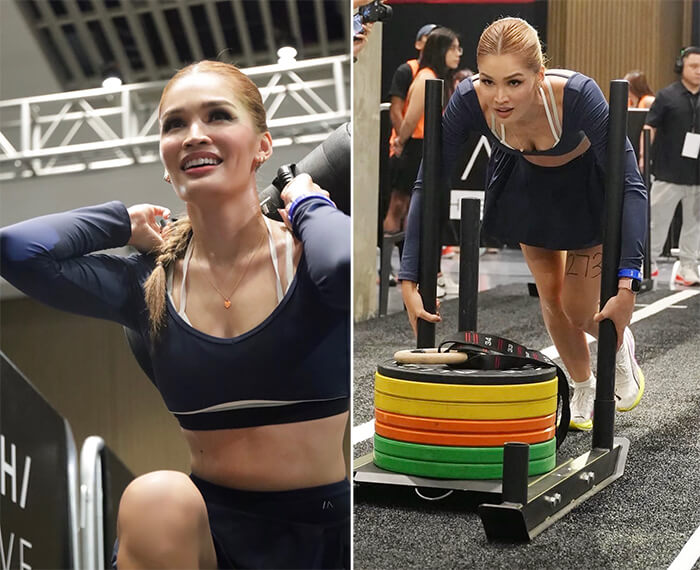
Taking her training seriously, she sought important tips from an expert before joining the fitness race of Bench Active, while planning to eventually compete in a Hyrox race. Enter coach Eronile Alfonso Castellon, a Hyrox Pro athlete and UESCA-certified running coach. He is the first Hyrox performance coach based in the Philippines. He has completed seven Hyrox races across five divisions over two seasons, training and competing largely to study the demands of the sport and apply those insights to coaching.
He also served as a Wall Ball judge at the Hyrox World Championships in Chicago last year and was head judge at the recent Hyrox Hong Kong event. So what did he advise first-timers like Anna? We asked.
CONTINUE READING BELOW

THE PHILIPPINE STAR: For a regular gym-goer, how many weeks do you need to prepare for your first Hyrox race?
Coach Eron Catellon: Technically, anyone can finish a Hyrox race any day. That is part of the beauty of the format. There is no strict time limit, so the race is designed to be accessible to a wide range of participants.
However, for athletes who want to truly enjoy the experience and perform well, about 16 weeks of preparation is usually recommended. This allows time for proper periodization. Training can first focus on building an aerobic base, then gradually developing the strength and conditioning needed for the stations.

Attempting the stations without proper preparation often leads to poor movement habits or injuries. Structured preparation helps athletes build both endurance and the mechanics required to move efficiently during the race.
What fitness tests do you conduct to assess a person’s readiness to race?
When working with athletes, three areas are usually assessed. The first is aerobic capacity. A simple benchmark is whether someone can comfortably run a 10K or sustain 90 minutes to two hours of continuous running, even if it includes run-walk intervals.
The second is movement awareness. Basic patterns such as squatting, hinging, pushing and pulling are observed. Hyrox stations are not just about strength; there is a lot of physics involved in how efficiently the body moves weight and equipment.
The third area is movement under fatigue, which is typically evaluated later in the training block. By combining running with stations, it becomes clearer whether an athlete can maintain pacing and technique while tired.
Hyrox is roughly 50% running. Should training lean more toward aerobic base or functional strength?
The Hyrox Science and Sport Report (2025) shows that the race is actually more than 50% running, which means it is primarily an aerobic event.
Because of this, training generally leans more toward building a strong aerobic base and improving aerobic threshold. Functional strength is still important, but many regular gym-goers already have a reasonable strength foundation.
The real challenge is the ability to run efficiently after performing a station, repeatedly throughout the race. A strong aerobic engine allows athletes to recover faster between stations and maintain better pacing.
Which stations usually reveal the biggest “energy leaks” in beginners?
Two stations that often expose pacing mistakes are the SkiErg and the RowErg. The SkiErg is the first station, and many athletes go too hard because it feels manageable early on. That can lead to excessive lactate accumulation, which then affects the running segments and the sled push that follows.
The RowErg is sometimes mistaken for a recovery station, but it is actually one of the most demanding efforts in the race. Poor pacing there can contribute to cramping and fatigue later in the lunges or farmer’s carry.
Another common energy leak appears during burpee broad jumps. Explosive jumping in every repetition tends to burn energy quickly. In many cases, a slower but continuous rhythm is more efficient and sustainable.
For the sled push and pull, what is the most efficient body angle?
The sled push and pull rely heavily on mechanics and leverage.
For the sled push, athletes typically benefit from a forward body lean with the shoulders slightly past the bars. A useful cue is 10% down, 90% forward, emphasizing horizontal force. Standing too upright often causes the back of the sled to lift, which reduces forward drive.
For the sled pull, athletes should sink their weight and position the chest slightly behind the hips before pulling. Once the sled begins moving, using body weight as leverage becomes more effective than trying to overpower the load.
How does one avoid shoulder burnout in the wall ball station?
Wall balls are most efficient when the movement is driven primarily by leg and hip power. The squat generates the force that sends the ball upward, while the shoulders and forearms mainly guide and stabilize the throw.
One useful technique cue is to relax the arms after releasing the ball. Many beginners keep their arms locked in tension after the throw. Instead, bringing the ball back quickly to the chest and catching it slightly lower helps maintain a smoother rhythm.
When the movement flows correctly through the legs, hips and torso, the shoulders experience significantly less fatigue.
How can athletes stay injury-free and maintain longevity in HYROX training?
Three principles are emphasized when working with athletes: progression, balance and recovery.
Training volume should increase gradually so the body can adapt to both the running load and the strength demands of the stations.
Balance is also important, which is why Hyrox training frequently includes unilateral strength work such as lunges and split squats.
Finally, recovery plays a major role. Sleep, proper fueling, and structured easy days help athletes maintain consistency. Hyrox workouts can be highly glycogen-demanding, especially closer to race day, so adequate nutrition is important to support training.

WATCH: Can you still trust someone who betrayed you? (Generations Ep. 22)
September 23, 2026
WATCH: Save for retirement or enjoy life now? (Generations Ep. 21)
September 16, 2026