

DOLE reminds private sector of work suspension rules amid inclement weather
The Department of Labor and Employment has released an advisory on work suspensions in the private sector due to inclement weather.
In Labor Advisory No. 14, series of 2026, the agency said that private employers may suspend work during typhoons, heavy rains, or other weather disturbances to protect employees’ safety and health.
Employees who do not work are generally not entitled to regular pay unless covered by a more favorable company policy, collective bargaining agreement, practice, or accrued leave credits.
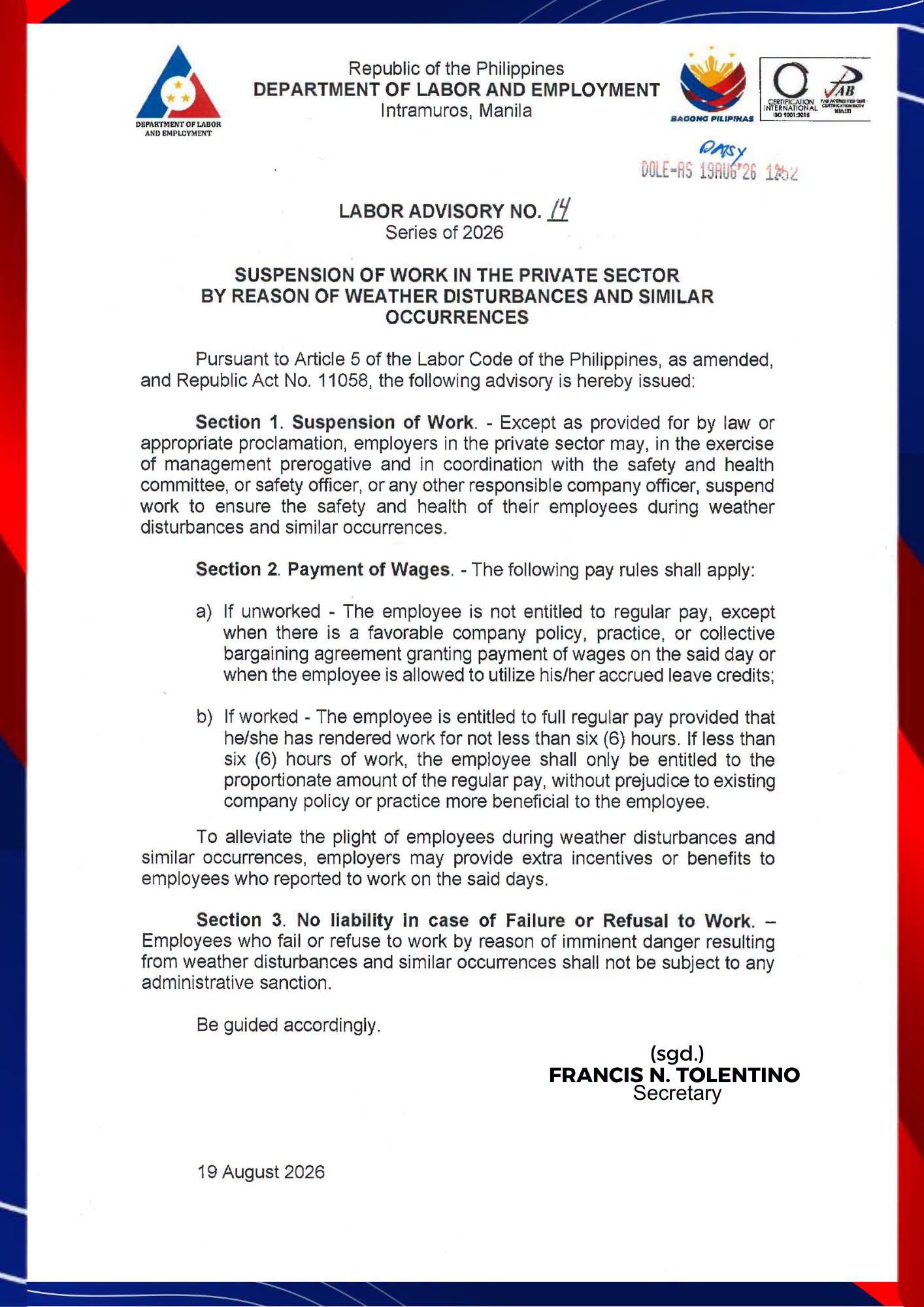
Those who work for six hours or more receive full pay, while those who work less than the minimum will receive proportional pay based on the actual hours worked. They may also be entitled to additional incentives or benefits provided by private employers to ease the difficulties they experience during such weather disturbances.
Meanwhile, employees who are absent or refuse to work due to "imminent danger" caused by severe weather should not be subject to administrative sanctions.
CONTINUE READING BELOW

On August 17, PAGASA recorded 201.7 millimeters of rainfall in five hours as the southwest monsoon, or Habagat, brought heavy rains to parts of Luzon. The rainfall prompted flooding and difficult travel conditions in several areas.
As the Habagat continued, authorities announced the suspension of face-to-face classes for Wednesday, August 19, in affected areas. Malacañang also directed government offices in Metro Manila and other affected areas to adopt alternative work arrangements to reduce the risks posed by continued heavy rainfall, flooding, and dangerous travel conditions.
Tropical Depression Neneng is expected to enhance the southwest monsoon, bringing more rain to parts of Luzon in the coming days. Neneng is forecast to move west-northwestward and may make landfall along Taiwan’s eastern coast between Thursday afternoon and Friday morning before weakening.
Despite not making landfall in the Philippines, Neneng is still expected to strengthen the Habagat and bring continued rains to western Luzon.

WATCH: Discovering Vietnam in three days
June 9, 2026
WATCH: Save for retirement or enjoy life now? (Generations Ep. 21)
September 16, 2026
WATCH: Pixar Summer Fest adventure at Hong Kong Disneyland
August 10, 2026