

Art Panganiban on his law, his passions, his legacy—and secrets to a long life
In the 72 hours before he was to appear before the Senate Impeachment Court as an amicus curiae, or friend of the court, retired Chief Justice Artemio V. Panganiban had an unusually heavy if grueling daily schedule.
CJ Art was in balmy Madrid, Sept. 5 to 14, as a VVIP guest and was going to watch the Formula 1 Spanish Grand Prix when he received the Senate Impeachment Court’s invitation. He was to appear as an amicus curiae, one of three retired chief justices and one retired associate justice who was also a framer off the 1987 Constitution, invited to comment on an existential issue—whether the Impeachment Court can lower the two-thirds of all senators voting threshold to convict an impeached official, Vice President Sara Duterte.
Duty and country first
Summoned by duty and country first before a Ferrari run, CJ Art raced half-awake to catch a 21-hour flight. He arrived home in Makati, Sept. 15, a day before the hearing. He spent the whole night writing his legal brief and presentation before the Impeachment Court.
At 5:30 a.m., Sept. 16, a near-sleepless Art squeezed in golf: nine holes for two hours in nearby Manila Golf.
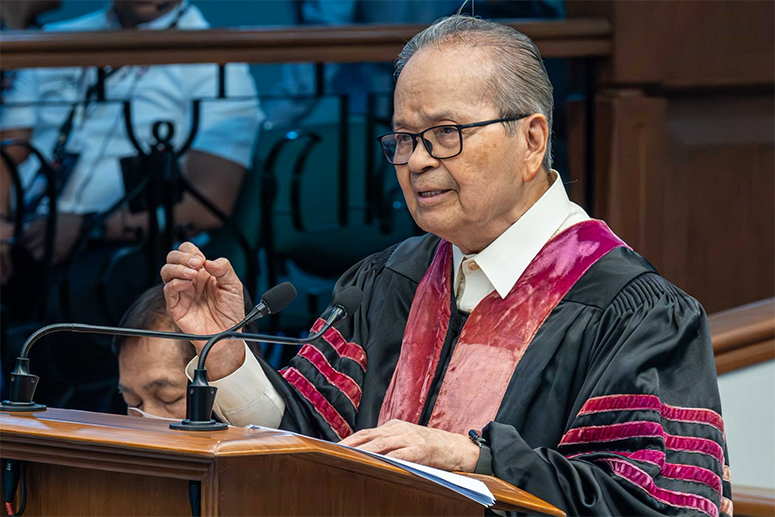
Four hours later, at 9:30 a.m., he was at the Senate. He donned his jurist’s robe and prepared to do battle with legal minds and lawmakers in the next six hours in the nation’s highest legislative chamber. Called first by reason of seniority, CJ Art spoke for 20 minutes. His presentation, complete with PowerPoint, was a masterclass in elegance of language, clarity of thought and legal wisdom, and in how to read and interpret the Constitution.
Two ways to read the Constitution
CONTINUE READING BELOW

There are two ways to read the Constitution, he said:
- Verba legis, whereby words are plainly read and given their ordinary meanings. In such cases, there is, Art quoted the Supreme Court of the Philippines, “no need for interpretation, but only application of the provisions.”
- Secondly, Ratio legs set anima, or, to quote the Supreme Court: “The reason of the law is the soul of the law.” The text must be understood within its constitutional ambiance.
But the veteran jurist of 11 years explained that there is a third way.
CJ Art advised that the senators could apply neither of the two. How? “In accordance with their mandate as representatives of the people, especially reflecting the common sense of the people guided by two fundamental standards—truth and fairness.” Even more importantly, the Impeachment Court’s decision cannot be appealed before the Supreme Court, he said.
CJ Art raised pointed questions about the fairness of absentee senators voting in an impeachment trial:
“Is it truthful and fair to allow senators to cast their votes despite being absent from the proceedings? Is it fair and truthful should the Senators be allowed to vote though they are in hiding, abroad, legally detained, sick, hospitalized, or otherwise absent and have not been able to access and examine the documents, have not heard the testimonies, and have not observed the demeanor of the witnesses? Is it truthful and fair to the parties, to our country, and to our people to allow those abroad, those looking at the Pyramids along the Nile, or shopping in the fashion houses of Paris, or riding the romantic gondolas of Venice, or deliberately hiding in the dark comers of the world, while everyone here is sweating it out?”
Senate conviction vote from 16 to 14
CJ Art’s wit, humor, brilliance, common sense, and command of law and language must have been such that the Impeachment Court decided later that two-thirds of 20 senators present, or 14 (not 16), could convict Sara.
Asked by Sen. Erwin Tulfo if the constitution is perfect, Art replied, “Only God is perfect.” “Now, in the judiciary,” the jurist added, the Supreme Court is not perfect. But it is always right. Sometimes also, it is not always right, but it is never wrong.” Laughter. Tulfo asked the same question of retired Chief Justice Reynato Puno, who replied, “There is no perfect Constitution in the world.”
By 3:30 p.m., CJ Art finished his nation-building task at the Senate Impeachment Court, and motored to a 4 p.m. Audit Committee Meeting of PLDT.
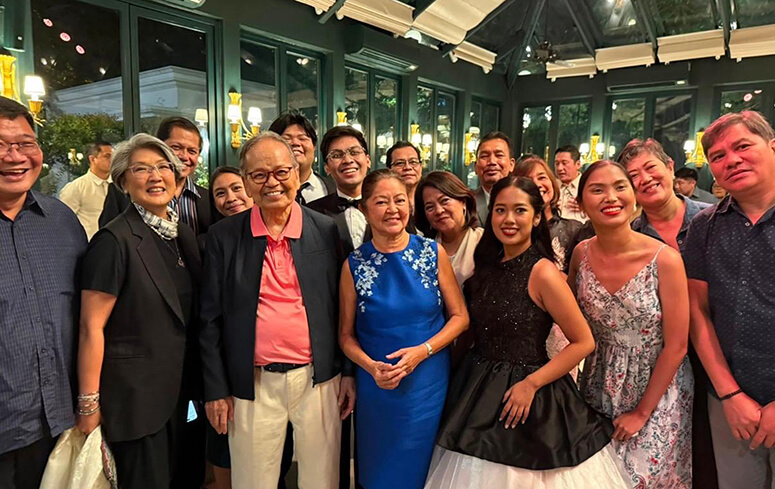
At 5:30 p.m., Art was at the Manila Polo Club for the annual awards of scholarships and prizes for the wards of his Foundation for Liberty and Prosperity (FLP) attended by First Lady Louise Araneta Marcos and Bangko Sentral Governor Eli Remolona. The glittering event ended past 10 p.m.
‘My father died in my arms, without emergency medical help. My being a lawyer was his last wish,’ says former Chief Justice Artemio Panganiban.
Art’s FLP has funded 126 law scholars, 25 MBA fellows, 42 dissertation writing winners and 16 professorial chairs in various schools. He has spent P88 million for the scholarships.
Secrets of long life
How does CJ Art, who turns 90 this December, manage such a man-killing daily schedule? He has a formula for healthy living: Avoid the three S’s—sugar, salt, and stress.

Art lives in a sprawling mansion he built in 1979 on a 1,500-sqm Dasma, Makati property bought in 1973 when one could see Manila Bay and where the millionaires’ village still had no houses. Daily, he sleeps for four to five hours, wakes up at 3:30 a.m., takes a heavy breakfast and a heavy lunch. “Heavy” is meat and a little rice. “I avoid four-legged animals because they are difficult to digest.”
Exercise regimen
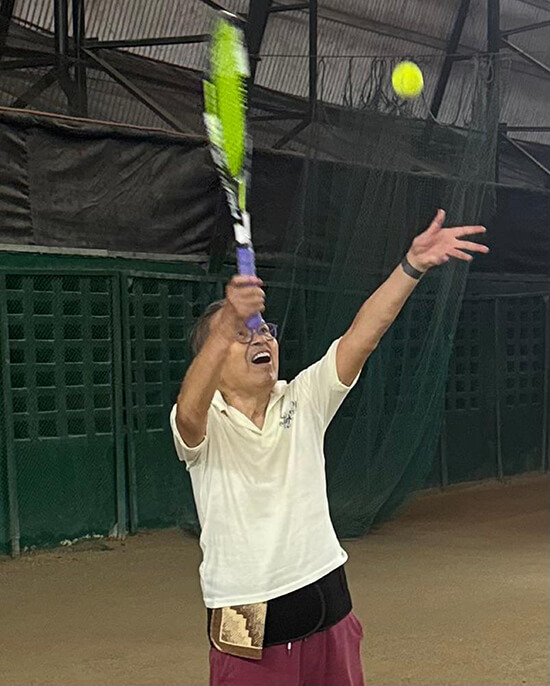
Art keeps a regular exercise regimen—a mean session of tennis, Monday and Friday, and a relaxing golf game, Wednesday and Saturday. Every Tuesday and Thursday, he walks 3.3 kms. “I hold the tennis racket every hard. I play singles. In golf or tennis, I normally win.” Art usually takes a siesta after lunch.

In addition to avoiding the three S’s, Art suggests this acronym: SED (sleep, exercise, diet). And most importantly, SP: a special purpose in life.
During his 10 years and three months as an associate SC justice and one year as chief justice, Art wrote on average two full, signed decisions or 104 ponentes a year or about 1,200 decisions.
Plus one book a year. Among his books: Love God, Serve Man (1994); Justice and Faith (1997); Battles in the Supreme Court (1998); Leadership by Example (1999); Transparency, Unanimity & Diversity (2000); A Centenary of Justice (2001); Reforming the Judiciary (2002); The Bio Age Dawns on the Judiciary (2003); Leveling the Playing Field (2004); Judicial Renaissance (2005); and Liberty and Prosperity (2006).
A Renaissance jurist
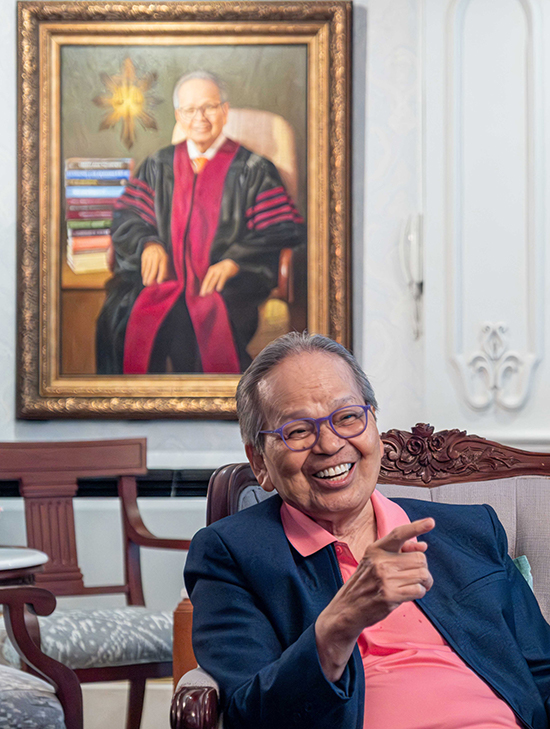
Not surprisingly, when Art retired as chief justice on Dec. 6, 2006, the SC passed a unanimous resolution declaring him as the “Renaissance Jurist of the 21st Century.”
“His is a life story replete with successes and defeats, from his humble beginnings as a young newsboy in the streets of post-war Manila to his prevailing 11-year stint in the Supreme Court of the Philippines,” said a businessman who introduced him as PICPA’s March 2026 guest speaker. “He is now much respected and sought after as a director or adviser by many publicly listed companies, top corporations and philanthropic foundations in the country. Thus, Ageless Passion is premised upon his indefatigable acuity and spirit—not to mention his charisma.”
Retired Chief Justice Hilario Davide has talked of CJ Art’s mental dexterity: “He extricates the possible from the hypothetical, the emerging from the established, the literature in science and the law in art.”
How to be relevant
Retiring Chief Justice Alexander Gesmundo envies one quality of CJ Art—“his incomparable ability to remain relevant. Irrelevance, inconsequence, insignificance, these are the dreaded curse accompanying retirement.” With his inimitable art of relevance, CJ Alex notes, “Chief Justice Art undeniably continues to be a resonant voice, not just heard but read and listened to by many, from people with no legal background, to lawyers and law students, justices and judges alike, and even those of us currently sitting in the High Court. His columns discuss the burning legal issues of the day with more freedom than he had when he was sitting in the Court bound by its rules and proscriptions. Not in a few instances, Chief Justice Art has articulated sentiments and views which incumbent members of the Court could only wish to say themselves. His analyses of jurisprudence are incisive and can cut to the quick, but are always insightful. He likewise continues to write about his passion for reform, which he promoted assiduously as a chief justice.”
Not many Filipinos realize it but CJ Art was actually the legal (master) mind behind the ouster of President Joseph Ejercito Estrada on Jan. 20, 2001. He convinced then Chief Justice Hilario Davide to declare a vacancy in the presidency to enable VP Gloria Macapagal Arroyo to take over as the “acting president.” On April 3, 2001, the SC decided with finality that indeed Estrada had resigned as president before Arroyo took over.
His lasting legacy
Perhaps, CJ Art’s lasting legacy is his Foundation for Liberty and Prosperity. The foundation, says its website, “aims to perpetuate CJ Art’s core judicial philosophy that jurists and lawyers should not only safeguard the liberty of our people but must also nurture their prosperity under the rule of law. To Art, justice and jobs; freedom and food; ethics and economics; democracy and development; nay, liberty and prosperity must always go together; one is useless without the other. The attainment of this dual goal involves an understanding of the intertwining relationship of law and business, and of regulation and entrepreneurship.”
His odyssey of scholarship, success, and happiness Art credits all to his one love, next to his late wife, Leny—the Lord God Himself. “My purpose in life is to be a humble servant in the Vineyard of the Lord,” he says simply.
Three things to remember about art
Three things to remember about Art:
First, he is a Catholic gentleman. “Everything I own is from the Lord,” he says. “I was nothing. I didn’t even know religion. I was born a Catholic. But my parents were not practicing Catholics. They didn’t know any better. My father was a high school graduate, my mother an elementary school graduate.”

“Every turn in my life was something I either didn’t want, or it just happened. I didn’t want to be a lawyer. I wanted to be a chemical engineer, because I was good in math. But my father told me, ‘Don’t be an engineer. Be a lawyer.’ His ambition was to be a lawyer but he didn’t finish college. ‘You are my last hope. You are the youngest,’” Art says, recalling his father’s words. “My father died in my arms, without emergency medical help. My being a lawyer was his last wish.”
Art is the only Filipino appointed by now Saint Pope John Paul II to the Pontifical Council for the Laity for the 1996-2001 term. In 2024, Chief Justice Panganiban received the highest papal award, the “Pro Ecclesia et Pontifice,” from Pope Francis.
Second, scholarship. He is honor graduate in elementary, high school and college. No. 6 in the Bar. Says Art: “It’s through hard work and vision. Sometimes there are turns I never imagined would happen. I never thought I would be in the Supreme Court. I was a businessman, an entrepreneur from the very beginning.”
One of the best
And finally, as a jurist, CJ Art today is considered one of the most influential and best of Filipino jurists and of Supreme Court chief justices.
Being a jurist, says the quintessential jurist and renaissance man of law, “fulfills a life-long goal, and it is proclaimed in my website (cjpanganiban.com): ‘To attain a just and humane society where liberty is safeguarded, and prosperity is nurtured, under the rule of law.’”

WATCH: Do you still believe in marriage? (Generations Ep. 17)
August 19, 2026