

Believe your non-lying eyes
George Orwell’s 1984 would be little more than a catchphrase, a dusty novel assigned to high schoolers if it didn’t remain so sharply relevant today.
Just weeks ago, the Trump administration, after ICE agents shot Renee Good and Alex Pretti on Minneapolis streets, rushed to label them both “domestic terrorists” and “leftist lunatics” for using their cellphone cameras to document anti-immigration activities, even before ample video evidence surfaced to debunk the government’s claims. The White House has not corrected the record since then.
When the US government loudly labels American citizens as “terrorists” with no evidence, then George Orwell is alive and well.
When the US government strips away any mention of George Washington ever owning slaves from a Philadelphia historical site, claiming it violates an executive order signed by Donald Trump calling for “Restoring Truth and Sanity to US History,” you know that Orwell is still eerily present.
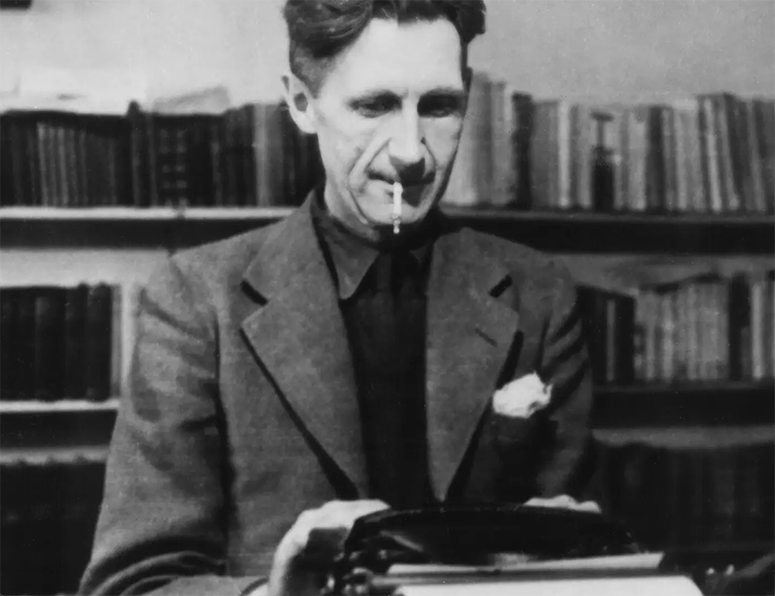
Last year’s documentary Orwell: 2 + 2 = 5 shows us what led a middle-class Englishman named Eric Arthur Blair to take on the role of British Empire cop in places like Burma, and how it shaped his life-long abhorrence of fascism—but more importantly, the tools of fascism that never really change over time, despite which tinpot dictator is in charge.
Blair became writer George Orwell, penning resonant parables of fascism such as Animal Farm, as well as dissective inside views of class structure in Burmese Days and Down and Out in Paris and London. Perhaps his most-taught essay was “Politics and the English Language” (1946), which still stands as a guide for the watchful to treat every public pronouncement with heavy skepticism. There, he warned against stale metaphors, cut-and-paste phrases, and “verbal false limbs.”
CONTINUE READING BELOW

His finale was 1984, a novel he labored over until close to his death in 1948. Published in 1949, it immerses us in the world of Winston and Julia, two lovers in a world that is constantly at war, not only with shadowy foreign powers but with its own citizens.
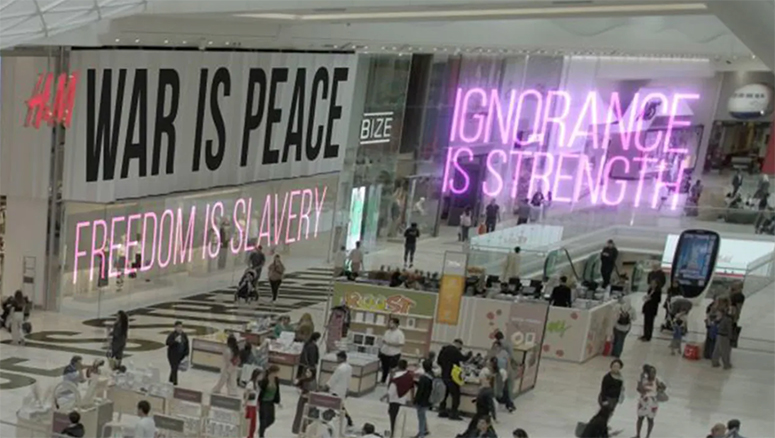
In Raoul Peck’s meditative documentary, images from filmed versions of Animal Farm and 1984 from the last 75 years are intercut with recent political news footage. Highly subjective, yes; jarring and effective, even more so. Clips from Myanmar Diaries (2022) share screen time with images of Pinochet, Ferdinand Marcos, George W. Bush, Putin, Viktor Orban and Trump. Instead of narration, we get spoken words from Orwell itself, who became “woke” when he realized his job as a cop—part of the “oppressor” class—distorted his view of the oppressed. Art, he felt, should provide a corrective lens. (“The opinion that art should have nothing to do with politics is itself a political attitude.”)
If fascism has some common threads, they are pulled by manipulation of language, Orwell realized. In 1984, he called this “newspeak”—a kind of reverse mental jujitsu that citizens of Oceania are expected to swallow on a daily basis. War is Peace. Ignorance is Strength. Freedom is Slavery. Failure to echo these truths requires “correction” by the government.
In the case of Minneapolis, Americans were expected to disregard what was apparent on the ground and swallow the government line: these were “terrorists” and “fanatical leftists” who were “obstructing” law enforcement, and therefore deserved what they got. Not moms and ICU nurses.

In the matter of Ukraine, Putin’s war was termed a “special military operation,” and any Russian who described it as “war” was put in prison.
Language becomes reality if you jettison any rational thinking or skepticism. Or as Winston put it in 1984: “The Party told you to ignore the evidence of your eyes and ears. It was their final, most essential command.”
There is a double-edged sword to language, though, in that satirical language can still wield great power. While lies can be used to confuse and discombobulate, lampooning the truth tends to deflate the lie. The weaponizing of the FCC, which governs US broadcasting, against late-night comedians (Steven Colbert, Jimmy Kimmel) is proof that satire still gets under the thin skin of overreaching rulers. Let it continue to be so.
There’s also a double-edged sword to technology. Maria Ressa provides a cameo in 2+2=5, warning us that “deep fakes” will make it harder to recognize truth. (“We will have to struggle harder for agency, for independent thought…”) I’m reminded of a recent Department of Homeland Security recruitment ad that opens with the words “Blessed are the peacemakers” in Gothic font; night-vision images of military forces rappelling into a building are paired with Lorde’s cover of Everybody Wants to Rule the World, and we eventually realize the soldiers are “invading” American cities to remove “illegals.” It’s a head-spinning PR move. We must do more than just trust our own eyes, at a time when the very fabric of history can be whitewashed, altered, or removed by decree. Such decrees may be reversed over time, as new leaders take office. But as Orwell himself notes, even if the apparatus changes, the effort to control our way of thinking remains: “Totalitarianism demands, in fact, the continuous alteration of the past.”
* * *
Stream Orwell: 2+2=5 on Amazon or Apple TV.

WATCH: Save for retirement or enjoy life now? (Generations Ep. 21)
September 16, 2026