

[OPINION] Why are we importing mass shooting culture?
Spoiler: I am going to come at this issue as an emotional wreck of a parent, and to say I was scared before, and I’m even more terrified now, is a monumental understatement. It seems to be all any of us parents are talking about, especially here in Mindanao.
The reason being is not because of the guns, the accessibility to it, or anything like that. But that the entire event was accessible to us all. Not only is it that the most terrifying thing for a parent is no longer simply that the world can reach our children; but it is that our children bring the world in, willingly, to watch. The stranger doesn't even have to speak directly to your child anymore, because an algorithm can repeatedly put that stranger in front of them.
There is something grotesquely appropriate about the fact that we use the same word for both a gun and a camera. We shoot a gun. We shoot a video. One captures a moment; the other can destroy.
There is something grotesquely appropriate about the fact that we use the same word for both a gun and a camera. We shoot a gun. We shoot a video. One captures a moment; the other can destroy. Yet in this particular kind of violence, the two can now exist together. One hand can hold the weapon while a camera records what the weapon does. The violence is no longer simply committed. It can be framed, captured, uploaded and transmitted.
Before I go any further in this highly contentious topic, I will say I am not at all pointing fingers at anyone (pun so totally not intentional); I am merely speaking as a mother that didn’t realize this type of violence now is in our schools. As much as the actual act and everything that went on is absolutely horrific, and I condemn and condole with the rest of the country, I’m also examining it from the lens of why did this even occur?
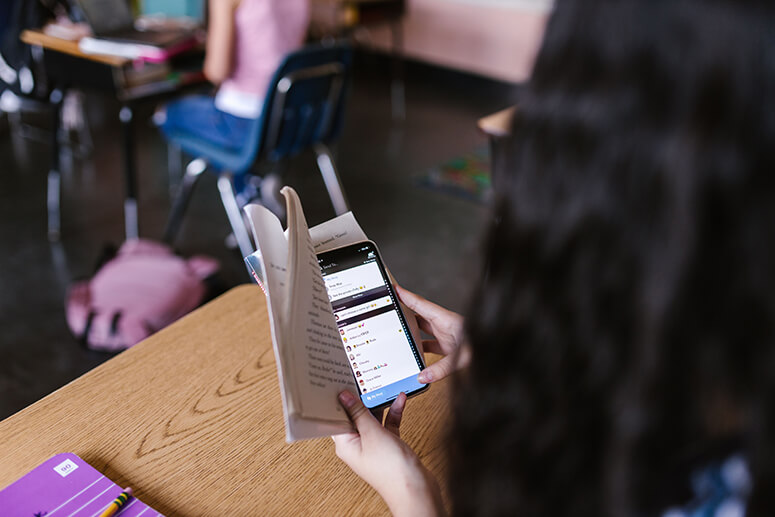
Perhaps that is the technological leap we have not fully reckoned with. The phone has collapsed the distance between an act and its audience. There is no longer necessarily an editor, a television station or even another witness standing between what happens and what the rest of us see. The person committing an act can also become the person documenting it, producing it and broadcasting it. The gun shoots in one direction; the camera shoots in another. One is aimed at the person in front of it. The other is aimed at us.
That is what frightens me. Not that cameras cause violence, nor that every terrible act recorded on a phone was performed for attention. That would be far too easy an explanation. It is that we have created a world in which the possibility of an audience is almost always there.

There was a time when keeping a child safe was, for the most part, a question of proximity: Where are you? Who are you with? When will you be home?

We locked our doors, taught our children not to wander off with strangers and knew their teachers, classmates and perhaps their friends' parents. A child in their bedroom was home. Their world had physical boundaries. Those boundaries barely exist anymore.
We spent generations teaching children not to talk to strangers, then handed them devices through which strangers can talk to them all day. A child can lie safely in bed listening for hours to a person whose real name they do not know, enter communities populated by people whose ages, identities and intentions are impossible to verify, and encounter pornography, violence, conspiracy theories, self-harm, extremism and misinformation without ever opening the front door.
We worry about who our children are talking to. Perhaps we should also worry about who they are listening to.
So where are the gates?
We restrict children's access to alcohol, cigarettes, gambling and films because we accept a fairly uncontroversial premise: children do not yet possess the judgment of adults.
Online, that principle becomes complicated. Age restrictions are easily circumvented. Disturbing material travels faster than platforms can remove it. Parents are attempting to supervise technologies that change faster than most of us can understand. Yet regulation raises another question: who decides what children should be allowed to see? Parents? Schools? Governments? Meta? TikTok? Google? Apple? And who decides what constitutes harm?
The internet demolished the gatekeepers. You no longer needed a newspaper editor to publish an opinion, a television network to broadcast yourself, a record company to find listeners or a publisher before somebody could read your words.
Everyone got a voice.
There is something extraordinary about that. People previously excluded from public conversation could speak for themselves. Communities could organize. Abuse could be documented. Information could escape censorship. Artists could find audiences without waiting for an institution to declare them worthy.
But giving everybody a voice did not give everybody expertise, discernment, judgment or good intentions.
The world before social media was hardly a golden age of truth. Newspapers printed falsehoods, governments lied, broadcasters had biases and powerful people controlled which stories were told. But there was friction between having a thought and broadcasting it to millions.
Now there is almost none.

Fact, opinion, rumor, propaganda, satire, conspiracy, eyewitness testimony, manipulated video, artificial intelligence and deliberate fabrication can arrive through the same screen, separated by a movement of a thumb. And the systems distributing it are not primarily asking: Is this true?
They are asking: Will you keep looking? And unfortunately, we do.
We look at outrage, fear, sex, scandal and conflict. We watch strangers cry, marriages collapse, parents humiliate their children, couples fight and teenagers have breakdowns. Someone falls over and before anyone reaches out a hand, someone else reaches for a phone.
Once everyone understands what we are willing to watch, people begin manufacturing it.
The breakdown becomes content. The apology becomes content. The fight becomes content. Tears become thumbnails. Vulnerability becomes strategy.
That does not mean every person who cries into a camera is pretending. But we have created an economy in which attention has value. If outrage performs well, there will be more outrage. If humiliation performs well, there will be more humiliation. If extremity produces attention, the incentive is to become more extreme.
Where does escalation end?
For decades, when a young person commits an act of shocking violence, popular culture itself is inevitably placed on trial. It was rock music. Heavy metal. Rap. Violent films. Then it was video games.
These are legitimate empirical questions and deserve empirical answers rather than convenient ones. If the evidence does not demonstrate that playing violent video games causes young people to commit real-world atrocities, we should not pretend that it does simply because the explanation feels satisfying. But perhaps we have been asking the wrong cultural question.
What if the more important distinction is not between violent and non-violent entertainment, but between simulated violence and performed violence?
A child playing a video game understands, at some level, that the people being shot are pixels. A film has actors. The blood is artificial. The dead get up when the director calls cut.
The internet offers something different.
A young person can encounter real violence committed by real people and discover that violence can produce something extraordinarily valuable in the economy they have grown up understanding instinctively:
Attention. Views. Shares. Reposts. Comments. Headlines. Notoriety.
Violence has always attracted attention. Murderers became infamous long before Instagram. But there was once an intermediary. Someone else decided whether your act would be broadcast.
Now the perpetrator can become a cameraman, publisher broadcaster and editor. The act and its representation can occur simultaneously.
I want to be very clear here: I do not know that attention was what this young man wanted, if any at all. None of us can know that simply because a camera was present. The camera does not prove the motive. But perhaps attention does not have to be the motive for the audience to matter. Whatever drove the violence, the means to turn that violence into something witnessed was already there.
The gun shoots in one direction. The camera shoots in another. And the audience can arrive before the act is even over.
Previous generations had their own mythology of young people and self-destruction: the rock star who burned too brightly. The so-called 27 Club transformed individual tragedies into cultural mythology. People who died desperately young became permanently young, their self-destruction tangled with their legend.
We should be extremely careful before drawing an equivalence. Guns have not simply replaced heroin. A school shooter, or any shooter, is not the new rock star.
But perhaps there is a question worth asking underneath the comparison: has the old human desire to make self-destruction mean something found a new medium?
The mythology of the doomed rock star offered a particular kind of immortality. Die young enough, spectacularly enough, tragically enough, and the person stopped aging while the story continued.
But the audience came afterward.
Today, the person does not necessarily have to wait for an audience to discover their self-destruction after it has happened. They can summon the audience themselves. They can frame it. Record it. Transmit it. Potentially watch the numbers climb while it is happening.
That does not mean every livestreamed act of violence is motivated by fame. But neither should we ignore what the smartphone makes possible: the possibility of witnessing one's own notoriety.
For a generation raised with visible metrics attached to almost everything they publish—views, likes, shares, followers, comments—attention is no longer abstract. It has a number.
Perhaps that is why safeguards cannot end with parental controls and age restrictions. We have to ask what kind of culture we have built around attention itself.
What are we teaching children when humiliation generates millions of views? When a public breakdown becomes entertainment? When cruelty becomes viral? When notoriety and achievement can occupy exactly the same amount of space on a screen?
Most children will encounter all of this and never hurt anyone. Most children who play violent games will never become violent. Most teenagers who spend too much time online will not become killers. Most young people who want followers simply want what young people have always wanted: to be noticed, liked, accepted and understood.
Technology did not invent those desires. It industrialized them.
We have given children something no previous generation possessed: access to almost the entirety of human knowledge. A child can learn from a professor on another continent, enter museums, read books, discover music and meet people whose lives would otherwise have remained unimaginably distant.
That is miraculous.
But we handed them something else at exactly the same time: cameras, algorithms, anonymous communities, strangers and audiences. We created platforms capable of broadcasting a child’s words, face, pain, anger, humiliation, brilliance or worst impulse to enormous numbers of people almost instantaneously. Then we told children and their parents to figure out the boundaries while already living inside them.
The question cannot simply be whether the internet was a mistake. Nor can the answer be to resurrect the gatekept world that preceded it.
The harder question is whether unrestricted access to an audience — and unrestricted access by that audience to our children — was ever as neutral as we pretended it was.
Because the internet did not merely democratize information. It democratized publication. It democratized speech. And, perhaps without quite meaning to, it democratized fame. You no longer have to be extraordinary to become known. You only have to capture attention.
But there is a darker question we may now be forced to confront. What happens when attention is valuable enough that someone is willing to purchase it with something irreversible? What happens when the price someone is prepared to pay for an audience is their own life? Or somebody else’s?
Perhaps that is the part we failed to anticipate when we gave everyone a stage. We assumed the great question would be who finally got to speak. We did not spend nearly enough time asking what someone might eventually be willing to do to make us listen.
The audience was already waiting.

WATCH: LGBTQIA+ people with unlikely professions
June 28, 2026
WATCH: Is OPM still as good as it used to be? (Generations Ep. 20)
September 9, 2026