

DOT boosts China connectivity with three new direct flights
BrandedUp in partnership with

For 39-year-old Chinese traveler Yang Yan of Hangzhou, business trips to the Philippines once meant taking a three-hour ride to Shanghai before catching a connecting flight to Manila.
As a frequent visitor to the country, she had grown used to the extra travel time.
Now, she no longer has to.
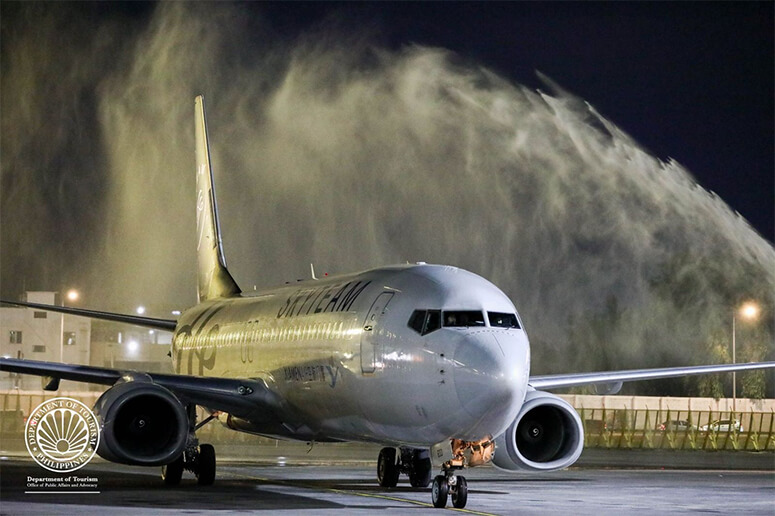

XiamenAir launched its inaugural Hangzhou-Manila service on May 20, marking another step in the continued expansion of air connectivity between the Philippines and China. The route will operate four times weekly—every Monday, Wednesday, Friday, and Sunday—until Oct. 31.
“It’s not my first time in Manila, but it’s my first time flying direct from Hangzhou to Manila, so it feels very convenient for us. The flight only takes around three and a half hours,” Yan shared.
Expanding access
CONTINUE READING BELOW

With nearly 99% of international visitor arrivals entering the Philippines by air, expanding seat capacity remains critical to sustaining tourism growth.
Under the Department of Tourism’s National Tourism Development Plan 2023-2028, improving accessibility and connectivity remains among the government’s priorities in strengthening the tourism industry.
From Jan. 1 to May 19, the Philippines recorded 7.78 million international air seats for direct inbound flights, reflecting an 8.31% increase from the same period last year.

The Hangzhou route forms part of a broader expansion of direct air links from China. On May 16, Qingdao Airlines launched its inaugural Changsha-Manila route, followed by XiamenAir’s Chongqing-Manila service on May 21.
Tourism Secretary Dita Angara-Mathay said the continued expansion of direct connectivity reflects the government’s strategy to accelerate recovery in the Chinese market while creating more opportunities for tourism growth.
“Visitor arrivals from China have already posted the strongest growth among our major source markets this year, supported by expanded direct services and measures that have made travel more accessible,” she said.
Angara-Mathay noted, however, that recovery remains below pre-pandemic levels, with current seat capacity from China still at only about half of 2019 levels.
“This tells us that the challenge is no longer demand alone—it is our ability to convert that returning interest into actual travel through sufficient, reliable and commercially sustainable access,” she added.
New gateways from China
Qingdao Airlines’ maiden Changsha-Manila flight arrived in Manila carrying 56 passengers, while the outbound Manila-Changsha flight departed with 170 passengers onboard. The route will operate every Tuesday, Thursday, and Saturday until Oct. 24.
Changsha, the capital of Hunan province, is known for its rich history, cultural attractions, and distinctive cuisine, opening greater access to travelers from central China.
Meanwhile, XiamenAir’s inaugural Chongqing-Manila flight arrived at Ninoy Aquino International Airport carrying 74 passengers, while the outbound service departed with 97 passengers onboard. Flights will operate every Tuesday, Thursday, and Sunday until Oct. 31.
One of China’s largest metropolitan centers, Chongqing is recognized for its multilayered urban landscape, modern infrastructure, and rapidly growing consumer market.


The inaugural Hangzhou-Manila flight arrived with 76 passengers onboard, while the outbound Manila-Hangzhou service departed carrying 122 passengers.
Known as one of China’s leading centers for innovation and technology, Hangzhou is also expected to support stronger business and investment exchanges alongside tourism.
The DOT said the Chongqing route marks the 33rd direct international route launched to the Philippines since the start of 2025, underscoring continued growth in international connectivity.
Tourism momentum
China remained among the Philippines’ leading source markets in 2025, accounting for 4.56% of total visitor arrivals.
Beyond China, the Philippines has also expanded international connectivity through new and resumed routes linking Manila and Cebu with destinations such as San Francisco, Seattle, Vancouver, and Paris.
Across Asia, expanded connections now serve key markets including Japan, South Korea, Taiwan, Hong Kong, Vietnam, Singapore, and Thailand, with international flights reaching not only Manila but also Cebu, Clark, Iloilo, Bohol, Kalibo, Caticlan, and Davao.
From Jan. 1 to May 19, the Philippines recorded 30,729 international flight arrivals, representing a 4.71% increase from the same period in 2025—another indicator of sustained momentum across the country’s aviation and tourism sectors.
* * *
Editor’s Note: This article was provided by the Department of Tourism.

WATCH: Save for retirement or enjoy life now? (Generations Ep. 21)
September 16, 2026
WATCH: Is Gen Z too soft? (Generations Ep. 23)
September 30, 2026