

The system is broken and I’m getting a law degree anyway
Being a law student is, sometimes, embarrassing.
It communicates to people that you still have some belief in institutions. That, despite the circus of a political landscape, you are willing to go through the stress of law school because you think the system is worth showing up for. I entered law school in 2021 knowing I wanted to do good work—or at least, that's what I told the panel during my interviews. I wanted social impact. Real work for real people's real problems. A few years down the line, with graduation finally in sight, people ask: “So, what's the plan?”
"Join a firm," I say. Easy, non-contentious, and true.
Law school beats you up in more ways than one. Intellectually, by humbling you until your undergraduate accolades feel like a different person's résumé. Emotionally, by teaching you how to show up day after day while running on empty. And mostly, it clarifies how you see the world—either by giving you the language and the framework to work within it, or by making you feel so defeated by the powers that be that you stop believing the framework matters at all.
Most days, it feels mechanical. You go to class, read, recite, get tested, repeat. Numb. Then there are the glimmer moments—the ones that break the rhythm entirely.

"This week is the anniversary of EDSA," Atty. Crisostomo Uribe said after concluding a class. "At wala pa ring nakukulong."
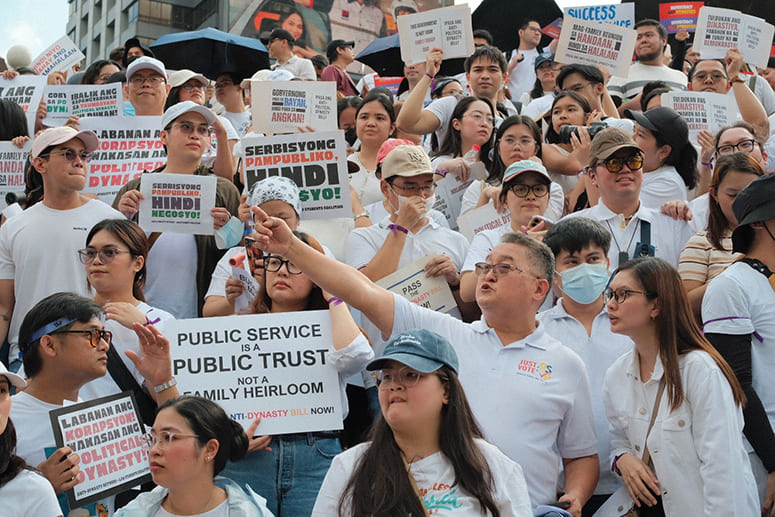
So on Feb. 25, over 300 law students broke the rhythm of reading, reciting and cramming to stand in the heat along EDSA. They came together under the Anti-Dynasty Network, setting aside their books and their schedules to do the thing law school supposedly trains you for but rarely asks you to practice: showing up.
Among them was Charlene Aguilos, a fourth-year student at UP Law. When asked if she hesitated, she said not at all. "I was a hundred percent certain about wanting to be there. It's been 40 years since the EDSA revolution, which my own father joined, yet here we are, facing one of the largest corruption scandals in history."
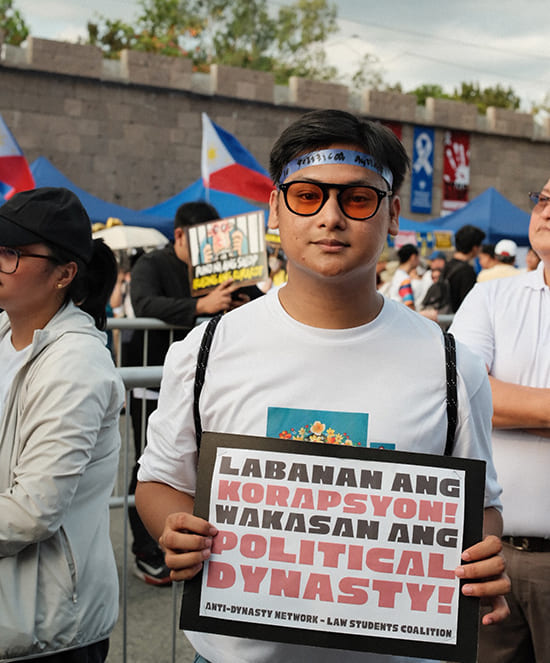
For Joshua Aquiler, a second-year at the University of Makati, it wasn't as clean. He's a scholar. Every missed recitation carries weight. "There was too much to sacrifice," he shares. "But even at the risk of having bad recitations due to lack of study, I think the need to show up in the streets and call for accountability outweighs the cons. My time to study can be re-strategized. My readings can wait. History, however, cannot."
The cynic in all of us knows what the calendar is telling us. EDSA's 40th anniversary is being commemorated under a Marcos administration—the very family whose abuses sent people to the streets to begin with. And the corruption hasn't just repeated; it's escalated. The politicians have grown more audacious; the stolen amounts more staggering.
The flood control scandal has exposed not just institutional cracks but something closer to rot—billions in public funds stolen, infrastructure projects that exist only on paper, and not a single person in jail. Filipinos, present and future, are left shouldering the debt. And in many cases, quite literally drowning in the floods that the stolen money was supposed to prevent.
Atty. Uribe, who has reminded his students of this more than once, puts the Pork Barrel Scandal in perspective: what was stolen then was only a fraction of what the flood control scandal has now laid bare.
So where does hope come from, in the face of all that?
When asked why he continues to fight, Atty. Uribe is honest. "Do not forget that freedom is fought for," he says. "It is not given on a silver platter. Many have sacrificed their lives to regain freedom. But it is a never-ending task.”
The uncomfortable truth—the one law students aren't always ready to hear—is that we are still, ultimately, in a position of privilege. We are working toward occupying positions of power, or at the very least sharpening the tools that will let us work comfortably within the system. We are learning the language of the very institutions we're critiquing. We will take the bar exams, and when we pass, we will have the letters after our names that open doors most Filipinos never get to knock on.
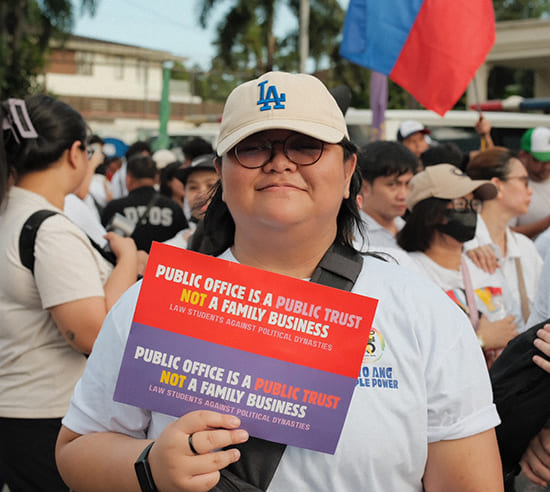
Rania Mamayog, a fourth-year student at Arellano University School of Law, shares a moment that cut through the noise: "Habang naglalakad ako pauwi galing People Power Monument dahil pagod na ako, ‘yung grupo ng MANIBELA, papunta pa lang, fists raised high and voices bellowing. I had eye contact with one of the protesters, at ngumiti siya sa'kin habang nakataas kamao niya."
She continues. "Parang nakakahiyang mapagod—dahil sila ay lumalaban nang tapat, and probably living on minimum wage, pero nandito pa rin sila sa EDSA dahil sa kagustuhan nilang marinig sila."
A law student walking home, tired. A worker marching forward, fist up, smiling. Two people in the same movement, separated by everything else.
Advocacy feels counterintuitive to legal training, which prizes objectivity and detachment almost as virtues. We have read cases showing obvious misapplications of the law. We have watched the Supreme Court reverse itself to the detriment of real people's lives, liberties, and property. We have seen how legal language can be twisted to arrive at whatever conclusion power finds convenient.
Aquiler wrestles with this openly. "I think about that, too. I sometimes even think that maybe someday, one of my law school friends is going to be on the other side, defending the dynasties. As a law student, it's elementary that we learned the Constitution prohibits political dynasties. This provision finds its basis in the history of Filipinos struggling against authoritarianism and despots. So I tell myself: Maybe as long as there are principled lawyers, there is still hope. But if all lawyers fail us—me included—I believe the people will not, for sovereignty resides in and emanates from them."
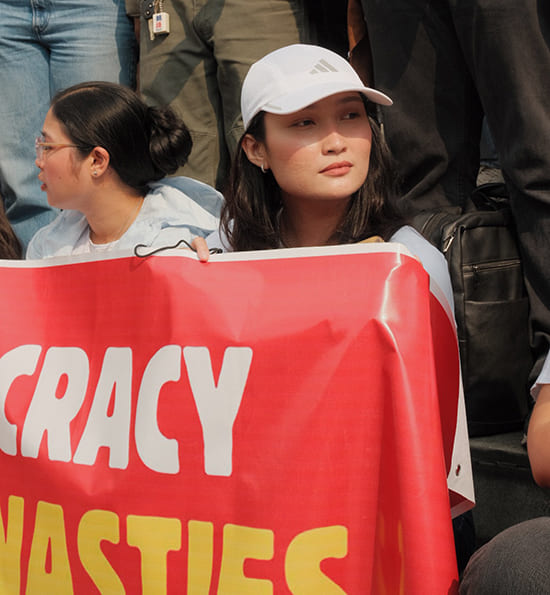
Aguilos brings it closer to home. "I think about my Lolo. He was the only lawyer in our family. Before he became a judge, he was known for being an advocate for poorer litigants. My grandmother constantly tells us stories about Lolo going to the market with an empty bayong and returning with it filled with produce and meat from his clients. He had a strong sense of justice, and he left behind a proud legacy of nationalism and patriotism. I hope this will guide me as I forge my own path."
The closer I get to graduation, the more I understand just how powerful this profession is. Not because lawyers are inherently noble—we all know better than that—but because to understand the law is to understand the history and evolution of a country. The law is the very thing that allowed martial law to happen. It is also the very thing that produced a constitution with stronger protective provisions against it. It shapeshifts. It is used and misused. And there has been more thought put into its making than most of us appreciate, even those of us studying it every day.
I spent years complaining about the workload, underappreciating the weight of what I was learning. But standing on EDSA, surrounded by 300 people who had made the same calculation—sacrifice the study hours, risk the recitation, show up anyway—something became clarified. This is what the work is for.
The embarrassment of being a law student, I think, is also its burden and its quiet dignity. Maybe I still have some belief in our institutions, but if I do, it’s definitely not a blind one—law school has made sure of that. But a belief that the tools exist, even when the people wielding them fail us. A belief that the Constitution is sovereign not because it is perfect, but because it is supposed to reflect the will of the people, where real sovereignty lies.
As Atty. Uribe puts it: "I hope my students will always remember that the Rule of Law is meant for Justice to prevail—for everyone. To serve the people is not an easy task. I hope they will always choose the Filipino people.”

WATCH: Can you still trust someone who betrayed you? (Generations Ep. 22)
September 23, 2026