

What is a mistrial and has it ever happened in the Philippines?
When the prosecution announced earlier this week that it would drop three of the four articles of impeachment against Vice President Sara Duterte, lead defense counsel Atty. Sheila Sison warned of a possible mistrial.
As they rested their case, lead House prosecutor Gerville Luistro said that they were withdrawing Articles I (misuse of confidential funds), III (bribery), and IV (grave threats). Presiding Officer Chiz Escudero later accepted their manifestation, meaning the defense will no longer present its own witnesses to dispute the allegations.
"If the withdrawal is intended to shorten the proceedings of this case, or of the presentation of the respondent's evidence so the court may immediately proceed to judgment, then we believe that the resulting process would bear the unmistakable characteristics of a mistrial," Sison said before Escudero's ruling.
In a post-trial press briefing, impeachment court spokesperson Atty. Regie Tongol said a mistrial doesn't occur in the Philippine context.
"'Yung mistrial na term na 'yan, mas akma siya sa foreign jurisdiction sa ibang bansa. 'Yun 'yung mga napapanood niyo sa How to Get Away with Murder, 'yung mga ganun po sa US," he said.
"Pero under our Rules of Court, wala pong term na mistrial. Walang provision regarding mistrial, and even on the impeachment proceedings sa Senate impeachment rules po, wala rin pong term na mistrial."

What's a mistrial?
"A mistrial occurs when a trial is stopped or set aside after a verdict because of serious irregularities, such as the denial of due process to a party," University of the Philippines College of Law Assistant Professor Atty. Michael Tiu Jr. told PhilSTAR L!fe.
UP Law lecturer Atty. Noel B. Lazaro added that mistrials commonly happen in jury trials in the United States.
"In United States v. Perez, 22 U.S. 579 (1824), the US Supreme Court recognized that a genuinely deadlocked jury could be discharged and the accused tried again. The Court established the principle of "manifest necessity" for terminating a trial without the accused's consent," he said.
Other circumstances can lead to a mistrial, including seriously prejudicial statements or events that prevent an impartial verdict. He cited another American case, Arizona v. Washington, 434 US 497 (1978), in which the court declared a mistrial over prejudicial remarks in the defense counsel's opening statement.
But Lazaro noted that these foreign concepts and their procedural consequences cannot simply be imported into Philippine impeachment proceedings.
Mistrial in the Philippines
According to Tiu, a mistrial has happened in the Philippines in the past in "rare" circumstances.
It usually serves as a basis to set aside a verdict of acquittal, he said. "An example is the case of Galman v Sandiganbayan, where the Supreme Court considered the trial before the Sandiganbayan a sham."
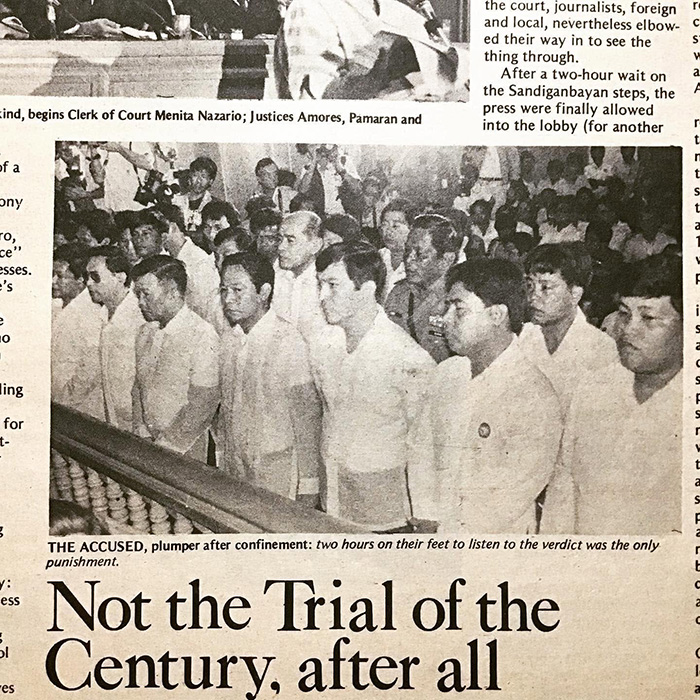
The 1986 case involved the acquittal of 26 military officers and civilians implicated in the assassination of former Sen. Ninoy Aquino and farmer Rolando Galman. The high court later declared the proceedings a "mock trial," as the judgment was predetermined, and there was interference with witnesses and executive pressure on the prosecution and trial.
"The Court invalidated the proceedings and acquittals and ordered a retrial before an impartial tribunal. Double jeopardy did not protect the accused against that retrial because the supposed acquittals were void: the prosecution, representing the People, had been denied due process," Lazaro explained.
"That is a particularly grave form of mistrial—a proceeding conducted in the appearance of a trial but deprived of the conditions necessary for a valid judgment."
Lazaro told L!fe that the 2000 Revised Rules of Criminal Procedure state ways to address defective proceedings, as not every irregularity must result in a mistrial.
The professor, however, emphasized that impeachment proceedings are distinct, as citing Duterte v House of Representatives (2025), the proceedings are both legal and political.
"Rule VI of the Senate's impeachment rules provides for the suppletory application of the Rules of Court whenever applicable. That qualification matters: ordinary criminal procedures supply guidance where appropriate, but do not automatically govern every impeachment question," he said.
Lazaro emphasized that the impeachment trial's sui generis nature does not exempt it from fairness.
The Duterte impeachment trial is currently on recess and will return on Nov. 9.

WATCH: Discovering Vietnam in three days
June 9, 2026