

EDSA @ 40: Crossing the Rubycon
Today we mark the second day of the EDSA People Power revolution of 1986. The blurb of the book People Power, published by the James B. Reuter S.J. Foundation in the same year, describes it as “a revolution without precedent.”
EDSA married the words “people” and “power” in order to spawn change: the restoration of free speech, Congress, freedom of the press and regular elections. All these are now potent tools in exposing corruption—most recently, in opening the floodgates to a torrent of probes into unprecedented corruption scandals.
Without the wheels of democracy, including a robust social media, the corruption would have bled the country dry beyond transfusion.
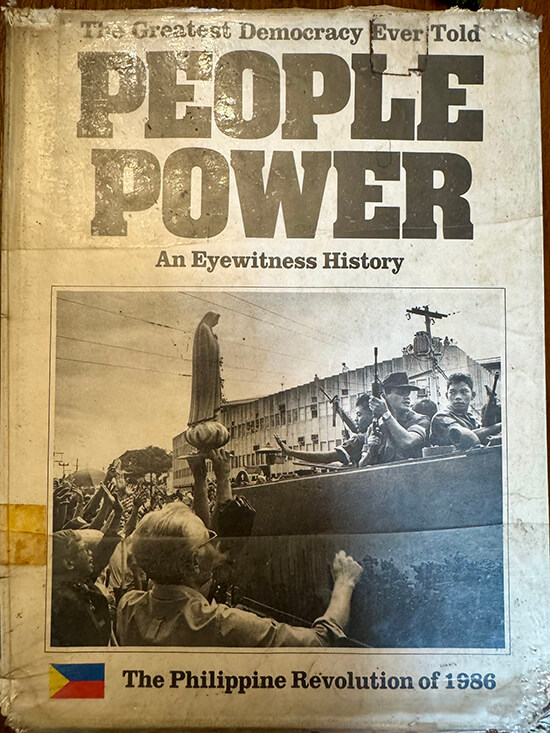
“With EDSA, we made an effort,” my husband Ed, who was in university through the First Quarter Storm, marched to Mendiola with my mother Sonia in 1986, and held my hand on EDSA, answered when I asked him if EDSA still mattered.
I recently flipped through the pages of my now 40-year-old book, People Power, and it gave me goosebumps.
But now that EDSA and the restoration of democracy in the Philippines is marking its Ruby year—a mid-lifer if it were a human—can its legacy survive gray hair and the osteoporosis of time?

Now that we’ve crossed the Rubycon, misspelling intended, quo vadis, Philippines?
We could start by supporting the right people for the 2028 elections.
***
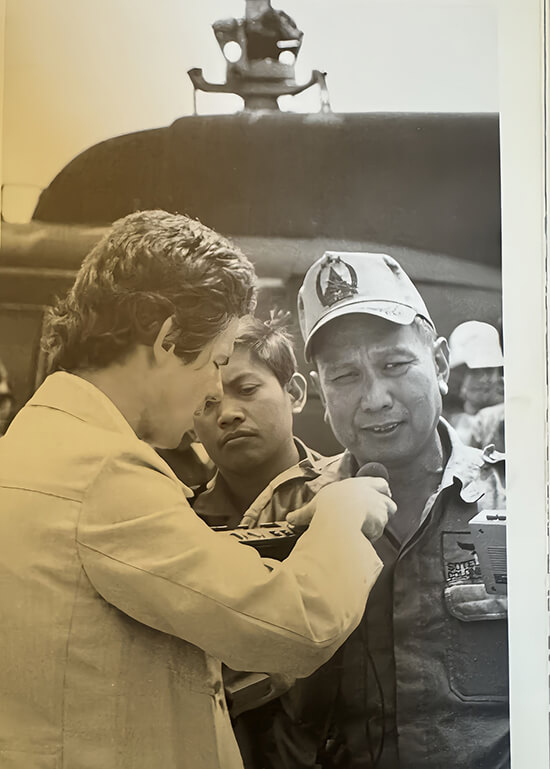
A ranking Cabinet member of the first Aquino administration once related how the defection of then Air Force Col. Antonio Sotelo changed the way the wind blew on Feb. 24, 1986.
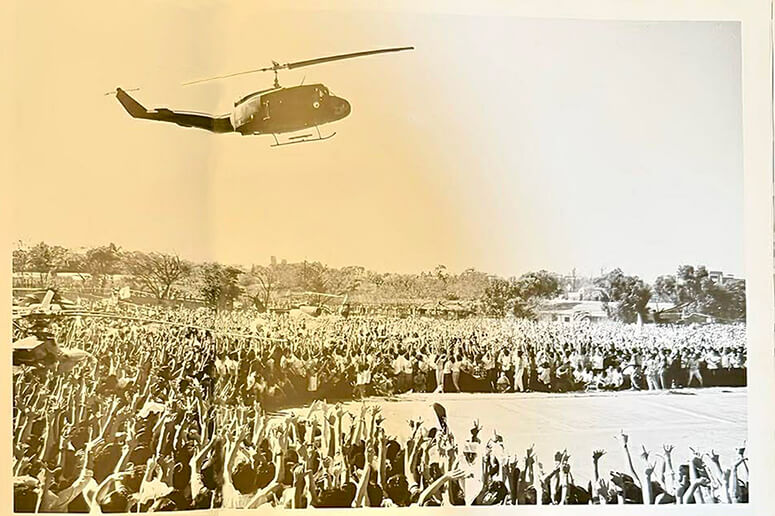
From People Power, which I think is still the authority on the People Power revolution, we learn that in the early morning of Feb. 24, the masses that gathered on EDSA “heard a distant snarling in the sky.”
“Overhead, they suddenly see the menacing helicopter gunships, upper and lower left. Guns are cocked inside the camp; outside, the people in the crowd realized that there was hardly any place to hide. Many prayed aloud, others stared in silence at the choppers.
“But the helicopters did not fire. They landed one by one inside (Camp) Crame amid instant jubilation. The world seemed to be yelling at once and the joy wiped all the terror away.”
A defecting helicopter pilot was welcomed with open arms into Crame, the rebels’ camp. He was one of 16 combat-ready pilots brought by Col. Sotelo.
“We followed our conscience,” Col. Sotelo was quoted as saying. “I think I have not really done much in my life.”
“For once, I wanted to make a decision for my country,” he said.
***
This is Col. Sotelo’s first-hand account of that day, also from People Power.
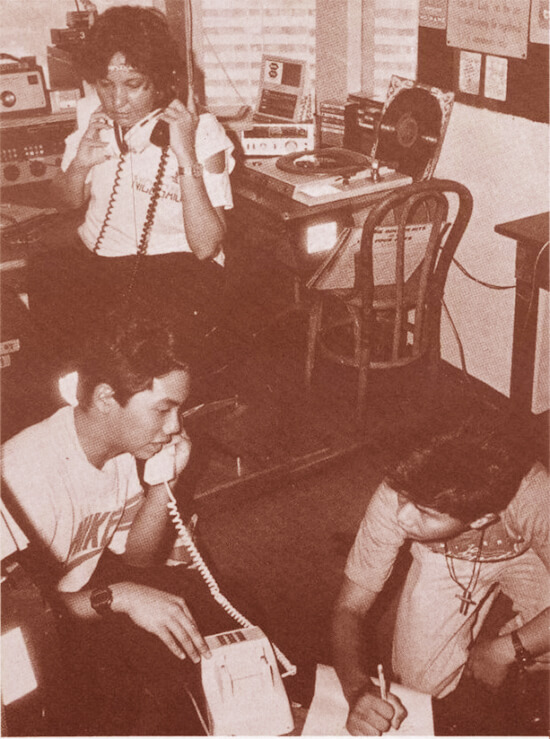
I woke up at 2 a.m., Monday (Feb. 24). Immediately, I tuned in to Radio Veritas, only to realize that it was gone. But I caught the familiar voice of June Keithley on another station. She was giving a blow-by-blow account of what was going on. It made me sad.
At 3 a.m., I got up and asked my wife to make me a nice breakfast. But since I felt like a death row prisoner, the food did not taste good at all to me.
I continued planning the details. I called Sangley and instructed the duty officer to gather the staff at my command post, the wing operation center, so that they could all hear my briefing by radio.
I told the supply officer to send me, by land, another 10 M-16s and two boxes of ammo to equip the guards. Of course, it was a fake: we brought all the guns and ammo with us.
In the briefing, I told them to wake up all the pilots and to prepare the aircraft, as we may be told to take off early. At this point, the pilots did not know yet their real mission. At 4 a.m., I got the call: the guns had cleared the gate. I was happy.
At 4:15 a.m., my son and I bade goodbye to my wife. A brief hug, a kiss, a few words of endearment, the prospect of seeing each other again, perhaps only in the next life, last-minute instructions, no tears—I did not look back. I got into the staff car, and the driver drove off. My first stop was the pilots’ quarters. I woke them up. The radio in my car was on; I knew what was happening.
It was pretty bad and deteriorating rapidly.
I got to the hangar at around 4:30 a.m. I checked the guns. They were loaded and ready to fire. The rocket tubes were filled. Extra ammo was loaded. My small bag of toilet articles and a few pieces of underwear. Rifles and bullets.
By 5:15, the pilots were all in. I ushered them to the briefing room. I asked if anybody wanted to back out. Nobody did. I strengthened their faith by saying that we would die only once, and it was a rare opportunity to die for one’s country. The squadron commander said that we had already received our first missio,n which was for two gunships to be at Bonifacio before 6 a.m. to report to the Army’s G-3. What a coincidence! I used it as my cover.
I then started my plane at 5:55 a.m. Briefing was finished in 10 minutes. The rescue squadron commander was at the briefing for the first time.
I was not sure what side he was on, so I told him to stay close to me before he went to his parking area, which was about 1/2 kilometer from the hangar. This was a precaution. If he were on the other side, we would be gone before the police could get at us.
I called my wife to tell her it was time for them to leave. I told Sangley to call me on the phone as I had confidential info for the staff gathered at the command post. So as not to arouse any suspicion, I talked first to the No. 2 man and asked him a few questions. I then talked to the No. 3 man and asked him a few questions. It was five minutes prior to start engine. I let the other Rescue Squadron Commander go to his unit.
I kept talking to my Squadron Commander at Sangley to waste time. At 30 seconds prior to start engine, I then said: “This is the last time I will talk to you. Your mission is to take off immediately and see me on 119.2 mega cycles or 126.2 mega cycles. If you don’t hear from me, land at Clark. Nobody knows these instructions except you.”
I put down the phone and ran to the aircraft, shouting: “Start!” On the way, I met an officer who came to the hangar. He talked to me, but I did not answer. The engines came to life, and in a minute or so, we were airborne.
A few seconds later, the Number 5 gunship called: “Airborne.” I had a complete feeling of serenity.
He crossed his Rubicon.
Today, this year, we must cross ours. The Rubycon of EDSA.

WATCH: Pixar Summer Fest adventure at Hong Kong Disneyland
August 10, 2026