

Strong, stable, trusted: How Filipinos view Japan today
BrandedUp in partnership with Embassy of Japan in the Philippines
In an increasingly complex global landscape, trust remains one of the most valuable currencies in international relations.
For the Philippines and Japan, this trust is not only intact. It is firmly established.
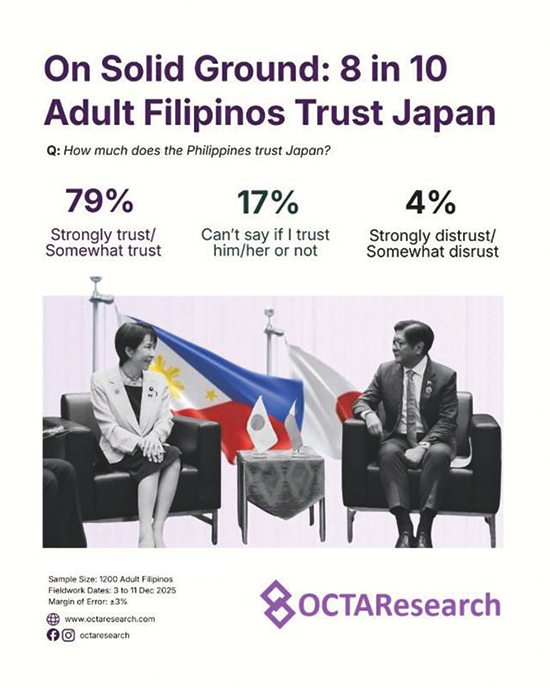
A nationwide survey conducted in December 2025 shows that 8 in 10 Filipinos, or 79%, express trust in Japan. Meanwhile, 17% are undecided, and only 4% express distrust.
The findings point to a clear and compelling reality: Japan is among the most trusted international partners of the Philippines today.
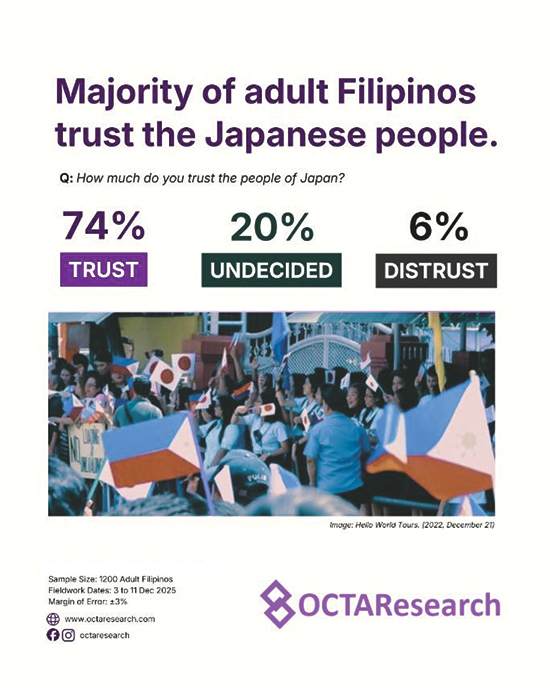
This confidence extends beyond institutions.

Around 74% of Filipinos say they trust the Japanese people, while 20% remain undecided and just 6% express distrust. Together, these figures reflect a relationship that goes beyond formal diplomacy: one shaped by familiarity, shared experiences, and sustained engagement.
Taken as a whole, the data points to a partnership that Filipinos view as not only positive, but stable and enduring.
Trust that cuts across society
One of the most notable insights from the survey is how widely shared these positive perceptions are.
Across the country—from Metro Manila to Mindanao—trust in Japan remains consistently high, reaching as much as 88% in some areas. Across socioeconomic groups, from Classes ABC to D and E, confidence in Japan is similarly strong.
In business terms, this broad-based trust signals stability. It reflects a favorable environment for long-term cooperation, where public sentiment aligns with economic and strategic engagement.
Such consistency also suggests that trust in Japan is not reactive or temporary. Instead, it is deeply embedded and built over time through visible and sustained collaboration.
Relationship anchored in everyday impact
Public perception of Japan is closely tied to its longstanding role as a key development and economic partner of the Philippines.
Over decades, Japanese support has contributed to infrastructure development, transportation systems, trade, and investment. These contributions are tangible: felt in everyday life through improved mobility, connectivity, and economic opportunities.
This visibility reinforces a perception of reliability. When development projects and cooperation initiatives translate into real-world benefits, they strengthen public confidence in the partnership.
Beyond economic engagement, cooperation has also expanded into disaster response, maritime security, and capacity-building, further deepening the strategic dimension of Philippines–Japan relations.
Power of people-to-people ties
While institutional cooperation is critical, the survey highlights the equally important role of interpersonal connections.
With 74% of Filipinos expressing trust in the Japanese people, goodwill clearly extends beyond government-to-government relations. It is shaped by human interaction, through tourism, education, cultural exchange, and the growing community of Filipinos living and working in Japan.
These people-to-people ties foster familiarity and mutual respect. They reduce uncertainty and strengthen the social foundation of the partnership.
For businesses, this translates into real advantages: smoother collaboration, cultural openness, and stronger mutual understanding in cross-border engagements.
Partnership seen as strong and stable
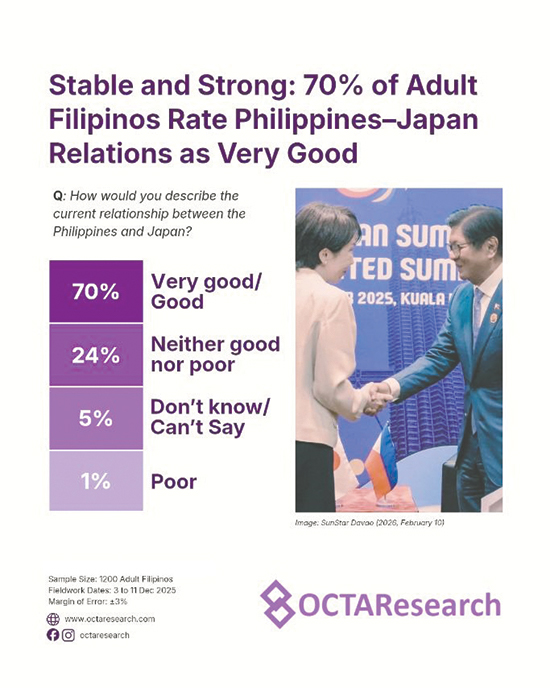
Public sentiment toward the overall relationship is equally positive. Around 70% of Filipinos describe Philippines–Japan relations as “very good or good,” while only 1% rate them negatively.
Importantly, this favorable assessment is consistent across regions and income groups, reinforcing the idea that support for the partnership is national in scope.
In survey research, this level of consistency is often a sign of structural sentiment; views that are rooted in long-term experience rather than short-term developments.
In other words, Filipinos’ positive perception of Japan reflects a sustained track record of engagement.
More than 70 years of evolving partnership
The strength of today’s Philippines–Japan relations is the result of more than seven decades of engagement.
From postwar reconciliation, the relationship has evolved into one of the Philippines’ most stable and trusted international partnerships. Over time, it has expanded across economic, cultural, and strategic domains, each reinforcing the other.
At its core, the partnership is built not only on shared interests, but also on shared values: a commitment to peace, stability, and prosperity in the Indo-Pacific region.
Foundation for the future
As global dynamics continue to shift, partnerships grounded in both institutional cooperation and public trust are better positioned to endure.
The survey findings suggest that the Philippines–Japan relationship stands on solid ground.
High levels of trust in Japan, strong confidence in the Japanese people, and overwhelmingly positive perceptions of bilateral relations all point to a partnership that is resilient and forward-looking.
For stakeholders in business, policy, and development, this alignment between public sentiment and strategic cooperation offers a strong foundation for deeper engagement in the years ahead.
What defines Philippines–Japan relations is not just strength, but stability. It is a partnership shaped by decades of consistent engagement, reinforced by people-to-people ties, and sustained by a deep reservoir of trust.
In a world where trust is increasingly rare, this may be its most enduring advantage.
***
Editor's note: BrandedUp is designed to provide you with insightful, inspiring, and educational content created by The Philippine STAR in collaboration with brands like Embassy of Japan in the Philippines.

WATCH: LGBTQIA+ people with unlikely professions
June 28, 2026