

Poems by women on the women of 'The Odyssey'
Now that common knowledge has it that Christopher Nolan based his adaptation of his film The Odyssey on the 2017 translation by Emily Wilson, educated viewers have taken to welcoming a feminist flavor that mellows out the patriarchal toxicity of the narrative.
What some might not know is that Homer’s Odyssey, itself an epic poem, has spawned perhaps the most number of subsequent poems that drew from its multifarious content.
Best known is C.P. Cavafy’s Ithaka, which stressed the value of a journey more than any arrival. First written in 1894, its popularity rose when it was read as part of the eulogies for Jackie Kennedy Onassis upon her demise in 1994. Here are the closing lines:
“Ithaka gave you the marvelous journey./ Without her you would not have set out./ She has nothing left to give you now./ And if you find her poor, Ithaka won’t have fooled you./ Wise as you will have become, so full of experience,/ you will have understood by then what these Ithakas mean.”
Earlier than Cavafy, Alfred, Lord Tennyson wrote two major poems, the first the 1833 dramatic monologue Ulysses, where Homer’s hero finds Ithaca boring upon his return. The second, The Lotos-Eaters, goes back to the middle of the narrative, imagining “the irresistible desire to abandon reality and surrender to eternal rest and idleness.”
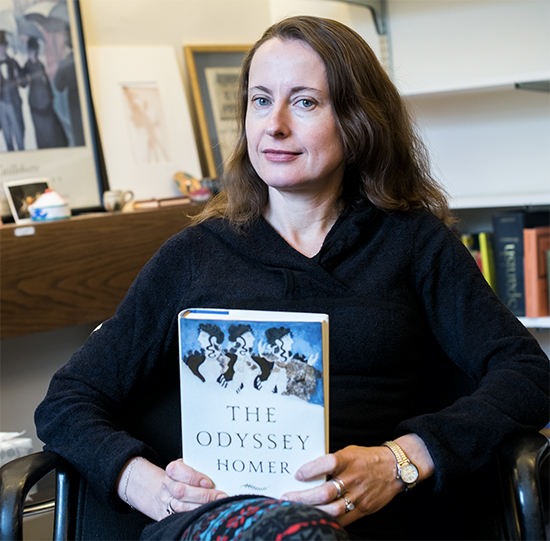

In the late 6th century BCE, the scholar Theagenes of Rhegium actually suggested that Homer’s epics contained hidden allegorical meanings. But the first to attempt a deeper interpretation was the 12th-century Byzantine scholar and poet John Tzetzes (ca. 1110–1180 CE), whose verse commentary Allegories of the Odyssey tried to explain these hidden meanings through the medium of poetry.
Jumping to 2022, the Lithuanian poet Jonas Mekas wrote There Is No Ithaca: Idylls of Semeniskiai & Reminiscences, a book translated into English by Vyt Bakaitis, with a foreword by Czeslaw Miłosz.
Many other contemporary poems have similarly reinterpreted substance while projecting insights from the narrative and the characters involved.
The Russian-American poet Joseph Brodsky’s Odysseus to Telemachus imagines a weary Odysseus writing to his son years after the Trojan War. Edna St. Vincent Millay’s An Ancient Gesture offers Penelope’s perspective with a weeping motif, while Dorothy Parker’s biting poem Penelope uses humor to contrast “the heroic tales of wandering with the everyday realities of the people left at home.” Michael Collier wrote Argos, employing the loyal dog’s poignant POV.

But the best appreciated of this legion of poems celebrating an epic one written centuries ago have been written by women—who themselves had already drawn critical acclaim by the time they added poems on the Odyssey to their collections. Three who stand out are the renowned Canadian poet and novelist Margaret Atwood, Pulitzer Prize-winning poet from New York Louise Glück (also the 2014 National Book Awardee in Poetry), and the UK Poet Laureate Carol Ann Duffy from Scotland.
Most naturally, their poems revolved around the female characters in various degrees of involvement with Odysseus. After all, they also happened to be the most interesting, symbolizing virtues, strengths, and particular facets of character, including questionable flaws.
Siren Song by Atwood, published in her 1974 collection titled You Are Happy, is expressed by the mythical siren Circe—half-woman, half-bird—whose vocals can lure sailors to their deaths. With Odysseus, the bond became love. Explored are themes of vanity and seduction, and stereotypes about helpless women. It also examines how “traditional gender expectations can trap people, pushing them to perform isolating, lonely roles.” She asks the reader to come closer; she needs help, even as “her tedious melody never fails her.” Here’s the brief poem in full, in wonderful tercets:
“This is the one song everyone/ would like to learn: the song/ that is irresistible:// the song that forces men/ to leap overboard in squadrons/ even though they see the beached skulls// the song nobody knows/ because anyone who has heard it/ is dead, and the others can’t remember.// Shall I tell you the secret/ and if I do, will you get me/ out of this bird suit?// I don’t enjoy it here/ squatting on this island/ looking picturesque and mythical// with these two feathery maniacs,/ I don’t enjoy singing/ this trio, fatal and valuable.// I will tell the secret to you,
To you, only to you./ Come closer. This song// is a cry for help: Help me!/ Only you, only you can,/you are unique// at last. Alas/ it is a boring song/ but it works every time.”
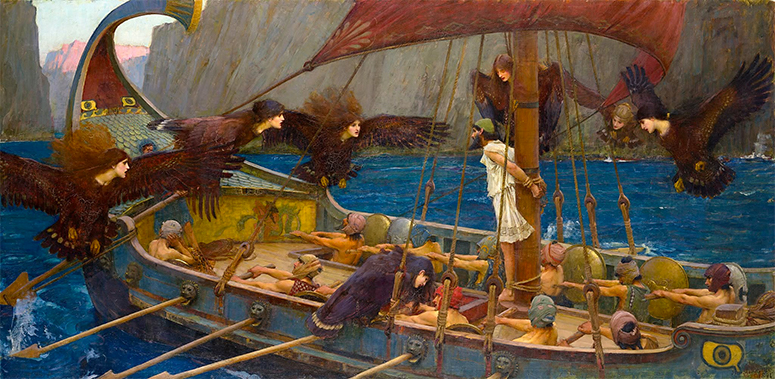
For her part, Glück reimagined Circe differently in two prominent poems from her 1985 collection The Triumph of Achilles. In Circe’s Power, she withdraws from passivity and addresses Odysseus directly, defending her action that turned his men into swine. “Every sorceress is/ A pragmatist at heart; nobody sees essence who can’t/ Face limitation. If I wanted only to hold you// I could hold you prisoner.”
In Circe’s Grief, she reverts into a powerful goddess. While still controlling her own narrative, she endures the pain of Odysseus’ departure. Emotionally, in a calculated comeback, her divinity allows her a disembodied voice in Ithaca, telling the woman he left behind about their affair.
“In the end, I made myself/ Known to your wife as/ A god would, in her own house, in/ Ithaca, a voice/ Without a body: she/ Paused in her weaving, her head turning/ First to the right, then left/ Though it was hopeless of course/ To trace that sound to any/ Objective source: I doubt/ She will return to her loom/ With what she knows now. When/ You see her again, tell her/ This is how a god says goodbye:/ If I am in her head forever/ I am in your life forever.”
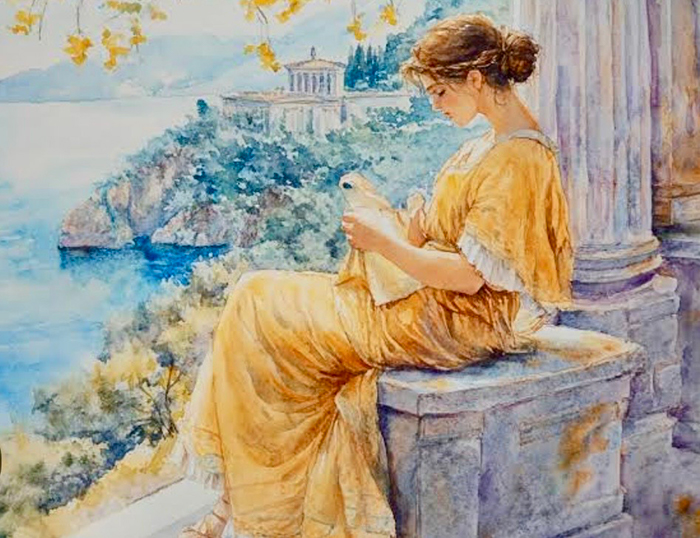
Carol Ann Duffy’s Penelope offers the wife’s perspective, from the time she takes up embroidery while waiting for her wandering husband. Sewing gives her joy, power, and independence, a world of her own. A reimagining of a familiar myth, the poem first appeared in Duffy’s 1999 collection The World’s Wife.
The opening lines: “In the story, he’d been gone twenty years./ I can’t remember much about him./ But I remember this: how I would sit at night,/ sewing a shroud for his father, designing a smile/ for the mouth of the man who would never return,/ a face in the ashes.”
From silence to self-awareness, she empowers herself. The poem becomes a feminist reclamation, ending thus:
“… I tried it. I was picking out/ the smile of a woman at the centre/ of this world, self-contained, absorbed, content,/ most certainly not waiting,/ when I heard a far-too-late familiar tread outside the door/ I licked my scarlet thread/ and aimed it surely at the middle of the needle’s eye once more”
As a metaphor for artistic creation, Penelope’s own voice is finally enough.

WATCH: Is Philippine cinema still thriving? (Generations Ep. 19)
September 2, 2026