

The new obscene
What happens to the aspirational, the power of dreams that lies in their being beyond reach?
I was trained to marvel, to equate shine with worth, sparkle with promise. The sight of a necklace of Burmese rubies and diamonds set something ablaze in me. A mansion on a hill made me dream. The word luxury was a promise, not a provocation. I turned the pages of glossy magazines as though they were passports to a better life, each photograph a lesson in aspiration. I longed for what was rare, for what seemed beyond my grasp.

When I was young, I basked in the pages of my mother’s lifestyle and fashion monthlies, my eyes wide at the people who would never be my neighbors, the cars I could never drive, the houses I could never own. There is profound power in aiming for the moon and the stars, a power derived solely from their impossibility. A dream, after all, is not a plan. A plan bends to reason, a dream defies it. A plan depends on means and method, a dream exists to remind us of our limits, to stretch our sight past what is possible. What happens to that power now that everything is reachable by hook or by crook?
Now I scroll and frown. The same sparkle feels sharp. The mansion looks like excess. The private jet reads as guilt. What changed was not the diamond, nor the marble floors, nor the gold-leaf ceilings. What changed was what I know.
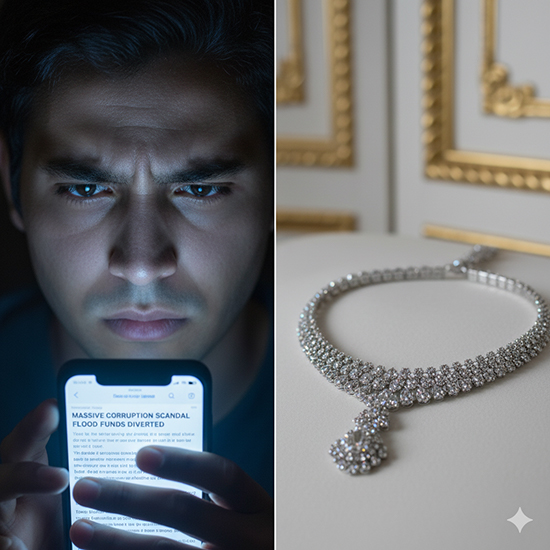
Every exposé has stripped the shine. The stories of thievery, of privilege inherited and not earned, of abuse disguised as entitlement, have peeled away the glamour. It is not only in the Philippines, where the flood control mess has revealed how public works have become personal gain, how projects meant to protect us have turned into paydays for the powerful. It is also in Nepal, where protests rage against systemic corruption and the misuse of public funds. It is in Indonesia, where the rich build islands while villages drown. It is in Bangladesh, where the price of a politician’s watch could feed a town. I have seen too much.
I no longer see wealth as destiny. I see it as evidence. Every act of greed has taught me what beauty costs, and who pays for it. The handbags and supercars still exist, but they carry a different story now, the story of the factory worker, the unpaid tax, the river poisoned for leather.
CONTINUE READING BELOW

But craft does cost. A gown glitters more when it is made by a team of hands painstakingly stitching threads, embroidering accents, puffing up folds. To honor craft is to understand labor, and that labor carries its own inherent worth and dignity. I grew up dreaming of untold riches, oohing and ahhing over glimpses of them on the pages of F. Scott Fitzgerald, Honoré de Balzac, and Edith Wharton. How do I dream of modesty when modesty is my reality?
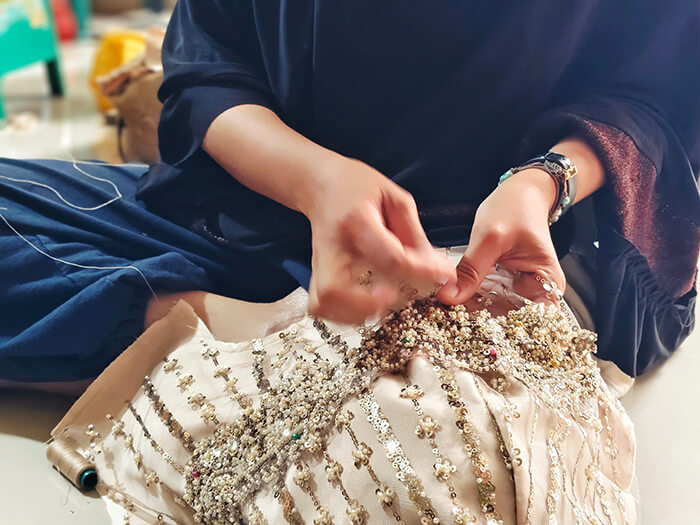
And yet, how do I defend the purveyors of luxury, the symbols of opulence, the joys of extravagance? I cannot deny the skill that gives form to beauty, the imagination that turns fabric into fantasy, the mastery that keeps old crafts alive. A jeweler’s precision, a couturier’s eye, an architect’s discipline, all these are human triumphs. They are not sins. What feels obscene is not the work, but the imbalance it reveals. When the few live in splendor built on the hunger of many, even the finest artistry can start to ache.
And what of those who embody high living, those who have what it takes to make us dream, to uplift our sense of possibility? They build worlds we can step into, even for a moment, to remember what beauty can be. Yet life bites hard. The same people who live large become examples when the tide turns, as if the world delights in watching the mighty fall. How do we tell envy from justice, admiration from accusation, awe from resentment?
What happens to the aspirational when it starts to look like complicity? I still desire, but the desire has changed. I want to possess what is earned with integrity, not what is acquired through imbalance. I look for meaning, not magnitude, though I still struggle to fully shed the old habits of measurement. A bowl shaped by hand in Tawi-Tawi now seems richer than dinner served on porcelain. A long drive out of the city, with no plan and no point, feels like a more genuine luxury than a suite at the Ritz.

Sometimes, the worst thing about luxury is its price. In the current political climate, expensive is no longer beautiful. It is especially suspect when flexed. To flaunt is to confess. The old language of status has turned awkward. The more, the louder, the more we cringe.
Maybe this is not loss but evolution. My eyes adjust to the truth. My heart learns new measures of worth. At the moment, I admit, the glitter of things is offensive to justice-starved eyes. I wish I could marvel at the grace of enough, but the old aspiration does not truly die. It simply seeks a purer object. I still dream of a single, flawless Fabergé Imperial Egg, lost to time and impossible to replicate, yet I have no desire for the deed of ownership. Its beauty, its value that lies not in its weight but in the lost mastery of its creation, is enough. That such things once existed, and might yet exist, is the true, enduring wealth of the world.

WATCH: LGBTQIA+ people with unlikely professions
June 28, 2026