

The fine art of not rushing
I was on my morning internet prowl when I stumbled upon a word that was new to me: “slowmaxxing.”
It appeared on a Facebook Reel showing a sheep in a meadow looking as though it was about to doze off as it chewed grass. The caption defined “slowmaxxing” as optimizing your life by doing less; prioritizing calm, balance, and meaningful moments instead of rushing through them.
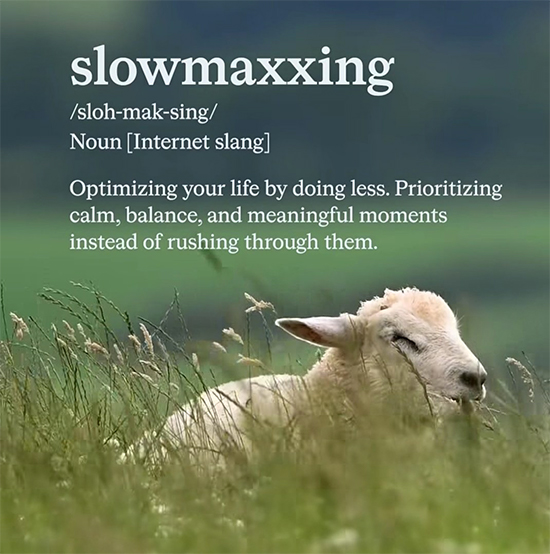
That sheep had it all figured out.
We know what slow is. Gen Z started adding the suffix “maxxing” to describe obsessively optimizing areas of life (e.g., “looksmaxxing” or “sleepmaxxing”). But I digress.
Modern digital culture keeps the pressure on like an oppressive Big Brother by bombarding us with tasks that are supposed to make us feel good about ourselves: wake up before dawn, exercise, feed the pets, have the first cup of coffee for the day, and roll out before the morning rush. There are variations, but between day and night, we compulsively load up on current events, viral posts, and trends in technology and fashion.
CONTINUE READING BELOW

We know what slow is. Gen Z started adding the suffix ‘maxxing’ to describe obsessively optimizing areas of life (e.g., ‘looksmaxxing’ or ‘sleepmaxxing’). But I digress.
On its face, this drive toward self-improvement is not a bad thing—until there is nothing left to improve. The demand among younger people is exponentially higher.
Somewhere under the weight of endless productivity hacks, the human engine runs out of gas. This is exactly why slowmaxxing exists.
And yet, we have been hearing versions of it for centuries. Aesop’s fable “The Tortoise and the Hare” has been telling hyperactive rabbits to calm down for over two thousand years. “Slow and steady wins the race” wasn’t merely advice for woodland creatures. It was a warning against confusing speed with progress. Even Confucius weighed in long before productivity gurus began charging subscription fees: “It does not matter how slowly you go as long as you do not stop.”
The modern world, however, worships velocity. We want instant coffee, instant noodles, instant messaging, instant delivery, instant celebrity, and instant opinions from people who only scan headlines.
We have speed dating—yes, apparently even here in the Philippines; perhaps taking the time to discover someone’s annoying habits is inefficient.

The irony is that the faster everything becomes, the less time we seem to have.
Just look at the Senate Impeachment Court. As it tries to achieve the constitutional oxymoron that is a “speedy trial,” it also needs to balance conflicting interests and opinions while navigating the tricky territory of law and lawyers. Legal proceedings—jurisdiction, due process, evidence, testimony—do not move like social media; they ooze, like a Korean drama that’s too slow to even binge-watch. Democracy, inconveniently, does not come with a “skip recap” or “skip intro” option.
This is one arena where slow is not a bug but a feature.
Sports offers another lesson. After losing to Alex Eala at Wimbledon, defending champion Iga Świątek lamented in the post-match interview that Eala “was serving slower and slower and it became tougher and tougher for me to return the serves.”

Evidently, sometimes slow is not a handicap, especially when it throws everyone else off their game. Alex fans—let’s call them Alexicans for now—might defend her measured serve as “tactical.” I’d call it “NI”: Needs Improvement.
Of course, there is also such a thing as taking slow too far.
We have, at one time or another, stood behind fast food customers who take their sweet time at the self-service kiosk, only to suddenly switch to the manual counter when they are unable to finish their order. Slow drivers on the fast lane often invite road rage, even in congested roads in Metro Manila, where speeding is more a treat than a violation. In the past, office workers raced to finish a task to get noticed, but now, slow Internet speed has turned into the favorite whipping boy of underperformers.
That is not slowmaxxing, but weaponized procrastination. The trick, I suppose, is knowing the difference between the two.
One of my favorite scenes in the 1984 film Starman involves an alien, played by Jeff Bridges, driving a car on Earth. He barrels through a yellow traffic light, nearly being hit by a truck in the process. When his terrified passenger asks why he didn’t stop, he calmly replies, “Yellow light, go very fast.”
His conclusion was perfectly logical. He was simply applying human behavior he had observed—hey, I witness this kind of reckless, irrational behavior every time I drive.
Maybe aliens understand us better than we understand ourselves.
We accelerate when we should pause. We check our phones every few minutes as though news about the impeachment or the latest tennis match cannot wait. We even read and send text messages while sharing a motorcycle ride—sometimes, we are the rider. We interrupt silence because silence makes us suspicious.
Perhaps that is why a video of a sleepy sheep chewing grass felt oddly profound. It was not trying to optimize anything. It was just… chewing.
Maybe slowmaxxing is not about becoming less ambitious, but about refusing to let urgency masquerade as importance. Maybe it is about recognizing that not every email deserves an immediate reply, not every trend deserves our attention, and not every free minute needs to be filled with something “productive.”
Let me take a page from The House at Pooh Corner. In this 1928 classic, A.A. Milne wrote that the stream knew where it was going, and it said to itself, “There is no hurry. We shall get there some day.”
After all, the destination remains exactly the same; we might as well enjoy the luxury of arriving late.

WATCH: Can we talk about death and grief? (Generations Ep. 25)
October 14, 2026