

The secrets of Mount Camisong
If, as Ralph Waldo Emerson once wrote, beauty is its own excuse for being, then Mount Camisong has more than earned its right to be. Located in Itogon, in the highlands of Benguet, Mt. Camisong is a stretch of majestic mountain ranges that rise towards an azure blue sky, its peaks now poking at the clouds, now glowing in the sunlight, now becoming a canvas of nature’s splendor.
Here and there, the views are framed by pine trees with outstretched branches bearing clusters of pine cones. Their needles perfume the air with a fresh fragrance, dispersed by the soft breeze and the occasional mountain wind. The hushed silence dominating the landscape makes even a whisper sound like an intrusion.
As overwhelming as it can be, Mt. Camisong’s beauty is only secondary. Or at least that’s what it has become. For beyond the views and the mountain air, Mt. Camisong hides secrets one couldn’t have imagined. For over a year, a group had worked feverishly to transform its environs into an ideal forest park. By the time the place opened to the public in 2025, it had become a bastion of sustainability and conservation.
“I first bought the lot in 2023 through a high school batchmate who knew the owners,” explains Ludette Querubin, chairman of Mt. Camisong Property Management. At first, the lot owner thought she merely wanted to build a tourist spot along the Itogon roadside. But what she was really interested in was the part of the land that extended inward (looban), closer to the revelation of the beauty of the mountains.
“I wanted something different, not just a place with a view but also one with facilities we can be proud of,” she says, thinking of the resorts she had seen in her travels abroad.
Queribon’s passion for conservation and sustainability became the framework upon which the resort was built. She tapped a friend who was very much involved in sustainability, and together they made sure they did everything right—from the preservation of the trees to the building of the walkways.
CONTINUE READING BELOW

It’s more than just a beautiful view.
“We saved all the trees we could by working around them. We cut only three to four pine trees, and that was because those already had beetle infestation,” Querubin recalls. They also planted fruit-bearing trees like mulberry and flowering trees like kalachuchi, which attracted flocks of birds other than the crows that hovered around the pine trees. At sunset, when these birds come to roost, they create a symphony of twittering sounds.
At the entrance, the uniqueness of the place immediately announces itself, as solicitous attendants greet the guests. A map details the various attractions, which have lyrical names derived from classic Pilipino. There’s Alapaap, a viewing deck; Marahuyo, a café overlooking a magnificent view of the serene mountain ranges; Dagitab, an amphitheater; Binhi, a sustainability hall; Luntian, a garden venue; and Samyo, a garden tree walk. Even the gift shop bears the intriguing name Kalupi, while the ranger station hiking trails are named Kahilom.
In keeping with their vision, the group planted vetiver grass throughout the place, a perennial grass with deep roots that stabilizes the soil and helps in controlling erosion. Likewise, they used pervious concrete for the pathways, which allows water to seep through to the ground, thus preventing flooding.
One of their abiding principles is water management. While making sure they have their own water source, all the wastewater emanating from their facilities is treated and recycled (for watering the plants, for instance). To reduce the use of plastic water bottles, they have installed hydration stations to supply visitors with free drinking water.
As for food waste, Mount Camisong’s management team has found secret allies in a worm and a fly. Eugene, their pet name for the African night crawler (Eudrilus eugeniae), eats the raw and uncooked food waste. On the other hand, Hermie, a black soldier fly with an elongated body (Hermetia illucens), eats the cooked food wastes and kitchen scraps. Through this method, literally nothing goes to waste. Moreover, the manure excreted by Eugene and Hermie becomes vermicast, an organic fertilizer that’s rich in nutrients, improves soil health, and helps in the growth of plants. For their roles in waste management, Eugene and Hermie have become the resort’s official mascots.
The food waste they don’t consume is turned into other uses. The banana peels, for instance, are dried and used as garnish for the banana split served in Marahuyo Café. Food concessionaires are also provided with plates and utensils that are eco-friendly.
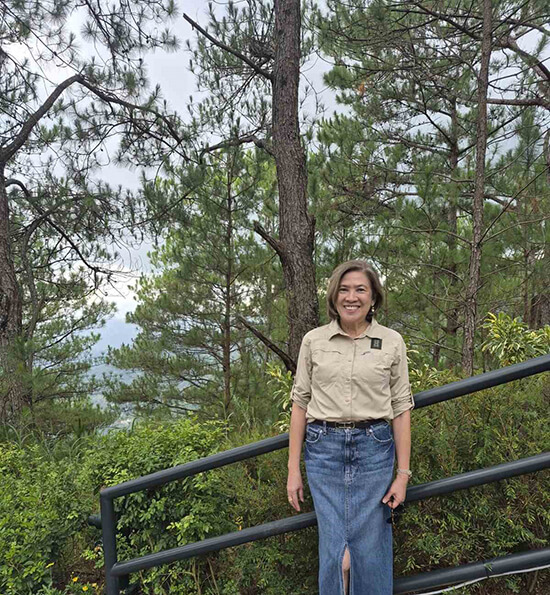
“We take food waste management seriously,” declares Querubin.
Already, their work has been noticed internationally. Recently, a group from the National University of Singapore visited Mount Camisong to observe their methods of conservation and sustainability. Meanwhile, visitors continue pouring in to marvel at the spectacular views and enjoy all the attractions within.
During a recent visit, my brother Udy and I walked carefully along the rolling terrain, worried about getting too tired to continue our exploration, only to find there were benches conveniently located every few meters, for those who need to rest, which we gladly did. But not for long because we were pulled by the commanding views and the well-paved walkways. At the Alapaap Viewing Deck, we could only sigh at the amazing panoramic views of the mountains, which looked verdant green at one point, then hazy blue at another.
Walking further, we came across a few kiosks selling souvenirs and handicrafts. Intricate hand-woven tapestries were displayed alongside hand-painted canvas bags and what looked like amulets. Another kiosk was selling jars of honey. Hand-harvested from the Nectar Knights Apiary in Baguio, Benguet and Mt. Province, the honey is pure, raw, and unadulterated. Varieties include Wild Calliandra, Orange Blossom, Manuka Bush, and Wild Sunflower. They were also selling very tempting tubs of wild honeycomb, honey-based barbecue sauces, and chili sauces.
At the Marahuyo Café, we were confronted by a menu of local specialties: Camisong longganisa with kangkong sambal, pork binagoongan with peanut sauce, pinangat na tilapia, tapa pigar-pigar, open-faced lumpia, and adobong marahuyo. Don’t let their rustic names fool you—the dishes are served on stylish dinnerware and garnished with strips of vegetables that look like they had graduated from high-end culinary schools.
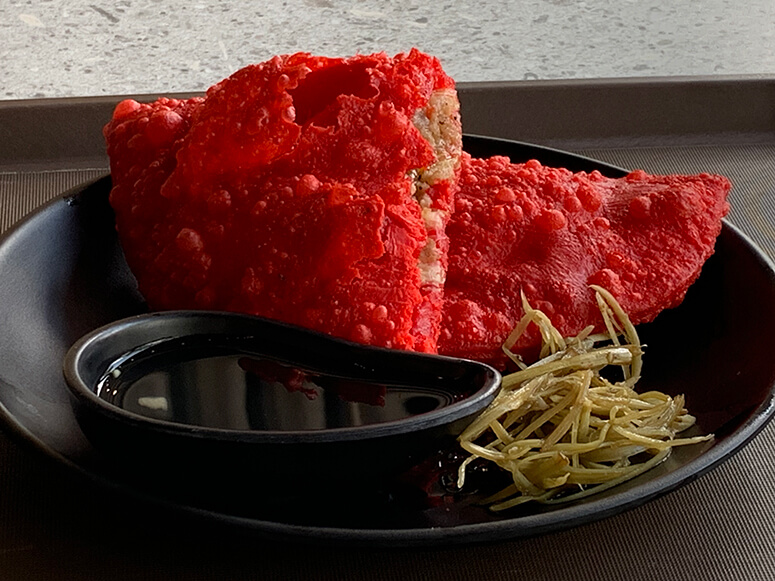
After much consideration, we chose Ilocos empanada, crispy, cabbage-filled turnovers with a color as fiery as the sunset. We were absolutely enamored by the drink with the dramatic name Takipsilim, a refreshing icy purple concoction made with lavender and blue ternate flowers.
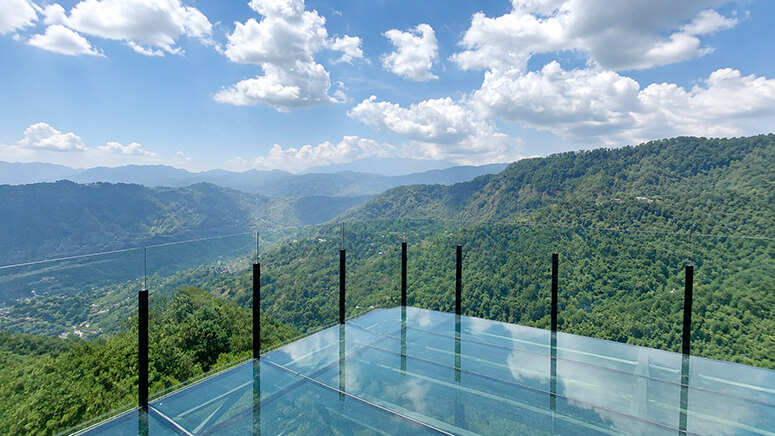
Refreshed and energized, we challenged ourselves to hit the glass and steel bridge, stepping ever so cautiously onto the transparent glass jutting out of a cliff. Directly beyond we could see the splendid mountain range amid a sea of clouds. But we tried not to look down because just below us was an abyss that could trigger dizziness and a primal fear of falling. Bravely, we walked just within touching range of the glass edge and posed nervously as volunteer guides took our photos.
Other attractions include the Dalisay playground, a food hall (Muni Muni), which serves quick bites and sandwiches, mountain trails for hiking (overseen by forest rangers), an amphitheater where there are occasional cultural performances, and a picnic area. A big surprise was the ultra-clean, very modern restroom.
“I’m a stickler for restrooms,” admits Querubin. Hence the resort has Japanese-style toilets that conveniently keep the seats warm. There’s soap and water for washing hands, and the floors are kept clean and sanitized. Considering the state of restrooms in other resorts, this is a big bonus for visitors.
In sum, being in Mount Camisong is much like being on a stylish (as opposed to rugged) adventure. There’s a rolling terrain, nooks and crannies to explore, magnificent views to admire, and the thrill of a glass bridge with a transparent walkway to rev up the adventurous spirit. But the paths are also well paved, there are roaming carts to pick up tired guests, a parking lot with solar roofs, restaurants to feed the hungry, water stations for the thirsty, as well as souvenir shops and kiosks for the inveterate shopper. It’s a bit like mountain climbing but with safety nets and all the modern amenities.
Most of all, this is one place that’s built on sustainability, a place that protects the environment while being a showcase of nature’s grandeur. Its beauty may be its own excuse for being, but its role in ecological preservation has also given it functionality and purpose.
Guidelines to Mt. Camisong:
Getting there: Mt. Camisong is located in Itogon, Benguet, about 30 minutes from Pacdal Road in Baguio City. But it’s a long and winding road with lots of sharp curves, so those who tend to get dizzy should be prepared for the ride (maybe they should take their dizziness medicines ahead of time). The place is open daily from 7 a.m. to 8 p.m.
For those without their own vehicles, there are shuttle buses leaving Pacdal for Mt. Camisong on an hourly basis (check the schedules ahead). Some hotels and inns can help make arrangements for the shuttle bus.
Entrance fees: It’s P500 per person, but there are discounts for residents, seniors, PWDs, and students with valid IDs. Management explains that the fees are necessary to fund and sustain the environmental and ecological system they had so meticulously incorporated. Children below seven years old get free admission.
Temperature: It can get quite chilly, especially in the early morning and late afternoon hours. So it’s best to bring a jacket or a shawl. There’s also a lot of walking involved, so be sure to wear sturdy, comfortable shoes.
Rules: No pets are allowed so as not to disturb the local fauna and to maintain the cleanliness of the play areas. Similarly, in order to reduce non-biodegradable waste, visitors may not bring in food and drinks. Food is available in Marahuyo Café and in Muni Muni food court. Drinking water is provided for free in the hydration stations (you may want to bring your own tumblers to fill up on free water).

WATCH: How to experience Bangkok and Kanchanaburi in one trip
October 21, 2026