

Mabini, the new heroes and the smallness of the present
Mabining Mandirigma, Tanghalang Pilipino’s steampunk musical at the Cultural Center of the Philippines Black Box, may be set during the revolution from 1898 to 1899, but it certainly dovetails with our present socio-political realities. Now on its fourth iteration since premiering in 2015—when it won 12 Gawad Buhay Awards, including Outstanding Original Musical—its themes feel even more urgent.
Apolinario Mabini, the brains and moral compass of the government led by President Emilio Aguinaldo, encountered the same problems we face today, as playwright Nicanor Tiongson lists them: “Feudal patronage which privileges underlings who are pawns of those in power; violence against officials and citizens who speak truth to power and are labeled subversive; legislators who pass laws that consolidate their class and family interests and create budgets that allow easy access to government coffers; and leaders who compromise the territorial and political integrity of the nation.”
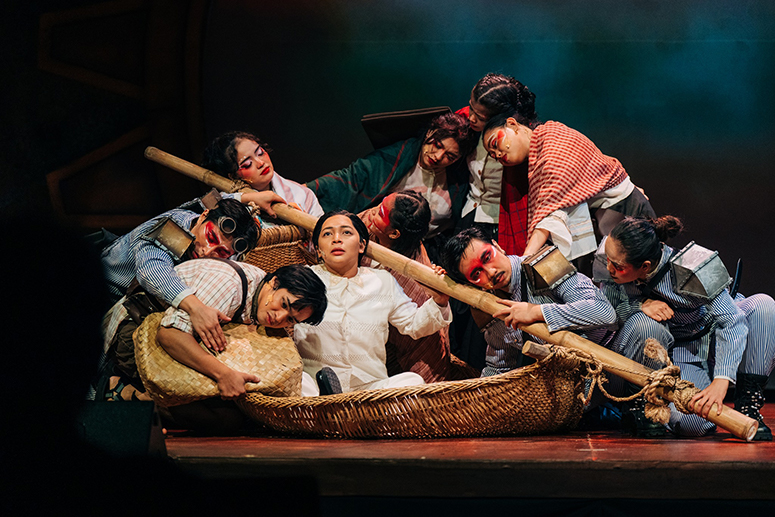
Mabini was a singular hero in every sense of the word—a patriot who fought for independence and good governance until the end, exposing self-serving oligarchs and other anomalies. The role has always been played by an actress—a female voice rising above the din of bickering voices from a predominantly male cast—and Shaira Opsimar could not have been a better choice, with her remarkable range and deep emotive power.
Arman Ferrer’s Aguinaldo (alternating with David Ezra) is an excellent match, his strong operatic tenor complementing Opsimar’s performance. Together, they form a powerful duo navigating the complexities of composer Joed Balsamo’s eclectic score, arranged by TJ Ramos, which features dissonant rhythms, extended recitative passages, and soaring crescendos.
Balsamo plays the piano live, highlighting orchestrations that allow the actors to shift seamlessly from spoken drama to lyrical passages, supported by a formidable cast led by Tex Ordoñez de Leon as Dionisia, Mabini’s mother; Gelo Molina as Pepe, his assistant; and Jonathan Tadioan, Marco Viaña, MC Dela Cruz, and Roby Malubay as the Ilustrados.
CONTINUE READING BELOW

Tiongson’s script is historically detailed, but director Chris Millado keeps it engaging through inventive and often witty staging while maintaining clarity and emotional resonance.
The tableaux are visually striking, with cinematic flourishes supported by his creative team. The steampunk aesthetic finds its edge in Toym Imao’s sculptural sets of industrial machine elements and stylized Maranao motifs, complemented by projections by GA Fallarme and James Reyes’ Filipiniana punk costumes.
Denisa Reyes and Richardson Yadao devise dynamic and intellectually expressive choreography, where Mabini’s dignified stillness contrasts with an ensemble that moves as a physical extension of his thoughts and ideas. This is enhanced by Roman Cruz’s lighting design, which adds texture, depth, and dramatic intensity.
Making its premiere in a new venue, this version is more intimate, strengthening its emotional power and making its themes resonate even more strongly.
If Tanghalang Pilipino’s production, together with its companion musicals Pingkian and Gregoria Lakambini, tackles heroes of the past, Dulaang UP’s Ang Kaliitan ng Kasalukuyan focuses on OFWs—our modern-day heroes.
The depiction of these bagong bayani could not be more authentic, written and directed by DUP artistic director Arlo De Guzman, himself a former migrant worker for nearly two decades.
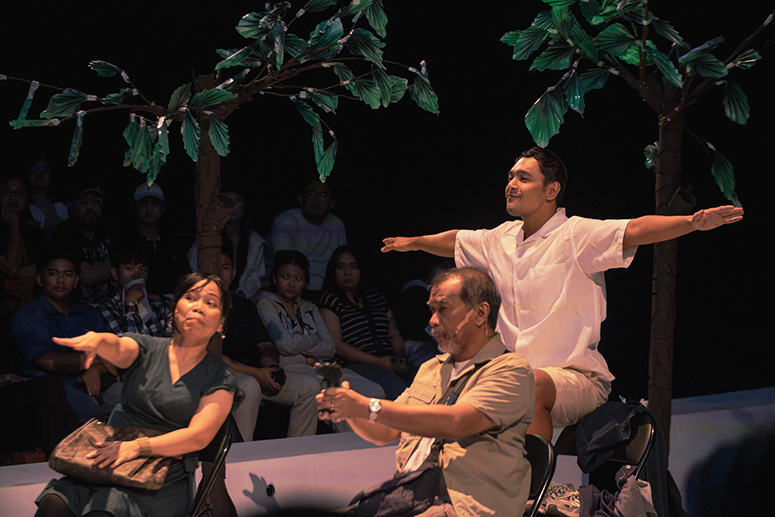
Aaron Misayah’s streamlined stage—an all-white runway-like structure that curves at one end and doubles as a projection screen for Jada Bartolome’s evocative visuals—allows for fluid scene transitions. It mirrors the stream of consciousness of Bulan (Sandino Martin), the OFW protagonist, who is filled with ennui and alienation—from his unfulfilling job as a writer in the Middle East, where he produces propaganda for his Arab employers, and from his family, who continually pressure him for money.
Martin delivers a sensitive portrayal of loneliness and inner conflict, both in dialogue and in songs composed by Angel Dayao. He shares an easy chemistry with his ate, Tess Jamias, as they navigate their filial obligations to their parents, played convincingly by Sheryll Ceasico and Fermin Villegas, who portray emotional manipulation with nuance.
A chorus, with notable performances from Jojo Cayabyab and Kerr Mangoma, complements Bulan’s journey through commentary and movement, maneuvering roll-aboard luggage that transforms into sets and furniture.
Props appear almost magically, turning into mobile sets that transport the audience from a provincial gathering to a desert in Dubai, enhanced by Third Salamat’s lighting design. There is also a deliberate effort to engage multiple senses, including the scent of flowers that fills the air during a garden scene with Bulan’s lola (Marichu Belarmino).
Numerous theatrical devices are employed, including puppetry by Siglo and miniature building sets—requiring considerable creativity and effort. While this demonstrates the director’s deep investment in this highly personal project, the storytelling occasionally suffers from an overabundance of ideas that do not fully coalesce into a cohesive whole.
Nevertheless, the production is commendable for drawing attention to the “smallness of the present”—the everyday struggles of OFWs who make immense sacrifices in jobs that fuel the economy. These are acknowledged by a government that has historically romanticized their resilience, despite the reality that failures in governance often compel them to seek opportunities abroad in the first place.
* * *
Follow @tanghalang.pilipino and @dulaang_up.
