

The world is a miracle of entangled light and matter
A renowned artist who works with the lives and materials of the natural world, Olafur Eliasson’s artistic practice lends itself easily to being read as a critique of the decadent ways of living and cultural matrices that have led us to a present wrought by exploitative capitalist powers and environmental degradation. Before Eliasson’s practice is a critique, however, it is firstly a testimony to experiencing the beauty of the world around us, which we only truly become privy to upon realizing the ever-intertwined nature of things.
Olafur Eliasson’s “Your Curious Journey” is a traveling exhibition currently on its final presentation at the Museum of Contemporary Art and Design. Having made its stops at Singapore, Auckland, Taipei, and Jakarta before its showing in Manila, this series of installation works that playfully employ light, water, air, metal, and earth to defamiliarize our experience of the elements becomes, throughout its travels, a poetic journey that reveals simultaneously the ubiquity and wonder of everyday encounters with the materiality of our world—wherever we may be.
Spanning the entire height of the wall beside the entrance of the exhibition space is Eliasson’s “Moss Wall,” a vast field of reindeer lichen native to the artist’s home in Iceland. The “Moss Wall,” in its towering expanse and petrichor-like scent, immediately creates for the viewer a new sense of place within the exhibition space—the outside suddenly situated inside, life breathing within the static white walls of the museum interior.
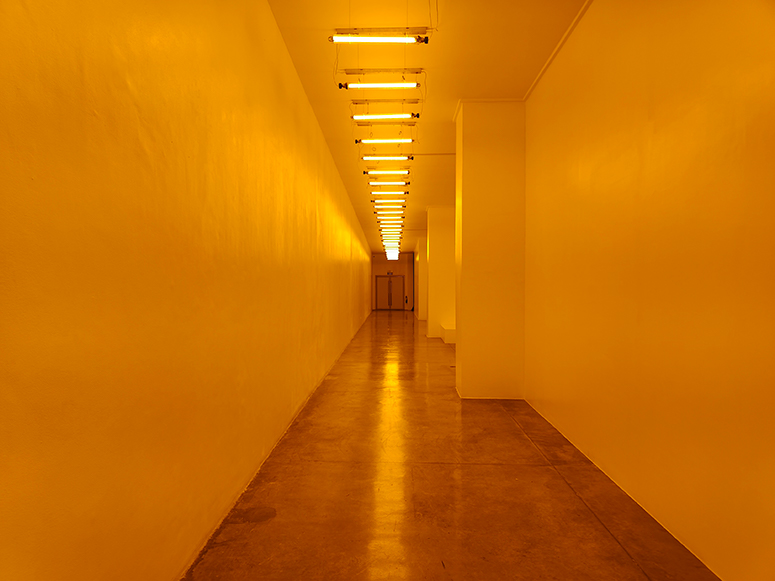
In “Ventilator” and “Yellow Corridor,” we find more defamiliarizations within the space through light, air, and everyday objects. The “ventilator” or fan hangs from the ceiling, curiously swinging frenetically as the air currents it produces push against the air occupying the room. Meanwhile, walking through the stretch of the “Yellow Corridor” lit by monofrequency lights, the viewer is immersed in an environment that causes them to visually perceive their surroundings in monochromatic yellow, everything in sight consequently appearing with a sharper contrast as darker values appear with a bluish tint.
All these defamiliarizing effects seem to recur throughout the works in the exhibition and actually become key to what Eliasson calls making the “invisible” visible as the viewer experiences or interacts with the work. In a 2024 essay entitled “Felt, experienced, lived!”, Eliasson speaks of his artistic practice as something deeply informed by the kinesthetic experience of dancing, a way by which we render space—once seemingly invisible—actively or suddenly visible with our bodies.
But what is it exactly that is revealed or becomes “visible” to us when we experience the physical matter of the natural world—when we interact with or perceive light, water, air, metal and earth? Do we merely gain a heightened awareness of these elements that surround us? Or is there something more profoundly revealed in our aesthetic experience—hence eliciting in us a fascination even with the humblest lives and matter that make up our world?
CONTINUE READING BELOW

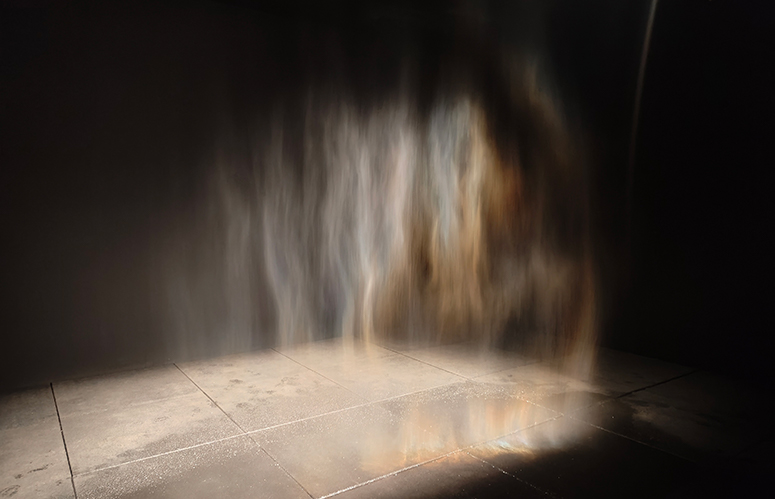
Eliasson’s work “Beauty” clues us in to a possible answer. Inside a dark room, a blanket of mist is illuminated at an angle by spotlights from above—such that the mist appears like a scintillating curtain of falling sand that entrances with its aurora-like gossamer. Depending on where the viewer stands, the mist seems to scintillate in shifting colors. The phenomenon of beauty here “takes place” through the viewer’s experience of the work as they realize in awe that the appearance of the mist changes according to how they move around or interact with it. What the work then reveals is that beauty becomes possible through something as simple as the humble interplay of light, water, space, and most significantly, our physical encounters with these elements.
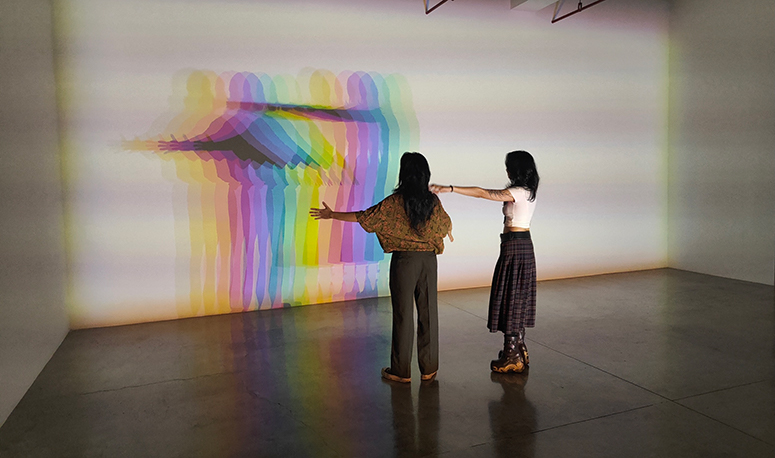
Similarly, in a work entitled “Your pluralistic coming together,” the appearance of multicolored overlapping silhouettes cast by the viewer’s figure on the white wall opposite a row of LED lamps covered in colored glass filters depends entirely on one’s movement within the space. The silhouettes dance on the wall as a cascading pattern as one moves, rendering visible a playful entanglement of light, space, and bodies in vivid color.
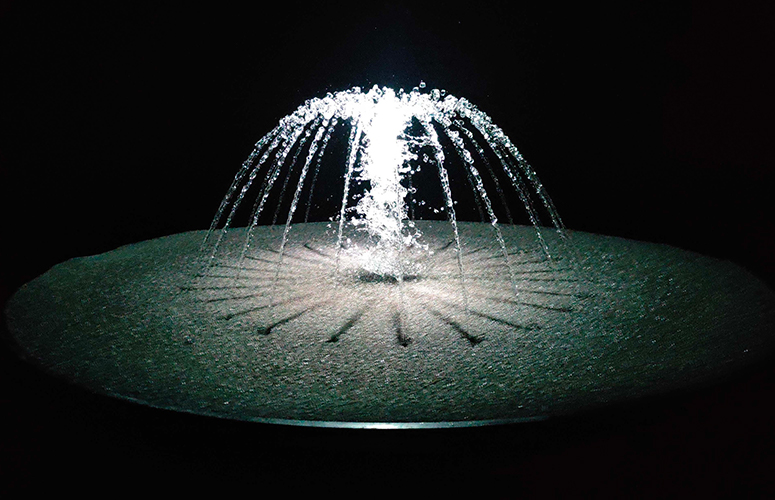
Another work with a striking defamiliarizing effect is “Object defined by activity (then),” a fountain lit by strobe lights in a dark room, with each instance of flashing light illuminating the spouting motion of water just briefly enough to appear as if the water had crystallized for a moment. This brief instance of illusory stillness becomes fascinating because it makes one privy to the animated encounter between light, water, and air as the viewer perceives the work according to the limits of their vision.
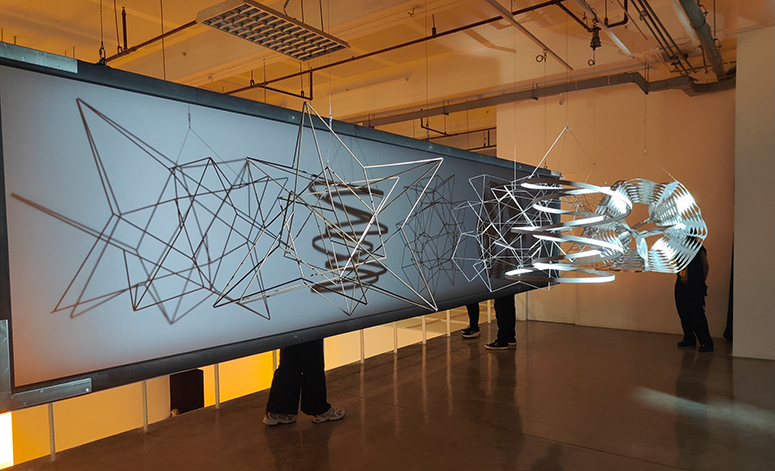
Throughout these works, the defamiliarizing effect comes with the realization that behind these fascinating aesthetic encounters, there is an interplay of elements that perhaps were always already intertwined to begin with. We see this exemplified in the work “Life is lived along the lines,” where five rotating metal models cast a ghostly yet mesmerizing geometry of shadows on a projection screen. Behind the projection screen, the complex structure of the metal models is revealed, revealing once again an entanglement of light, air, and solid matter beneath the surface of what we initially perceive. “Life is lived along the lines” exemplifies the idea that there is always more to the world than meets the eye.
Instead, there is always an entangled world of things that makes the beauty of rainbows and auroras, the mystery of shadows possible—a world to which we are inevitably intertwined and whose humble wonders we play a part in through our everyday experience of light and matter.
