

Rage is a thing with feathers
A young man in his late teens, reclusive Eli (a compellingly crushed Elijah Canlas) is tormented by visions of a not-so-distant past. He’s been struggling to keep such visions at arm’s length, waking up sweat-stained from nightmares about it. Worse, he’s left with no choice but to helplessly tape his days to listen to on his handy Walkman.
We’ll know the exact source of the nagging unrest halfway through Raging, at least if you haven’t looked up the film online prior to watching it. But that hardly matters, given the string of clues writer-director Ryan Machado sets up early on, pointing to some form of abuse. In this way, I find an unnerving kinship with the film, for I have lived its story more than once, more than I’d like to admit. I am not in denial so much as I reject being in a position where the abuse neatly defines me.
It’s not that Eli has yet to summon the strength to report what happened to the local authorities; it’s more to do with the disheartening inaction that follows, so much so that a promise of help outside of town seems more like wishful thinking to him than an actual possibility. Like Eli, lodged inside me is a cynical distrust of a system built against survivors of sexual violence. Over the course of the movie, Machado deftly calls into question what it really means to live a “normal life” in the wake of abuse.
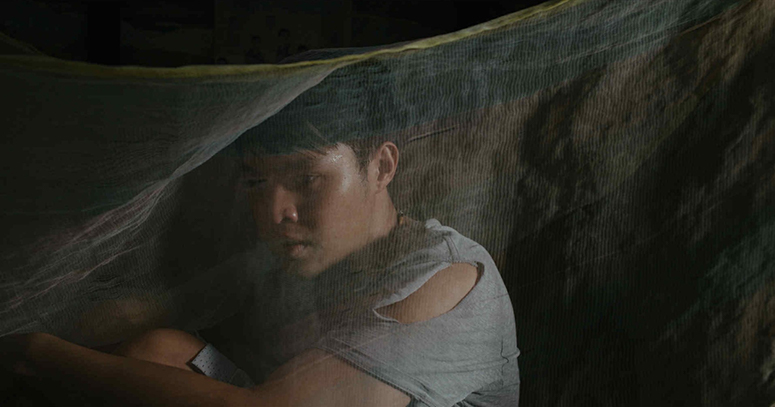
The result is a languid drama that swaps the magical realism of the filmmaker’s debut feature Huling Palabas for a straight-up, though still stylized, realism—a movie that is much less interested in detailing the circumstances of the wrongdoing committed than it is in examining the full extent of the damage done. Raging, then, is free of all the graphic, torturous rehearsing that works of its kind typically indulge in.
Lonely and left to his own devices, Eli is a lost soul amid the vast and seemingly mystical expanses of forest green, traipsing all over the mountain town—at every turn, he comes across his abuser Arjo (Ron Angeles) and peers he’s since distanced himself from—or killing time on a makeshift bench perched on the cliff overlooking the open sea no one seems to cross, and where he’ll witness a plane crashing and then vanishing over the ridge one stormy day. But no one really bothers to notice or care, save for him; not even his consoling gay best friend Jopay (Reynald Santos). Like a moth drawn to flame, the plane crash clearly ignites something in the young man—another tragedy to make sense of his own.
But the town mayor (Glenn Sevilla Mas) dismisses the sighting, like Eli’s rape, as nothing but a made-up tale. If something this big and obvious could go unrecognized in such a small community, then it’s much easier to ignore everything else, hanging the question of whether “proper channels” for discussing abuse can actually exist. In this respect, Raging is another small-town story by way of Machado. Every mist-shrouded landscape, every whispered concern, every soft sigh of this world fundamentally suggests something far more sinister. To that end, John Rogers’ edit takes a fluid approach, and it’s pretty easy to play down the way dramas of this sort are edited for they are almost always self-effacing, but Rogers clearly grasps the virtues of rhythm necessary for the film’s purgatorial ethos, as if to incarnate the shock and anguish haunting the protagonist.
CONTINUE READING BELOW

Tragedy is routine here, as one villager might imply: a death of a worker in the mining site, a mountain swallowing strange objects, the hunting of endangered species in the forest. The film tersely commits to immersing us in that mindset, as it shadows Eli’s search for answers just as Machado and cinematographer Theo Lozada return to the director’s hometown, the island province of Romblon, to hunt for better muck and better mist and therefore better images than the duo came up with in Huling Palabas. (Save perhaps for the image of Eli and his peers covered in thick mud intermittently punctuating the film, a symbolism I find rather insufficient in that it merely paints rape as dirty instead of utterly despicable and disgusting.)
This version of Romblon is a little further back in time: in the mid-1990s, in contrast to the first film’s 2001 milieu, though this temporal detail hardly registers if not for the brief appearance of a framed photograph of former Philippine president Fidel V. Ramos nailed to the wall of the mayor’s rustic office or Eli’s beloved Walkman (analog media are becoming a fixture in Machado’s films).
Every shot in the movie is mounted to evoke the quasi-mysticism of the rural community, and every ambient sound is maximized to reflect the river of rage that silently runs through the threadbare plot and the protagonist’s psyche. There is one stirring scene in which Eli puts on a pair of unplugged earphones to block out the steady murmur of the countryside and instead listen to the white noise seemingly playing on loop inside his head. It isn’t a disconnection from an external world so much as a tiny, intimate moment of emancipation, which sometimes is all you have post-abuse. Sexual assault, I realized over the years, is not a door of no return, but a revolving door of harm and healing. Every waking day, without warning, you are put through the emotional wringer.
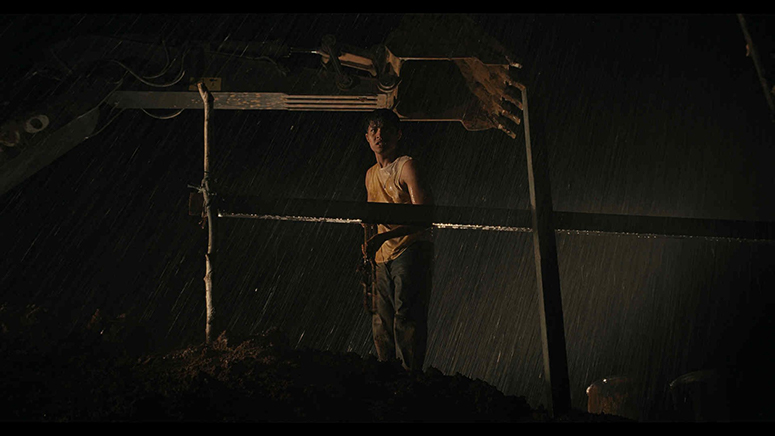
Whereas Huling Palabas primarily relies on static shots and close-ups, Raging’s camerawork retains the locked-down setup but also introduces some new movements, or at least a sense of it: it pans or zooms in/out unhurriedly, or, in one stunning gesture, uses a slow pedestal down shot combined with a zoom. Most impressively, the shot of Canlas under heavy downpour near the coda strikes me as classic in that it feels like a low-angle reversal of the chase sequence near the end of Lino Brocka’s Jaguar in which the high-angle camera settles on the trapped, terrified visage of Phillip Salvador’s Poldo Miranda, only here Eli’s terror thaws into momentary relief.
Since 2014’s Sundalong Kanin, Canlas has incredibly matured as an actor in much the same way as he has developed his signature doe-eyed mien, which, thankfully, he ditches here, allowing for a performance that demands a kind of dread that physically debilitates and forces an abused person to retreat irrecoverably inward. Canlas not only displays the perfect toolset to translate the magnitude of Eli’s grief and pain so palpably, but he also weaponizes it in a way that makes for his best work since Kalel, 15. Canlas is among the most moving of current actors just in terms of the power he generates in his quietude.
Raging is basically Ryan Machado in better form. It’s a small-scale movie of veritable force. But contrary to its title, Machado’s vision is not in fact raging in the most explicit sense. Whereas Huling Palabas has more heart and feels unmistakably spurred by small-town anecdotes that shaped the director’s cinephilia, Raging has a lot more control—in fact, it’s so controlled that some critics predictably dismiss its restraint as a refusal to indulge in a more explosive catharsis or indeed give rise to a gut-punch ending.
That would certainly not feel out of step with a movie that seems building towards that conflagration of emotions, but I find it more honest and moving that it doesn’t really go there, that it disabuses itself of the tendencies people often associate with movies about rape and sexual violence, therefore capturing a crucial aspect of the trauma—sometimes, there are simply no grand gestures that make the pain somehow more legible or livable—even if I think this is still just an approximation of the many, complex ways abuse can totally screw you up. Eli’s abuser may be dead, but he still has to live through what part of him survives, and what’s more painful is that he has to live through it in silence and isolation, within a system designed to work against him rather than for him. It may just as well be some of us in the place of Eli in the film’s final minutes, alone in the calm rush of the river, seemingly inconsolable but content with what nature fleetingly offers him.
Sexual assault has its way of inhabiting your entire being, so much so that you begin to lose grasp of how to resynchronize yourself with the world again. To trust even the ones you love. It is always hard to name what exactly the trauma entails and how exactly it will end, just as Raging offers no definite answers on what must be done and how it must be done, though we already have an idea. And, somehow, that feels more sincere. That should be enough for me.

WATCH: Pixar Summer Fest adventure at Hong Kong Disneyland
August 10, 2026