

From Malabon to Venezia: Ronald Ventura mounts collateral show at 61st Venice Art Biennale
VENICE, Italy—Four o’clock in the morning (if you could call that morning) in Malabon during those heady times in the Nineties was different: The food stalls had just opened and were serving a few of us straggly zombies who either woke up early or hadn’t slept at all. At this devilish hour, a young Ronald Ventura—having painted all evening into the small hours—would wake up his brothers and me (I was not young long, I met the soul early) to go eat at nearby Connie’s. Ronald’s head would still be buzzing with ideas about art, painting, and impaling the essential down on canvas.
Over our favorite sopas (thick elbow macaroni soup), we’d talk about Botong, Basquiat, Bacon, and the idea of how to effectively conjure from tubes of lowly paint bought from a store all these narratives, ideas, and emotions, or how to participate in an age-old existentialist, conversational thread: why do we make art? Or why make art at all? A question that hung in the breeze of a Malabon morning, past the brackish esteros and the fishponds of this part of Metro Manila where you’d feel most isolated due to typhoons, high tides and impassable roads, but, at the same time, you’d be instilled with the pride of being part of a community of fisherfolks, traders, craftsmen, artists and musicians, all those who make a living with their hands. We’d talk until it was time to go to school or get to the office—well, the very mundane things hindering us from becoming who we were.
All the while watched by the moon.
Fast forward to early May of this year, and this same lonely satellite hovered over us in the floating Italian city of Venice as one of the Philippines’ leading contemporary artists had just opened his “Ronald Ventura: Luna” exhibition at Docks Cantieri Cucchini, Castello 1/A.
Near winding canals once again.
The same moon, a lifetime in between.

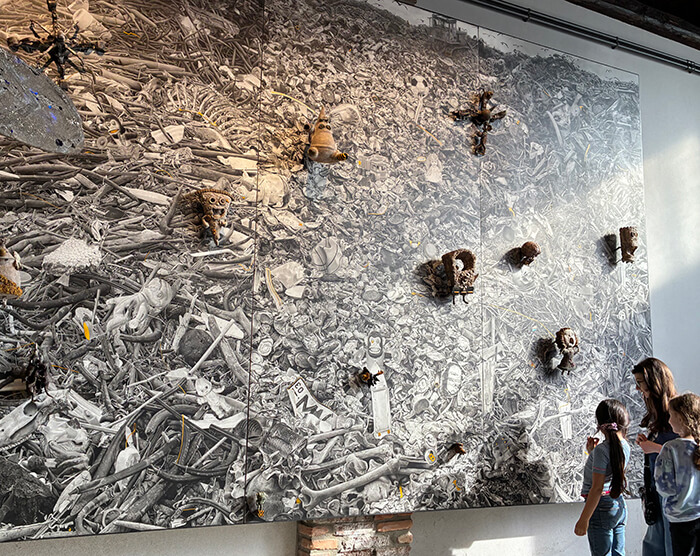
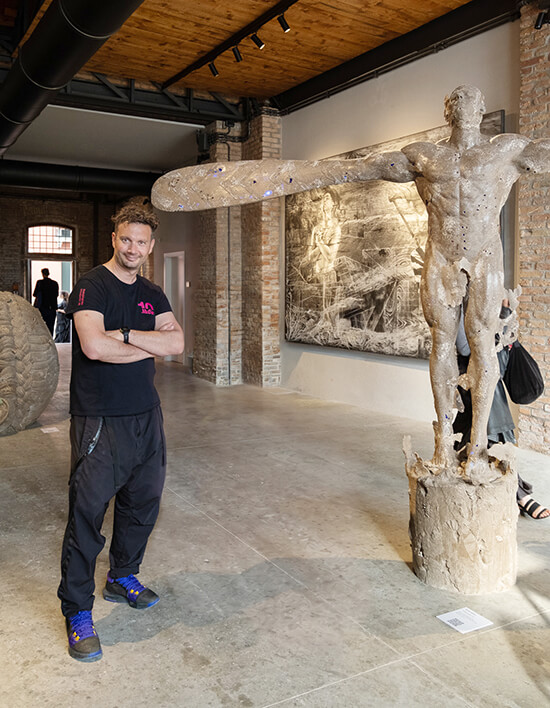
The first time I heard the concept for the exhibition was a year ago at Ventura’s Makati studio with longtime curator Ruel Caasi. The pair talked about the large-scale drawings and sculptures of human boats, crabs, and a paddle-armed sentinel that Ronald would create for a proposed show in Venice, and already there were studies. I had a glimpse of postcard-mashups between the two tidal cities (similar in a way, but also blatantly different) as well as notes for a triptych in graphite of debris either washed ashore or found in the aftermath of a flood. I was puzzled as to why no one thought of it before. The parallelism between the two places was staring us right in the face: Venice, artfully structured between stanzas of sky and water, and Ventura’s hometown, with the hum of industry and the resilience of stone along the estuaries of Manila Bay.
The journey from that initial meeting to the opening reception of “Ronald Ventura: Luna” felt, at times, like a lifetime. Mounting an official Collateral Event within La Biennale di Venezia is a tough task, like wading through rising flood water in precarious stilettos. Getting chosen is one thing. Living up to the Biennale’s strict guidelines is another. It is easy for exhibitions in Venice to slap themselves with the “collateral” label, but to be officially designated is a distinction bestowed yearly upon not so many. For Filipino artists, that rarity has only a few clear touchpoints—among them Fernando Zobel’s inclusion in the Biennale’s official collateral program in 2017. David Medalla, of course, is in his own category.
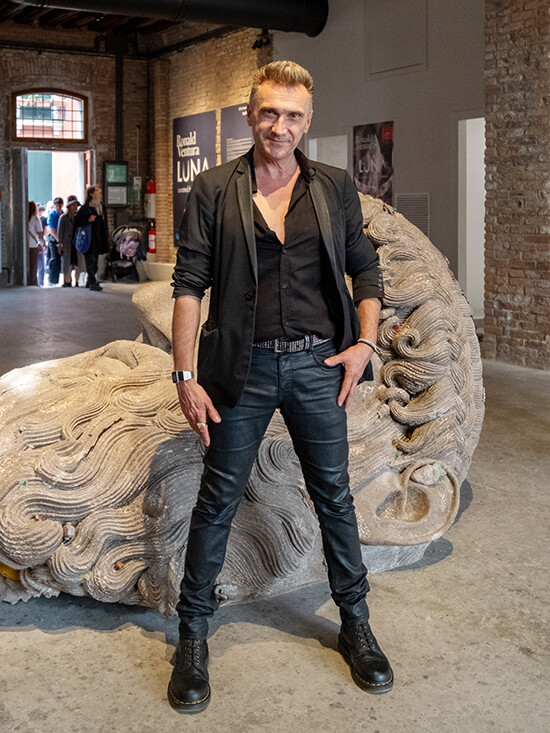
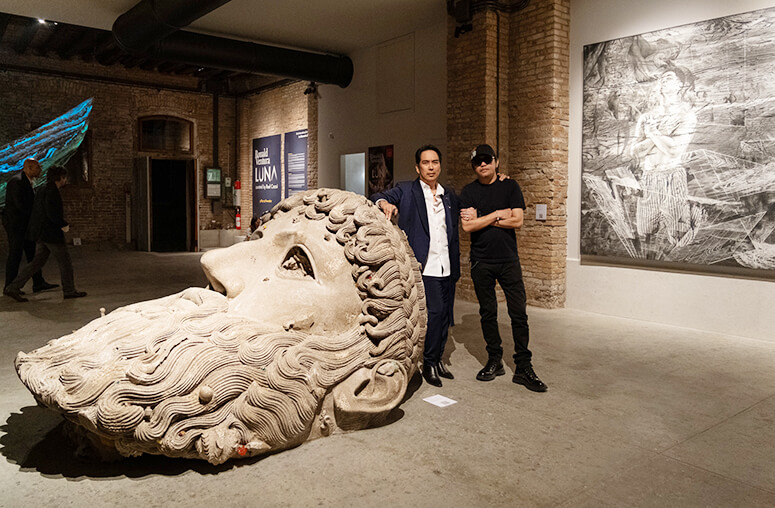
Running from May 9 through Nov. 22 at the docks toward the tip of Via Garibaldi, the “Luna” exhibition curated by Ruel Caasi explores the deep-seated connections between two water-bound locales through more than a dozen newly realized works that blur the miles between two water-bound worlds, capturing the slow sedimentation of history and memory.
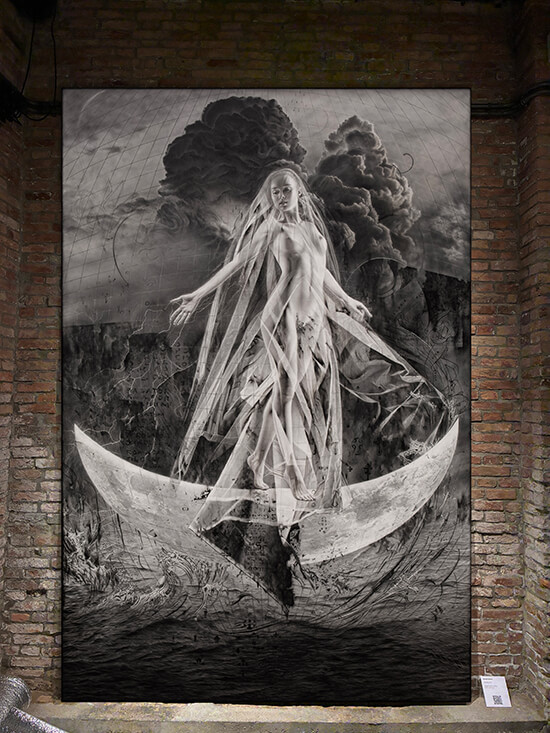
“Look up and you’ll find human figures—a man and a woman—reimagined into the crescent curves of boats,” pointed out Caasi. Suspended from the ceiling, these anthropomorphic vessels hang in floating suspense. They are a visual metaphor for bodies wholly adapted to the rhythms of the sea. Ventura views the moon as a kind of emotional satellite. The curator explained, “Just as distant lovers might seek comfort in looking at the exact same glowing sphere, the moon bounces signals between these two coastal cities.”
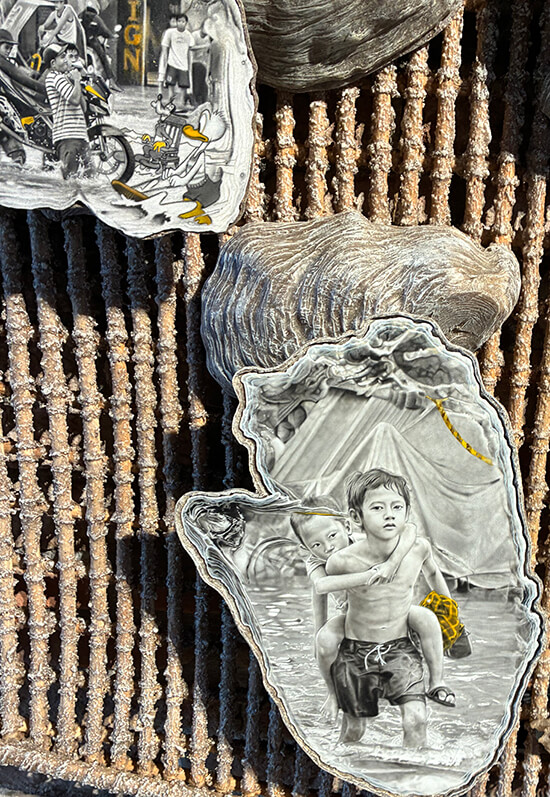
For Ventura, while looking at one city, he is reminded of its counterpart halfway around the world. In Malabon, known historically as the “Venice of the Philippines” (along with neighboring Navotas), water is considered a condition and not something relegated to the background. Water is its literal lifeblood, sustaining generations through a vibrant fishing industry and extensive aquaculture that form the backbone of the community’s livelihood. Decades of reclamation, rapid urbanization, and land subsidence have intensified flooding, worsened further by typhoons and rising seas. “The same with Venice: its beauty is inseparable from water but also from vulnerability.” The phenomenon of acqua alta, or high water, has become part of Venetian life—seasonal flooding that at first was manageable, but over time grew more severe due to subsidence, industrial activity and climate change.
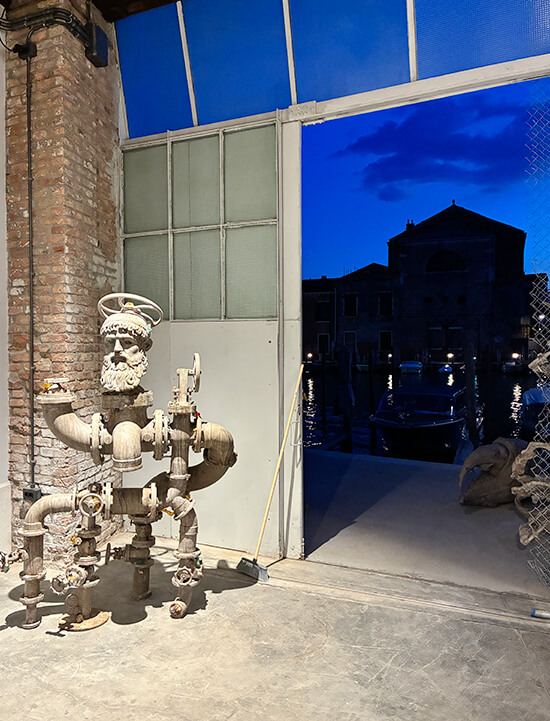
In Ventura’s vision, Venice and Malabon converge not just as geographical parallels but as metaphors for a world increasingly defined by rising tides. “Climate undoubtedly is not an abstraction for both cities.” Their histories, layered with memory, myth, and survival, invite reflection on what it means to live with water in all its contradictions.
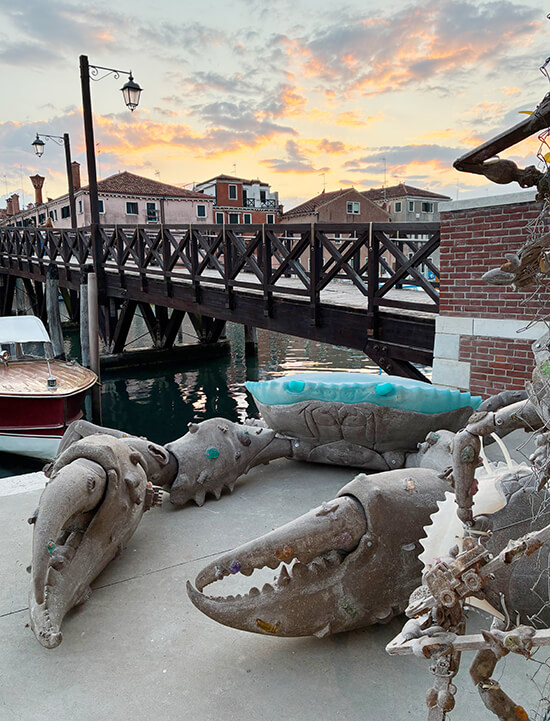
And rather than delivering a loud, sweeping manifesto, Caasi noted that the exhibition perfectly aligns with the Biennale’s theme, “In Minor Keys,” curated by the late Koyo Kouoh, with Ventura using the moon and the boat-bodies to show how people live with water day after day—its beauty, its danger, and the constant need to adapt. The featured works hum with the uneasy, emotional resonance of a minor chord, capturing the daily, persistent reality of living alongside a force that is simultaneously a giver of life, an agent of ruin, and a mirror of our collective future.
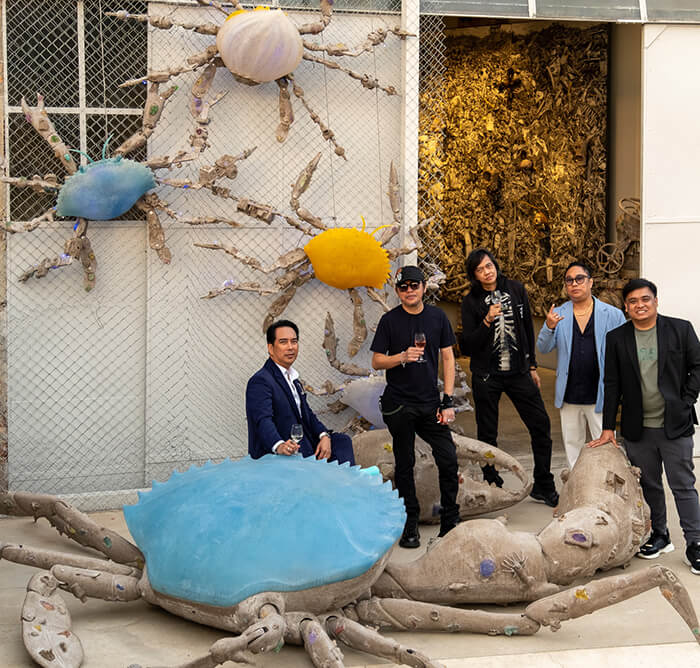
During the opening reception of “Luna,” the artist’s father, Ruben, was looking at the postcard artworks, pointing at the image of a schoolboy carrying his younger brother on his back across the flooded Malabon streets. “Ganyan si Ronald dati, karga-karga kapatid niya pag baha noon sa Tonsuya (That was Ronald before, carrying his brother upon his back during floods in Tonsuya).” You could sense nostalgia welling up in the man’s eyes. He pointed to the artist’s drawing of the San Simeone Piccolo Church right across the Venezia Santa Lucia train station beside the Grand Canal. “Ah, ’yan naman ang San Bartolome Church sa mismong bayan ng Malabon (Oh, that’s the San Bartolome Church right in the heart of Malabon).” There was something quite uncanny in how the artist’s father recognized, within that drawing, not Venice but Malabon itself. Under the same moon, surrounded by singing waters, there can be a blurring of territories, a mixing of memories.
Differences dissolve, distances collapse.
Space is folded like drawing paper.
* * *
For information, visit www.luna.ronaldventura.com.

WATCH: Pixar Summer Fest adventure at Hong Kong Disneyland
August 10, 2026