

Is there such a thing as ‘TMI’ when it comes to love?
In relationships, there are red flags. And then there are flashing-red, DEFCON 1-level warning lights.
With this delightful logline in mind, Norwegian director Kristoffer Borgli offers The Drama, in which Zendaya and Robert Pattinson navigate a modern relationship in the age of oversharing, asking the question: Is there such a thing as TMI (Too Much Information) when it comes to love?
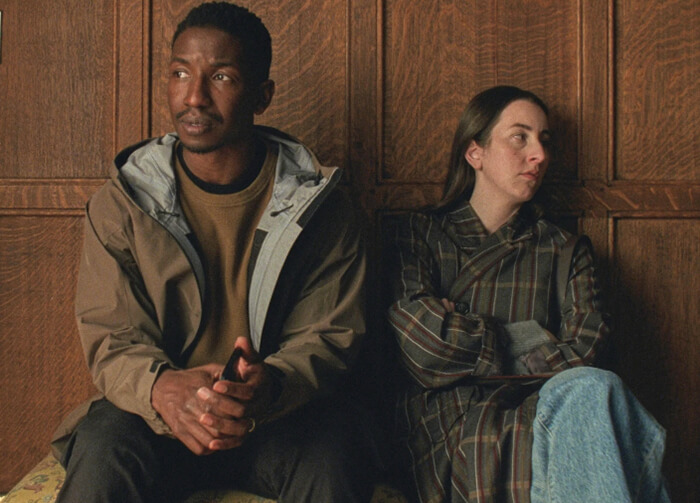
Emma (Zendaya), a literary editor, and Charlie (Pattinson), a museum curator, are the romcom picture-perfect couple, starting with a meet-cute in a coffee place and friends (Mamoudou Athie and Alana Haim) who help them prepare for their wedding. Then, in the kind of setup that makes for viral trailers, they play a drinking game of What’s the Worst Thing You’ve Ever Done? When Emma reveals that—spoiler!—she once seriously thought about shooting up her high school, their relationship and their world suddenly go tits-up.
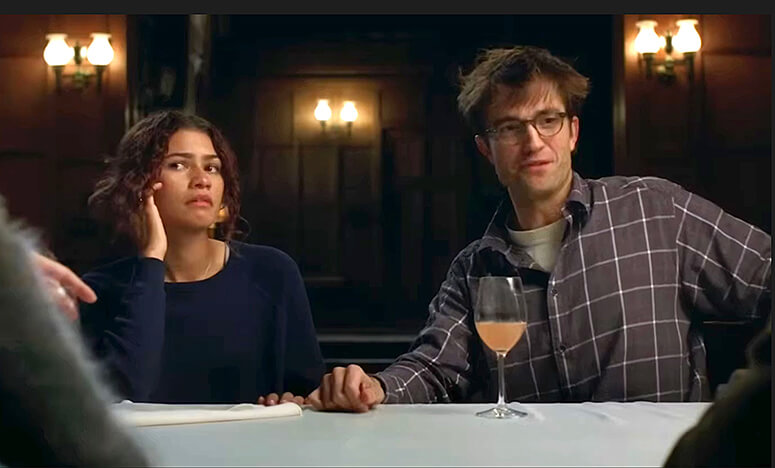
Borgli, who also wrote/directed Dream Scenario—an existential dramedy in which bitter academic Nicolas Cage begins popping up in millions of people’s dreams worldwide—cooks up another absurdist situation here, but this one is heavily laden with controversy. He goes there. And then, maybe, he pulls back at the last minute.
When Charlie’s suddenly confronted with Emma’s dark secret, he struggles to absorb it and move on. Emma doesn’t understand why he’s fixating on a period of severe mental stress in her past that the film treats like it was a 24-hour virus. Um, have either of you ever considered therapy?

Meanwhile, Athie and Haim offer varying soundboards to this elephant-in-the-room situation, and the film plays with all the comic and cringe-worthy potential of the subject matter.
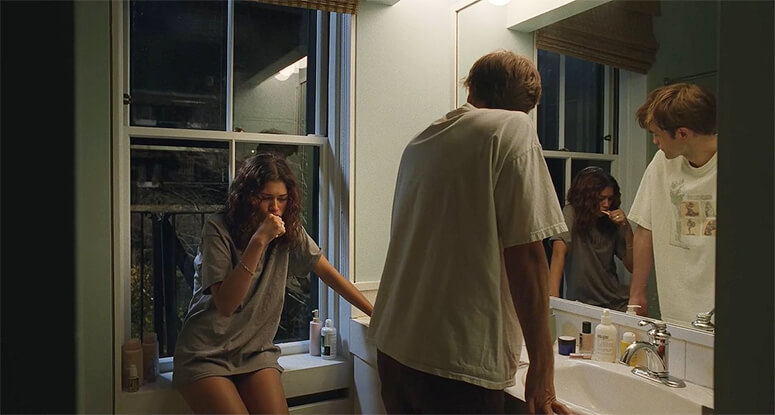
There are two kinds of discomfort in The Drama. One is when the tension onscreen is so thick, you can practically slice it with a knife. The other is the jokes, which serve as an intermittent release. The premise here is so, well, loaded, that you can’t help but laugh. Even a meeting with the wedding photographer turns into a series of rapid-fire reaction takes. (“We can shoot the maids of honor first, then shoot the parents…”)
Borgli cites Mazursky’s Bob & Carol & Ted & Alice and Michael Haneke’s The Piano Teacher as inspirations for his satire, and both are packed with uncomfortable moments. But the one underlying The Drama’s premise seems like more of a real-life dealbreaker.
There’s a question of proportion, of tone. The film’s poster marketing plays it all like a dream romcom wedding invite. Yet the movie’s “secret” lies there inside the giftwrapped packaging like a deadly poisonous snake.
Borgli’s script does touch on sticky questions, like how much do we really know our loved ones? And how much are we willing to negotiate to make our emotions fit with our logic?
Yet it also trivializes or exploits real-life tragedies that occur far too regularly in the US (as well as Norway and other countries). The question arises: Should such subjects be mined for comic effect?
I’d like to believe comedy doesn’t have set boundaries. Comics like Ricky Gervais and Dave Chappelle have made lucrative careers out of arguing this position. A recent New York Times interview with Trey Parker and Matt Stone about creating The Book of Mormon for Broadway reveals how much they agonized over material: Is this funny? The musical lampooning both a religion and the African AIDS crisis would be a hard pass for producers nowadays.
On the other hand, they cite Norman Lear, who made groundbreaking TV shows like All in the Family in the ‘70s that confronted uncomfortable social topics—bigotry, sexuality, abortion—by humanizing our reactions to them. “If you want people to really laugh,” Parker recalls Lear saying, “make it about something they’re really anxious about.”
But The Drama doesn’t exactly humanize our understanding of teen mental anguish, or other weighty matters it opts to raise; it treats its controversial subject as a setup for laughs, and even if it uses this to get at the heart of what ultimately draws people together (in a very Hollywood kind of way), it’s hard to see it as something other than cynical.

WATCH: Is Gen Z too soft? (Generations Ep. 23)
September 30, 2026