

The tragic comedy of power
Power corrupts and absolute power corrupts absolutely, but for the late Floy Quintos, it wasn’t that simple, as nothing ever really is in his plays, just like in Miranda and Yolanda, the twinbill of Encore Theater starring the two compelling women in the Palanca Award-winning plays Evening at the Opera and Ang Kalungkutan ng mga Reyna, written in 2011 and 2008. First presented at Virgin Labfest, the current run is attracting both longtime Quintos fans and first-timers who would like to experience the legendary playwright’s genius in a production crafted by the artists who were kindred spirit in the process of creation.
Political plays have been popular lately, but what sets Quintos’ apart is that they don’t just tell stories, they get into the psyche of the characters, resulting in more intriguing drama, working at multiple levels: intellectual, emotional and theatrical, to bring out the political themes and ideas which arise organically without the need to lecture. What makes the audience receptive are his characters that are so real, so flawed, so accessible, in his signature tragicomedy style that reflects the complex, contradictory nature of life. You empathize with them, you laugh and ultimately you witness their tragic fall which becomes even more profoundly devastating.
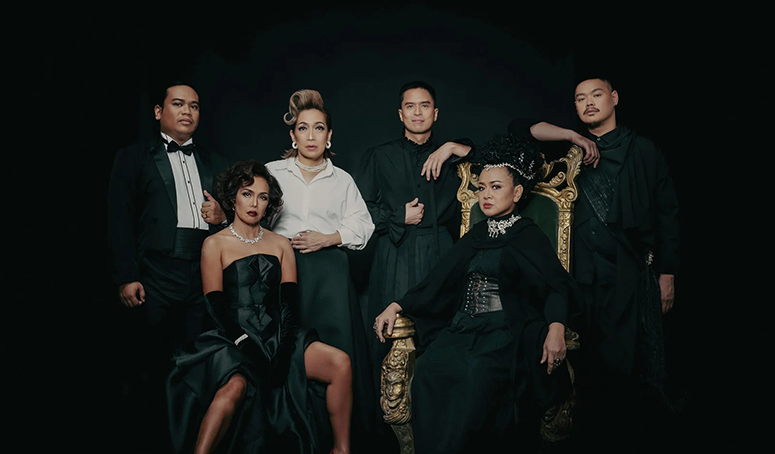
That is, if the director and the actors can pull it off. Quintos’ plays and characters are not easy, which makes them challenging and an absolute delight when done well, which, fortunately, this production achieves.
In Evening at the Opera, Miranda Beloto (Ana Abad Santos) is in her boudoir, dressing for the gala of “Cavalleria Rusticana,” an opera that she has “organized for the people of the province,” she tells her late mother Mamang (Frances Makil-Ignacio) who reminisces about her role as the previous governor’s wife before the Belotos, a political dynasty steeped in corruption, took over, prompting an arranged marriage for Miranda with the new governor, Bingo Beloto (Joshua Cabiladas).
Political plays have been popular lately, but what sets Floy Quintos’ apart is that they don’t just tell stories, they get into the psyche of the characters
Miranda and Mamang embody upper crust sophistication, channeled with stiletto precision by Abad Santos and Makil-Ignacio, a glaring contrast with Bingo who enters the scene to disrupt the proceedings with his nouveau-riche crassness that Cabiladas essays effectively as counterpoint to the painstaking gentility—providing the comic relief to the tension between two incompatible individuals in a miserable marriage that Miranda can only tolerate with her projects of “art and beauty” and one that Bingo escapes with a string of mistresses.
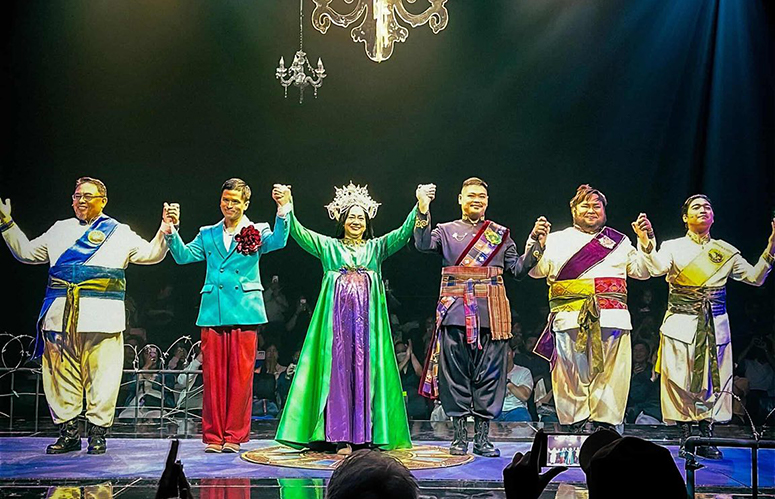
Even the very concept of the opera is one they are at odds over—she wants to share the beauty that she experienced at La Scala while he thinks it’s too highbrow for the masa and the P20 million would have been better spent for classrooms. Miranda acknowledges this but still berates him for all his corrupt practices. Ultimately, they are self-aware and know what the right way is and yet they’re stuck in an inescapable system of complicity just to stay in power.
CONTINUE READING BELOW

For Ang Kalungkutan ng mga Reyna’s Yolanda Cadiz (Shamaine Buencamino), who has just declared martial law as President, the only way for the country to go forward is to become a monarchy. She summons the hairdresser cum social etiquette expert Marcel (Topper Fabregas) who has styled royals abroad, to do her makeover as well as those of her staff headed by Ministro (Jules Dela Paz), in preparation for her coronation. Absurd as her desire is to become queen, Buencamino creates a multilayered portrait of the dictator: powerful but self-deluding, with cracks exposing underlying insecurities, megalomania and the need to control.
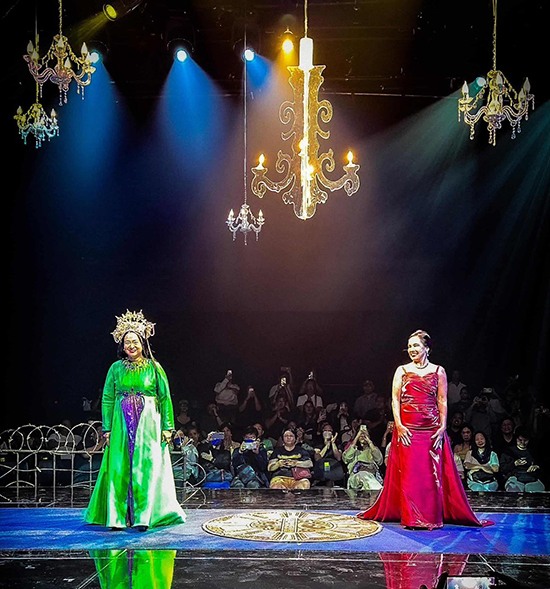
Her apple hairdo matched with a fatigue maxi coat, by production designer Mitoy Sta. Ana, projects an authoritarian who is actually a fantasizing little girl with guns at her disposal. Camp as she may look, Buencamino does not go the way of caricature. She may be funny in her ridiculousness but you still feel for her because you know she is driven by deep loneliness and a need for validation. She finds this in her stylist and, together, they have some of the most hilarious repartee—but Fabregas’ Marcel is not just a comic jester. He reveals much more: matching her presence without overpowering or shrinking, subtly transitioning from witty and detached to questioning authority, and eventually feeling pity, fear and moral conflict.
It is quite a feat for the actors to make all these emotions come through and keep the storytelling clear with such a talky script but director Dexter M. Santos, who has worked with the playwright on numerous plays in the past, manages to keep the text “alive” by focusing on what the characters are thinking, moment by moment. The actors don’t just deliver lines, they are actually processing ideas live onstage.
His understanding of structure, subtext and thematic layering builds the scenes logically and emotionally so that complex ideas remain clear. With strong individual performers, he manages to align their different acting styles into one coherent tone so that the ensemble feels unified. Having a refined sense of rhythm and pacing as a choreographer serves Santos well, knowing when to slow down or push momentum and when to let silence breathe which is so crucial in these tragicomedies.
Together with his creative team, he has orchestrated purposeful visual choices. Sta. Ana’s chandeliers rising high above the tableau bring a sense of grandeur. In Evening, Lucite furniture gives a glitzy sheen without distracting from the action. It turns into fairytale kitsch for Queen Yolanda. John Batalla’s lighting design is intimate with chiaroscuros for the psych wars in the first play, while concert level in the second where the queen makes a spectacle and commands her minions.
But while the production achieves realism and high drama, neither play feels overtly sentimental because of how Santos holds back. Instead of pushing big emotions, he lets tensions accumulate, allowing meaning to emerge subtly, so that in the end the emotional impact generated by the two women hits you harder. You may not even notice you’re affected until later, when suddenly Miranda’s restraint suddenly feels tragic and Yolanda’s fantasy is suddenly heartbreaking.
Miranda and Yolanda runs at PowerMac Spotlight, Circuit until May 3.

WATCH: Is Gen Z too soft? (Generations Ep. 23)
September 30, 2026