

Artists in residence
It isn’t every day that I get to spend time with two outstanding artists, and while I’ve become something of a recluse myself, exhausted by literary polemics and limiting my social life to a very close friends, I couldn’t say no when my wife Beng asked me if I cared to join her on a day trip to Los Baños to visit the sculptor and painter Junyee. Junyee was a good friend of Beng’s from the UP College of Fine Arts, and while he lives in Los Baños with his wife Tess, Junyee has done many art installations around Diliman and often comes by our house on campus to drop off some buko pie. I’d enjoyed chatting with Junyee whenever our paths crossed, taking in his stories about his arduous struggle to become an artist, including a time when he had to work as a makeup artist for the dead in a funeral parlor in Cebu. But more on that later.
I was doubly pleased to learn that we would be accompanied to Los Baños by another artist-friend, Fil de la Cruz, whom I had known for over 50 years, and by his son Janos, also a talented and highly regarded young artist. Fil stands among our most brilliant, versatile and accomplished printmakers; both he and Junyee have been nominated for the National Artist Award.
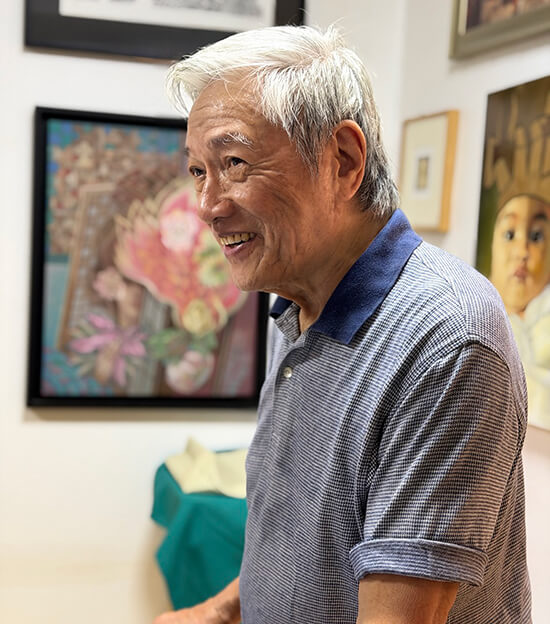
We had long been planning to visit Junyee in LB, where he and his wife Tess, who taught in UPLB, have lived for decades. When Tess retired a few years ago and they had to give up their home on campus, they found and bought a private lot just beyond the university property line, and built a new house there. Since anything that Junyee built was bound to be interesting, we wanted to see it, but the house was honestly just an excuse; we were going there for the artist himself. Now 84, Junyee recently hasn’t been in the best of health.
Though younger at 75, Fil has been facing serious challenges of his own. They had a lot to talk about, for sure—but we resolved to undertake this trip in high spirits, to celebrate art and life in joyful company.
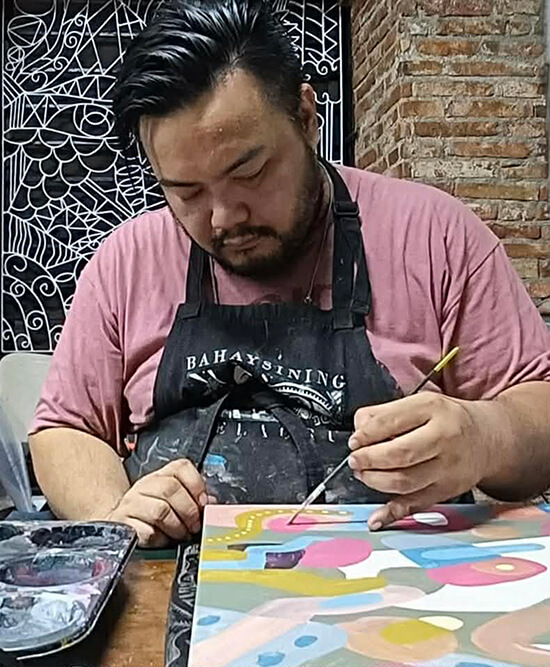
First we picked up Fil at his home in Muntinlupa. Aptly named Bahaysining, the three-story brick house is part (if not largely) studio, part gallery, and part living space, but immediately the visitor knows it’s a house made by artists for artists in both form and function. “This was much smaller early on,” Fil says of the place, ”and then I just kept adding to it as my practice and capabilities grew.” He shares the space with his son Janos, who keeps a studio of his own on the premises and helps his dad with both work and the daily business of living.
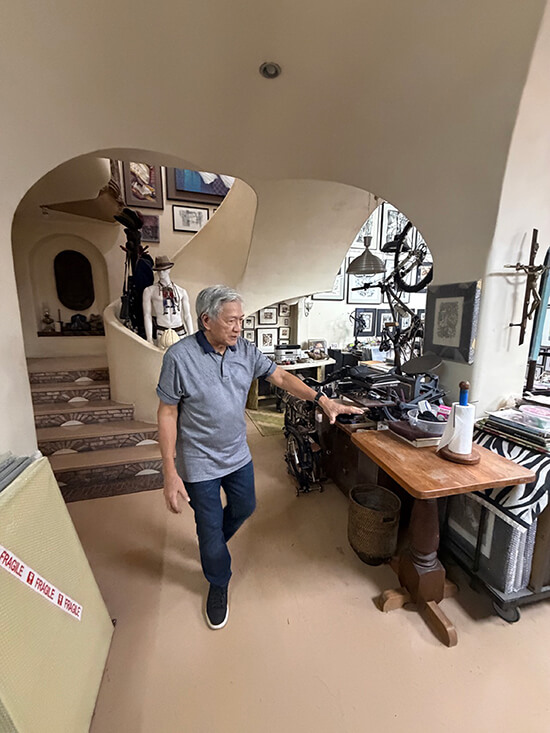
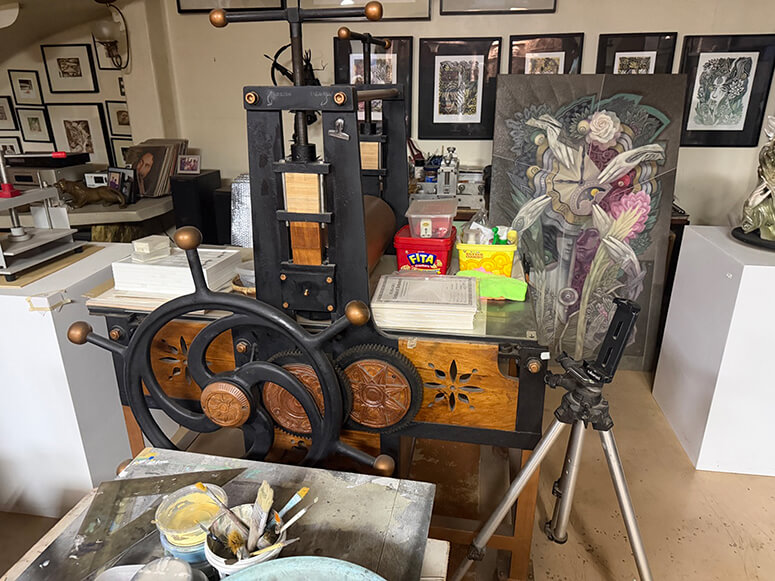
The rooms teem with paintings, prints, drawings, sculptures, and most visibly, printmaking presses in various sizes that Fil himself designed and had made over the years. Much of his equipment rolls on wheels, the better to move them around when the studio has to meet a commission, and Fil and Janos have to labor long days and nights to get the job done. Fil is amazed that clients remember him and his work from way back and return to order new pieces.
CONTINUE READING BELOW

Fil also paints and sculpts as does Janos, but it’s in printmaking—the art of producing numbered copies of a design pressed on paper in limited editions—that you know his heart truly lies. I met Fil in the early 1970s in one of my past lives as a printmaker. He had graduated from his studies at UST, and I had just come out of martial law prison—where, to pass the time, I had taken up drawing with my fellow detainee Orly Castillo, who then took me under his wing at the Philippine Association of Printmakers in Ermita. The PAP was a hotbed of production for young artists then, and I was lucky to run into the likes of Bencab and Tiny Nuyda (not to mention a pretty girl named June “Beng” Poticar, who became my wife)—and yes, Fil de la Cruz, who even then was already establishing himself as a master of one of printmaking’s most difficult techniques, mezzotint, which produces an almost velvety texture.
Perhaps because prints are relatively cheaper and come out in multiples, they’ve never quite gotten the respect they deserve, especially here in the Philippines, where the art market is enthralled by multimillion-peso paintings by the masters and by the exclusivity they exude. (Around 1974, when we were all working and hanging out at the PAP studio on Jorge Bocobo, it was a big day when a dealer came by to purchase our prints in bulk for as low as P15 per print, so she could stick them into frames she sold as décor to American servicemen in the bases.)
Fil’s come a long way from those days, and Bahaysining is a testament to his professional success, which has traveled a long arc from his youth in Bulacan and his student days at UST to further studies in New York and Paris, to over 30 solo exhibitions that have brought his prints to France, America, the former Czechoslovakia, Germany, China, Hong Kong, Korea, Spain, Belgium, and throughout the Philippines.
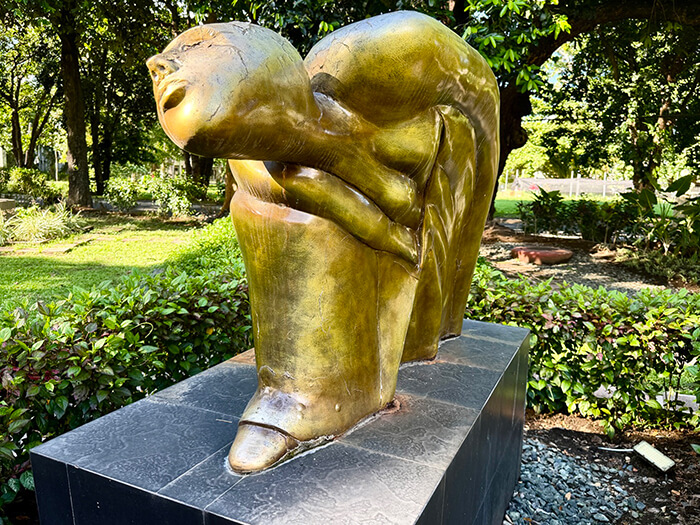
As it was a sunny weekday, the drive to Los Baños didn’t take long through the Jamboree route. Junyee had offered to take all of us out to lunch, but of course we first had to see and tour his and Tess’ three-year-old home.
To know Junyee—“Luis Enano Yee Jr.” on his birth certificate—is to understand how inseparable art and life can be in the person who, from his youth onward, has seen art not only as descriptive or decorative but liberative, rooted yet transcendent, impermanent yet memorable. Widely acknowledged to be the father of installation art in the Philippines, Junyee has always been testing and pushing the boundaries of art, unbothered by commercial trends. Whether he works with discarded wood, woven metal, or wisps of sooty smoke, Junyee seems compelled to give physical shape to our thoughts and emotions, often using outdoor space as his canvas.
Born in the South and discouraged by his father from pursuing his artistic inclinations, Junyee fled to Manila and UP, where he apprenticed with Napoleon Abueva and found support from Jose Joya—masters whom he would soon surpass in competitions. Caught in the insurgent politics of the Sixties, Junyee crafted work like his “Balag” trellis on which protesters could hang their slogans, but unlike many other artists of his time, he never let ideology dictate his insight and technique. He would later devote most of his art to environmental themes.
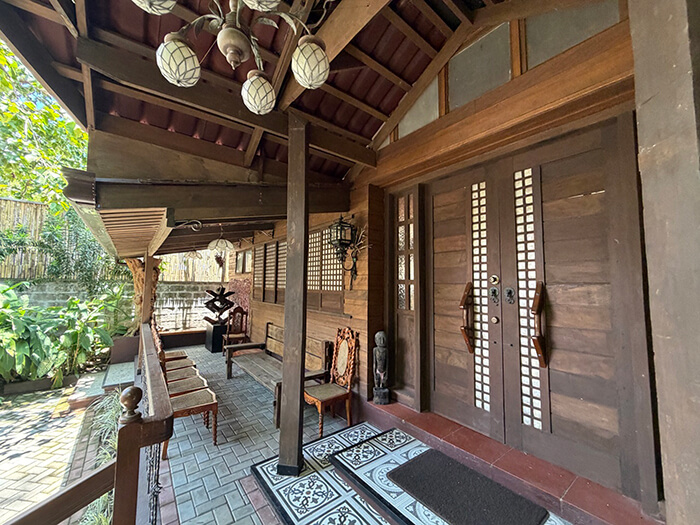
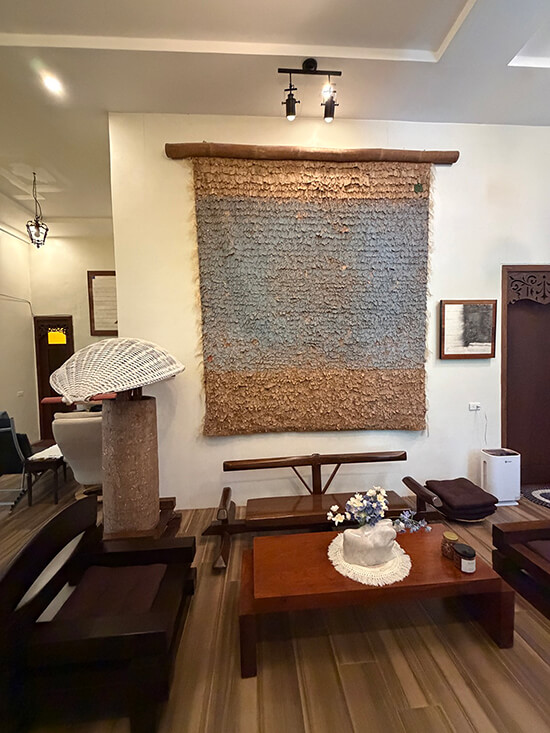
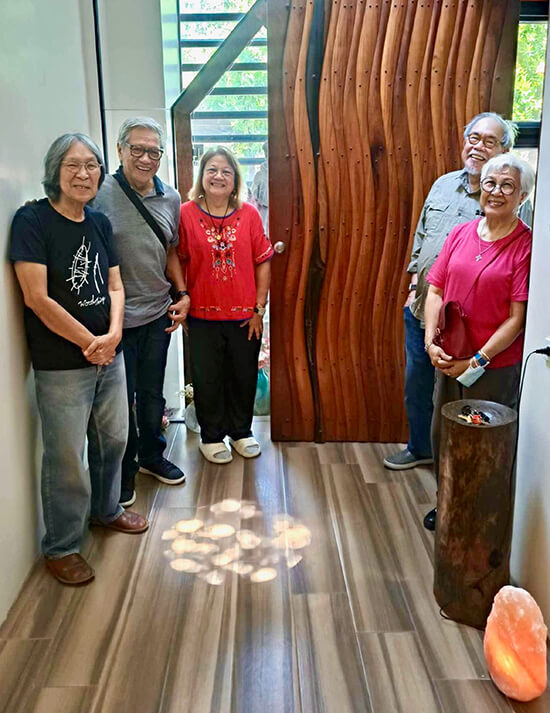
This was most evident in his new home, a modestly modern structure from the outside, nothing showy, but warm inside with wood, stone, and other natural elements, from the balayong door to the leaflike tapestry to the upturned hammock serving as a lampshade.
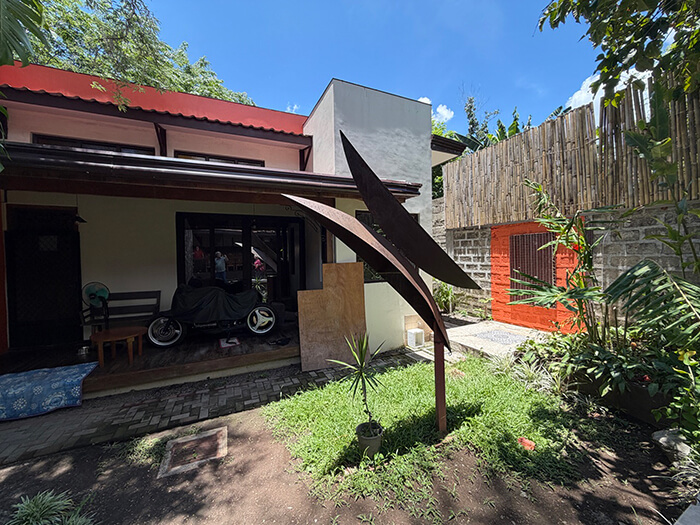
Welcoming our party, Junyee points to a blank wall and remarks with a chuckle that something big used to hang there but had to be let go of, presumably for his crushing medications. It’s one of the few times he’ll advert to his maladies, of which he—and Fil for that matter—don’t make a big thing. When Junyee learns that Fil is similarly afflicted, the men knowingly embrace and call each other “classmate.” They smile, they laugh, they speak excitedly of the work that occupies their waking hours. There’s no time to be glum. Fil and Janos keep racks of sporty bicycles at home, hanging from the ceiling; Junyee shows off a gleaming high-performance BMW motorbike which he received from a patron, adding with a chuckle that “I don’t even know how to ride one!”
Over lunch at a favorite restaurant nearby, we have an animated discussion of AI and its likely effects on art and literature. I expect them to resist, but Junyee in particular is surprisingly open to the possibilities of hybridizing art and technology, as I am. “I’ve always been a fan of science,” he says, “and when I write my memoirs, which I’ll be doing soon, I’ll make sure to include a section on how science has influenced my life and work.” But even more useful and valuable than science for both men right now is faith, and Fil and Junyee speak unabashedly of how their faith strengthens them through their trials. As an installation artist, Junyee has never worried about transience and impermanence. “Everything in this world will pass anyway,” he says.
We pay a visit to the Sculpture Garden that UP Los Baños has put up on campus to showcase some of Junyee’s most important pieces. It is an outdoor gallery of some of his finest pieces, displaying the full range of his concerns, techniques and capabilities. It’s hugely impressive, but Junyee makes it clear that he isn’t done yet. Across his home, he is constructing an art museum that he hopes will help spark a cultural renaissance in Los Baños, better known for agriculture and forestry, which Junyee’s art has also tapped into. His labors have not gone unnoticed; on top of his numerous local and international awards, Junyee will soon be receiving the highest recognition his alma mater can confer, among the worthiest of its recipients.
Neither is Fil de la Cruz resting on his laurels. He’ll be showing his newest paintings in an exhibit titled “Ephemeral & Eternal” opening next Saturday, Aug. 8, running until the 22nd at Art Camp in Greenbelt 5, Makati. “The central thesis of the exhibition revolves around the duality of existence—the fleeting ‘ephemeral’ moments of lived experience versus the ‘eternal’ span of divinity,” according to the exhibit notes. “De la Cruz does not present time as a linear progression but as a divine force, encompassing all. In this series, he treats the passage of time not with anxiety, but with a refined serenity and deep reverence, seeking to capture the precise point where the transitory nature of life intersects with the infinite.”
It’s as good a description as any of that trip to Los Baños and of our visit to these artist-friends’ homes, at this point between our shared past and the eternity that beckons to all of us.

WATCH: Save for retirement or enjoy life now? (Generations Ep. 21)
September 16, 2026
WATCH: Can you still trust someone who betrayed you? (Generations Ep. 22)
September 23, 2026
WATCH: Pixar Summer Fest adventure at Hong Kong Disneyland
August 10, 2026