Revisiting Purita Kalaw-Ledesma’s trove of art posters
You enter the De La Salle College of Saint Benilde Design and Arts Campus at the 14th floor to a mezzanine overlooking some 130 posters displayed down below on angled tables, like library periodicals. “Collecting the Moment: Art Exhibitions in Print” is literally an overview of two decades in which pioneering art critic Purita Kalaw-Ledesma amassed exhibit posters spanning 1970 to 1989—two decades, not incidentally, under the watchful eye of martial law, in which Philippine art was nonetheless marching along to its own rhythms.
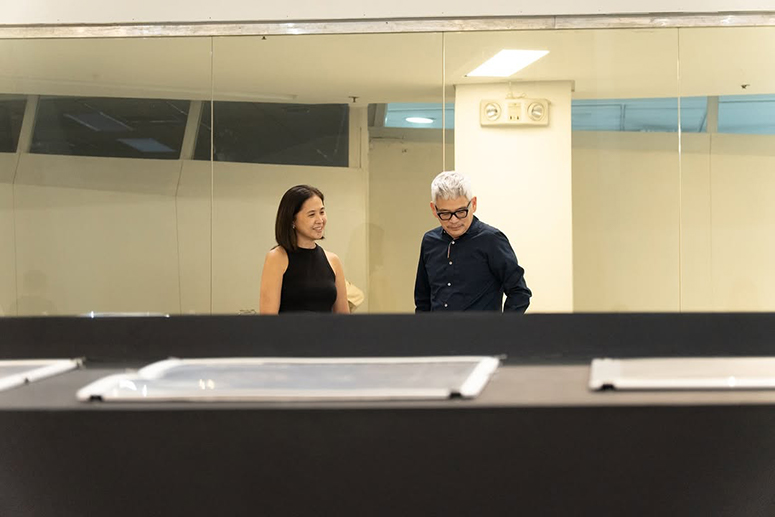
Seen from above, It’s an eye-catching macro view, and you spot Dindin Araneta, current director of the Saint Benilde Center for Campus Exhibitions, as well as Gabbie Lichauco, also a Benilde instructor and the designer of the exhibit’s unique look. Originally, “We were thinking of hanging the posters around the room,” he says, but instead hit on this chronological journey: you thread your way through the art posters set upon slightly angled, multileveled platforms. The multi-leveled tables remind me of Lichauco’s work with Rita Nazareno for this year’s Art Fair at Circuit Makati, which just concluded.
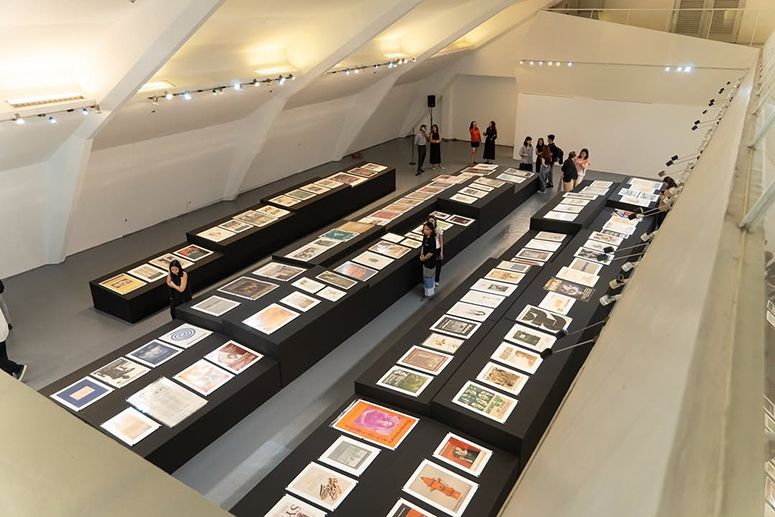
“Collecting the Moment: Art Exhibitions in Print” is a gift to Saint Benilde students, drawn from the archives collection of Purita Kalaw-Ledesma, many of the pieces donated to Kalaw-Ledesma Foundation Inc. They don’t get a public viewing very often, says Ada Ledesma-Mabilangan, trustee of the Kalaw-Ledesma Foundation. “She kept stacks and stacks of them in a bodega in her old house in Makati,” she recalls. “But they didn’t stay hidden—she would bring them out as part of her early work for Art Foundation. But except for a few posters here and there, they’ve never been exhibited in their entirety.”
Now it’s a chance to dive back into history. Not just a who’s who guide to the Philippine art scene of those decades—with posters promoting shows by Napoleon Abueva, Juvenal Sanso, Jaime de Guzman, Eduardo Castrillo, BenCab, Ang Kiukok, Anita Magsaysay-Ho; fliers for Amorsolo and Legaspi retrospectives, dance performances at CCP, group shows, print exhibits, a 1975 exhibit by a young upcoming Betsy Westendorp, Malang and Hernando Ocampo. It’s not just the names, but the history implied in the fonts, the typefaces and design strategies, with all the eye-popping energy on display. As Ada acknowledges: “There is always a team of creatives quietly toiling in the background to support the great masterpieces that we find on gallery and museum walls. We don’t know the names of most of these creatives, we don’t know who designed these posters, but today we pay them homage.”
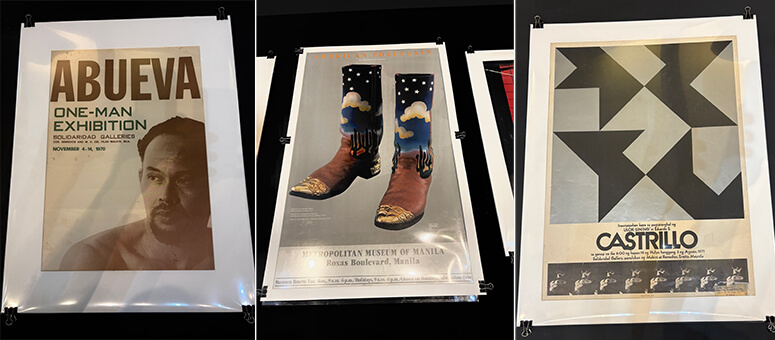
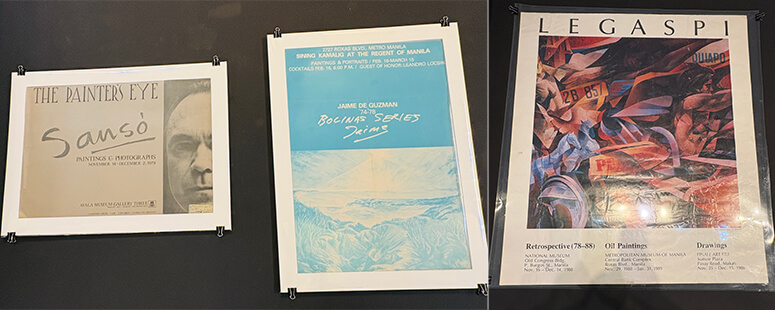
Purita Kalaw-Ledesma was not only an author—we see her volumes on art and even a cookbook on display near the entrance—buta magpie collector of clippings and materials from the scene she investigated and described. We’ve scanned her scrapbooks on display at the PKL Foundation Center in Makati, but this is something different.
“Many wonder how our founder came to have such a collection,” says Ada in her opening remarks. “It’s not something fine art collectors usually do. She didn’t procure these posters in bulk. Instead, she collected them one by one. With each exhibit she visited, she took home a poster as a memento of sorts.”
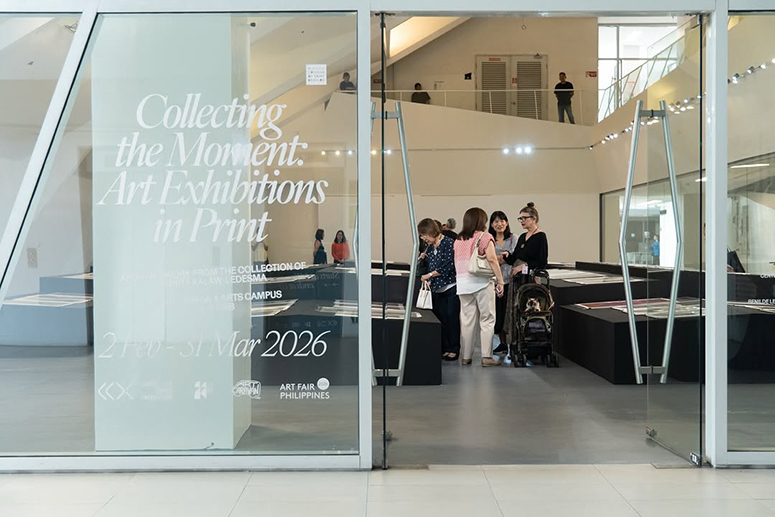
While her poster collection can seem like “simple souvenirs of past art events,” as Ada says, “Purita saw them as much more than that: as something worth keeping as a visual art guide of the era, much like the massive volume of newspaper and magazine clippings she kept in her now-famous scrapbooks.” Lichauco also notes the exhibit is of keen interest to design students here, who can still absorb the design and layout tactics of previous eras that have mostly aged very well.
“It’s interesting to see how they were like,” says Lichauco of the designs. “They all had their own narratives. It’s not just about the art, it’s more about graphic design.” The archival aspect appealed to Gabbie, as well as the opportunity to use the space in a different way.
I do find it odd that little indication of martial law can be discerned from these posters, almost as though art was unfolding in a sealed vacuum at the time. Maybe it’s not so hard to understand. I’m reminded that a lot of these advertised exhibits were held in CCP, a Marcos-friendly venue, as well as commercial malls at the time, so art-as-protest was not exactly a priority. Indeed, the program notes from Anna Rosete tell us: “During the 1970s, visual culture often conveyed ideals of order, refinement, and discipline under martial law. In the 1980s, as the country moved toward democracy following EDSA, these visual languages became more varied and open, expressing a broader and more democratic cultural identity.”
Any walk back through the past is instructive, for what it shows us of the times, as well as what it suggests about what was happening at the margins.
* * *
“Collecting the Moment: Art Exhibitions in Print” is part of Art Fair Philippines 10 Days of Art and is open to the public on the 12th and 14th floors of the Design and Arts (D+A) Campus until March 31