

Finding beauty and humor in ‘A Chorus Line’
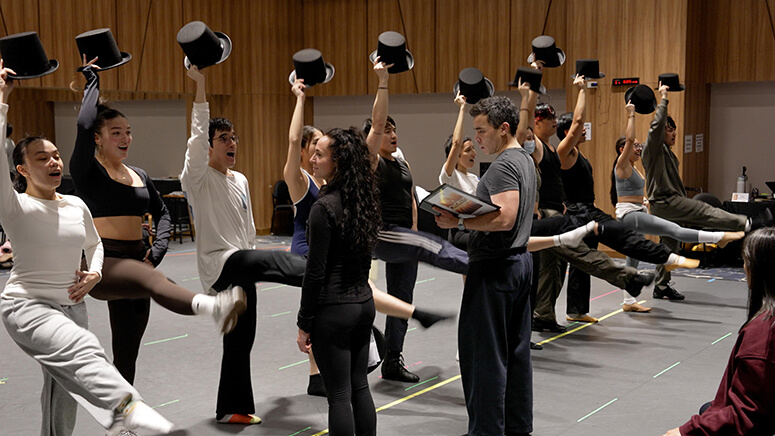
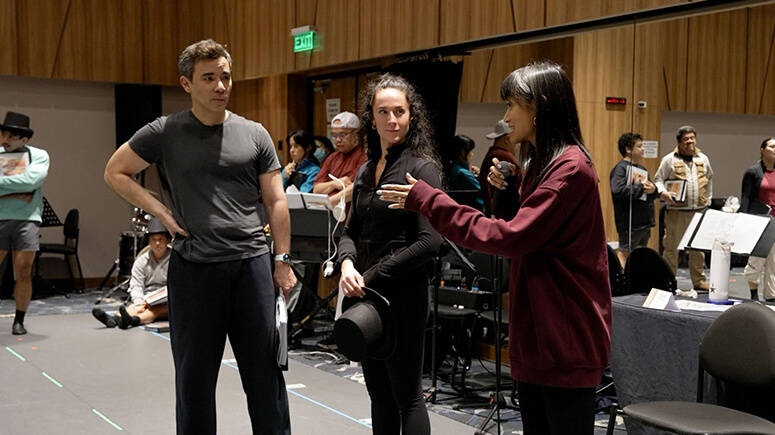
It was a spellbinding experience at rehearsals for A Chorus Line at Samsung Performing Arts Theater to watch the pivotal The Music and the Mirror scene, where Conrad Ricamora, as director Zach, confronts Lissa De Guzman as Cassie, his former lover, for auditioning for the chorus when she had already been a soloist before they broke up. This is her moment—pleading for the chance to do what she loves best: perform—in a stirring rendition of the iconic song-and-dance number that left everyone, including the ensemble, in awe before breaking into wild applause.
The top-tier dancers, selected from key cities in the Philippines and New York, were also witnessing the scene for the first time, making it a profound moment of admiration and support among fellow artists—perfectly summing up what this meta-theatrical piece is all about. This reverence and dedication to the craft have driven them, along with the creative and production team, over the past months to create a singular version of this multi-Tony Award-winning musical, which recently celebrated its 50th anniversary.

Emmy Award-winning director and choreographer Karla Puno-Garcia, together with Broadway stars Conrad Ricamora and Lissa De Guzman, invite us into their world with reflections on this treasured theater piece and how they are reconceiving it for modern times.
THE PHILIPPINE STAR: Karla, how do you balance honoring Michael Bennett’s original choreography and vision with creating a new, relevant production?

Karlapuno-Garcia: Baayork Lee generously shared with me the key ideas behind the choreography and storytelling, which gave me a strong starting point. From there, I followed my instincts choreographically—my sensitivity to musicality, shapes and composition, and the different textures of movement based on the tone of each number. This is the first time most of these actors have performed the material, so there is a built-in freshness. I’m also inspired by Bennett’s exploration of individuality within the ensemble, and I hope to carry that spirit forward.
Conrad and Lissa, what does it mean to step into roles that have been played by so many iconic performers since 1975?
Conrad Ricamora: It means the world to me because I am only at this point in my life now, at this age, able to play a character like Zach, who has decades of experience under his belt. In the last two or three years, I’ve often been the most experienced person in the rehearsal room. So being able to play Zach now, I feel well-equipped because of all my years in the entertainment industry.
Lissa De Guzman: Stepping into Cassie feels incredibly humbling because she carries such a powerful legacy. The responsibility isn’t to imitate what has come before, but to honor that history while telling her story honestly through my own experience. What moves me most about Cassie is her courage—she’s a woman willing to stand in front of a room and say, “This is who I am. Please let me dance.” That kind of vulnerability is timeless, and it’s a privilege to step into her shoes.
ACL is a show about dancers. How do you handle the physical and emotional stamina required?
Conrad: Zach isn’t a dancer; he’s a retired dancer. For me, it’s mostly about emotional stamina. It’s allowing everything I’ve gone through in the entertainment industry—at this point in my career—to sit just under the surface of my skin every night, and then letting it go at the end of the show. I think it’s going to be such a gift as an actor.
Lissa: Stamina in this show comes down to discipline, preparation, and taking care of both the body and the mind. It means consistent conditioning, proper warm-ups, recovery, and really listening to what your body needs.
Emotionally, what supports that stamina is the ensemble nature of the piece. Because we’re telling this story together, there’s a shared focus and trust onstage that gives you energy rather than draining it. At the end of the day, the show is about dancers who refuse to give up on what they love, and that passion naturally fuels the endurance needed to tell the story every night.
The show centers on the anxiety of auditioning. How do you create a safe rehearsal environment while mirroring the tension of a high-stakes audition?
Karla: We’ve had meaningful discussions about our own personal experiences. The actors have been very generous in sharing, and in doing so, they’re creating their own access to these tense circumstances. I aim to create a space where they feel safe to express and examine those emotions through their art.
What is the most memorable lesson you’ve learned from real-life auditions that you bring to your roles?
Conrad: It’s really the ups and downs of my career that I bring to Zach. There have been times I’ve gotten very close to roles and didn’t get them, and other times when I landed incredible roles. But whether I win or lose, I’ve held onto my love for the work. Zach has that same love—and even obsession—for his craft. That’s where I meet him.
Lissa: Auditions aren’t about proving you’re perfect—they’re about showing who you are. The moments that changed my career were when I stopped trying to guess what the people behind the table wanted and instead committed fully to honest storytelling. When Cassie returns to New York after pursuing stardom, she’s in her rawest form. I approach her audition not as a performance seeking approval, but as a moment of real human honesty. That’s what makes her story powerful.
Karla, what drew you to cast Conrad and Lissa?
Karla: I saw Conrad in Here Lies Love and was deeply moved by his performance. He has the ability to hold the audience in the palm of his hand. Because Zach is often heard but not seen in A Chorus Line, the actor must command the room while still connecting with everyone in it.
Lissa’s trajectory speaks for itself. She has been an ensemble member and later played Elphaba in Wicked for two years. She understands both the glamorous and grueling sides of this life—not to mention her undeniable triple-threat ability and calm leadership.
The Music and the Mirror is a legendary, high-stakes solo. How do you stage it to feel deeply personal?
Karla: Lissa and I have been collaborating on this solo for a couple of months, and it continues to evolve each day. We experiment with different choices and see how they heighten her emotion—from the song to the dance, back to the song, then the dance again. I want her to feel empowered by the movement and to take ownership of her version. Each time she runs it, she soars higher than before. I can’t wait for audiences to watch her fly.
Lissa, how do you balance vulnerability and technical precision?
Lissa: For me, technique and emotion aren’t separate—the dance is her emotional release. I first build physical precision so my body feels secure in the choreography. Once that foundation is there, I can let go and allow the desperation and heart to come through. It becomes a process of letting technique and vulnerability grow together. Cassie isn’t just trying to impress—she’s fighting for her identity. Holding onto that truth inspires me to keep working toward that balance every time I step into the studio.
Conrad, is Zach a villain, mentor, visionary, or simply doing his job?
Conrad: I don’t see him as a villain. I see him doing what’s necessary to prepare these dancers for the pressure of performing on Broadway eight times a week. He’s under immense pressure to find not only the best dancers, but the best actors. The only way to replicate that pressure is to ask tough personal questions and push them technically. I think back to directors early in my career who pushed me hard—I’m grateful to them now, even if it was difficult then. I wouldn’t be the actor I am without them.
The opening number I Hope I Get It is chaotic. How do you choreograph that precision?
Karla: This number is about competing. These dancers are fighting for their livelihood. They need this job to pay rent. As long as everyone connects to that urgency, the chaotic precision emerges naturally. Everyone’s reason may differ, but the fight is the same.
How do you balance high-energy numbers and intimate monologues?
Karla: The show flows at a strong emotional pace. After diving deep into trauma, we release it through play and humor, such as in Gimme the Ball from Montage 4. Those shifts help create balance. Exploring where each monologue sits emotionally within the actor makes those moments accessible.
Is the final kickline in One triumphant or critical?
Karla: I see it as a celebration—honoring their pride as chorus members and the sacrifices they make to earn their place. We spend a lot of time cleaning details of movement and body position, but unison dancing is also about shared energy. When they truly feel each other and move as one, there’s an incredible shared sense of accomplishment.
How does your father’s musical influence shape your approach?
Karla: My father’s musical ear is a huge reason I’m sensitive to tone and how music makes me feel—and move. His compositions were poignant and hopeful. He could hear technical nuances after one listen. I can’t help but highlight those qualities in ACL. He would be so proud to see a room full of Filipinos performing this show.
How is working with an all-Filipino cast different from Broadway?
Karla: It feels beautifully familiar—like family. It allows me to direct with a level of comfort I don’t take for granted. The pride I feel for this cast is immeasurable.
Conrad: There’s a deep familiarity and comfort performing with an all-Filipino cast. It feels special.
Lissa: Standing in a line with an all-Filipino cast is extraordinary. From the first rehearsal, there was a sense of family and support that can’t be faked—it’s instinctive. The humor, talent, work ethic, and care create a bond that makes even the toughest days possible. It’s an experience I’ll carry forever.
What is the most misunderstood aspect of A Chorus Line today?
Karla: Some may see ensemble members as thankless nobodies, but the chorus is the backbone of any musical.
Conrad: Modern audiences might think ACL is just flashy dancing, but it’s really about deep personal journeys.
Lissa: At its core, ACL is about identity, survival, and the need to be chosen. The dance is the vehicle—the story is about confronting fear and self-worth. That’s what makes it timeless.
***
Theatre Group Asia’s A Chorus Line runs from March 12 to 29 at Samsung Performing Arts Theater. Follow @theatregroupasia and @cpatofficial.

WATCH: Do you still believe in marriage? (Generations Ep. 17)
August 19, 2026