

Cultural quid pro quo in the work of Leslie de Chavez
There’s a determined effort to restage and “re-present” historical templates in the work of Leslie de Chavez that goes beyond mere recontextualizing. It’s more granular, as though the artist is seeking to reduce certain encoded meanings to a subatomic powder, polish them into something familiar yet new, reflective, and eerily mirror-like.
For “Halik sa Lupa (A Kiss on the Ground),” a show that ran last October in Singapore, the artist understood well the context of his native Lucban, its Pahiyas harvest festival, Holy Week rites, and parades of Higantes (giants); by stripping away the accepted religious meanings and incorporating local participation from the festival streets, the rice fields and church pews, everything was transformed—familiar yet no longer quite recognizable.
De Chavez sat down with writer-researcher Eileen Legaspi-Ramirez at Gajah Gallery Manila to discuss the local homecoming of that show.
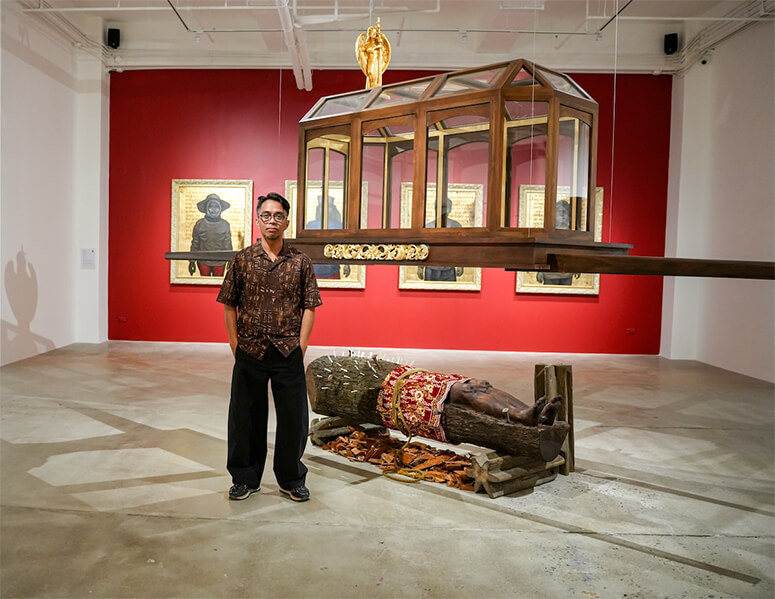
The artist credits Singapore curator Joyce Toh for “really digging into your ideas, asking you important questions to help you shape the work” when he was looking to Lucban for rituals that furthered his artistic strategies: “I look at it as, this is not just about celebrations and the expression of faith, this could be used to discuss contemporary, sociopolitical issues and how these things are rooted in these continuing rituals that we practice.”
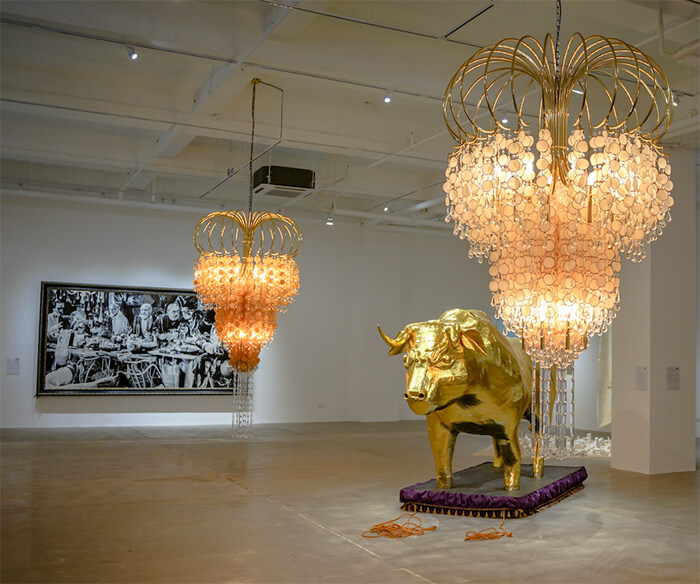
De Chavez’s work is rooted in the culture of Lucban, and it relies on a deliberate selection of materials, such as the rice-as-capiz and dried-pig-intestines-as-gems dangling from the CCP-modeled chandeliers (Hiyas: Imelda and Hiyas: Gloria) now occupying Gajah Gallery.
Hiyas, after all, means “gem,” and the Pahiyas festival also relies on adornment to make things seem more precious, elevated by artifice: “I find it really interesting, asking how can you alter this kind of form and then suddenly draw attention to it, how can you stretch it and change the conversation.”
CONTINUE READING BELOW

Then there’s Pagpag: Relics of Sanctified Bulimia. Above a field of everyday objects wrapped in plaster of Paris, there’s a floaty layer of silk, stained with desiccated pork intestine. The use of such earthbound materials forces our attention on the dichotomy of rich and poor, high and low, simplicity and decadence. At the very least, such details get your attention.
Incorporating the corporeal, let’s say, is central to de Chavez’s examination of elevated cultural symbols. He even plans a Hiyas: Leni chandelier that will utilize piña, a material that is “more precious.”
Center stage is a gilded papier-mâché bull. Ginintuang Pangitain (Gilded Phantasm) not only involved the community in crafting a huge toro covered in gold leaf, it adds a looped video nearby documenting the process. “I wanted to bring back that kind of access to creativity to the ordinary people because when you parade the giants, the optics are very colonial and very feudal: you have giants running after the locals and then on the periphery are locals watching the display of power of the rich people in that small town,” he says.
His parade of pieces here becomes an extension of the Pahiyas rituals back home, re-staged in the gallery as something no less mysterious. For Ang Alindog ng Hiwaga Para sa Kaluwalhatian ng Kaluluwa (The Allure of Mystery for the Splendor of the Soul), de Chavez presents the Senyor (Christ) wooden figure that is borne by the devout with rolled papers (prayers) inserted where nails would be. (This is no artistic flourish; the ritual actually occurs in Lucban.)
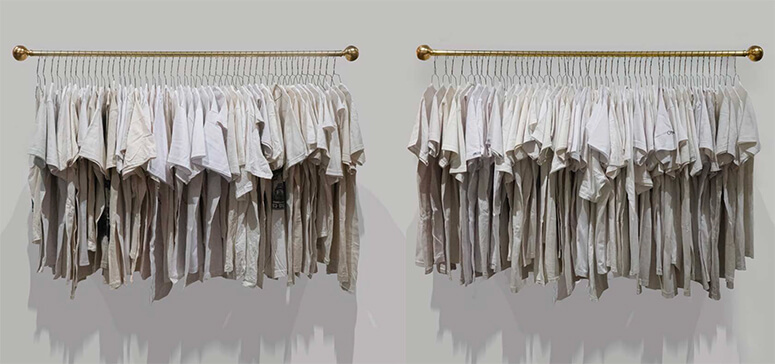
Those devout carriers are also referenced in a rack of worn T-shirts that de Chavez sourced from local participants for a piece called Lango (Intoxicated).
Legaspi-Ramirez asked about the “transaction” of giving his own designed shirts to devotees in exchange for their used garments, which are then displayed in the art piece.
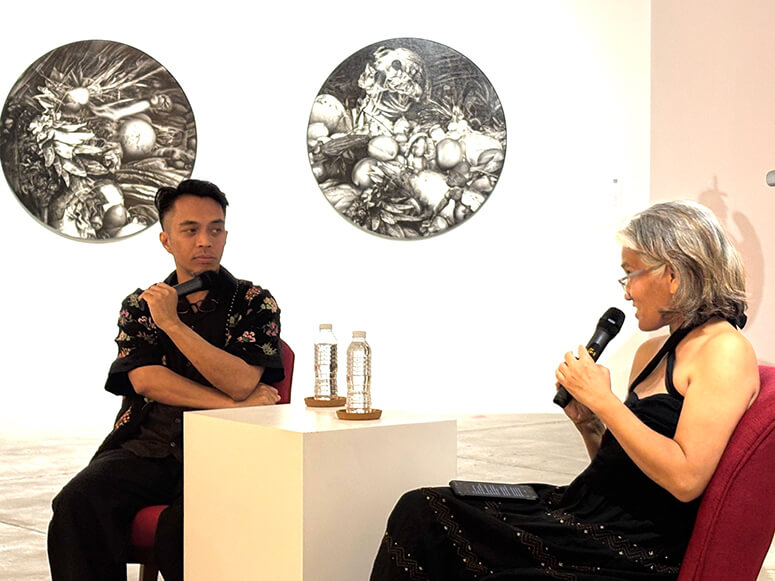
The project started with promotion, he says: an online open call for shirt exchanges. “It involved sourcing through social media—that was essential, if you’re obsessed with the current condition of the shirts.” He was careful to contextualize what the project was all about—“like an advance party to explain it”—noting there was supportive “word of mouth” in the small town. In other contexts, the use of solicited, used garment could seem… a bit exploitative, perhaps?
De Chavez also spoke of Project Space Pilipinas—his artist-run initiative in Lucban, where he tries to encourage mentees not to be limited by style, but to think of art as about ideas, expression, communication. The focus on local materials is part of that journey.
Yet de Chavez has lately adopted AI in his canvas pieces through a process of manipulating his own photos on Photoshop, using its regenerative functions. “It’s not just prompts or pulling from the internet, you have to command and train it to distort,” stretching the ideas into new forms. “I can’t even call it AI art, because I use it as a tool” to develop other layers in the work.
For Maglilinang (The Tillers): Portraits, he photographed four local rice farmers, who are ID’d by name, and asked AI to generate poem texts and narratives about each one, then placed that text in Gothic font on a gold-gilded field behind. “It’s about the idea of portraiture. I use the texts as textures, supporting ideas.”
For the black-and-white canvas La Paz Supper (The Last Feast), de Chavez refed online Last Supper images through AI, altering the results into eerie, multi-generated translations interpolated by technology.
De Chavez has long advocated a “recovery” of encoded cultural texts, suggesting that Filipinos should decide what all these historical templates mean, or create their own meanings. By involving the local community in, say, the creation of the golden bull, “you allow people to take charge and make their own ideas of what Higante should be. So they apply the gold paint, metaphorically conveying that this is something precious, this kind of narrative. So you’re giving them the agency.” Most of his work is guided by questions of interactivity and intention: What is art? What is it saying? In doing so, says de Chavez, “You’re activating another inquiry, reminding people that we should take charge of our own culture.”
* * *
Halik sa Lupa (A Kiss on the Ground) ran at Gajah Gallery Manila, 125 Pioneer St., Mandaluyong, until March 8.

WATCH: LGBTQIA+ people with unlikely professions
June 28, 2026
WATCH: Is Philippine cinema still thriving? (Generations Ep. 19)
September 2, 2026