

Toto Sicangco, our last great theater designer
Most people know that I apprenticed under National Artist Badong Bernal, but not many know that Toto Sicangco was also one of my mentors. “Eduardo,” as he was known in New York, was a prolific set and costume designer. He designed for opera, ballet, film, musical revues, circuses, and all sorts of extravaganzas in the US. However, he is not well known in his home country, the Philippines, primarily because he spent much of his working life (47 years) in New York.
In 1976, a young Toto had just finished working on Ballet Philippines’ La Carnaval and Act 2 of the Nutcracker under the guidance of his former teacher and mentor, Badong. He then left Manila to pursue further studies in design at New York University’s Tisch School of the Arts under the tutelage of the legendary American designer Oliver Smith.
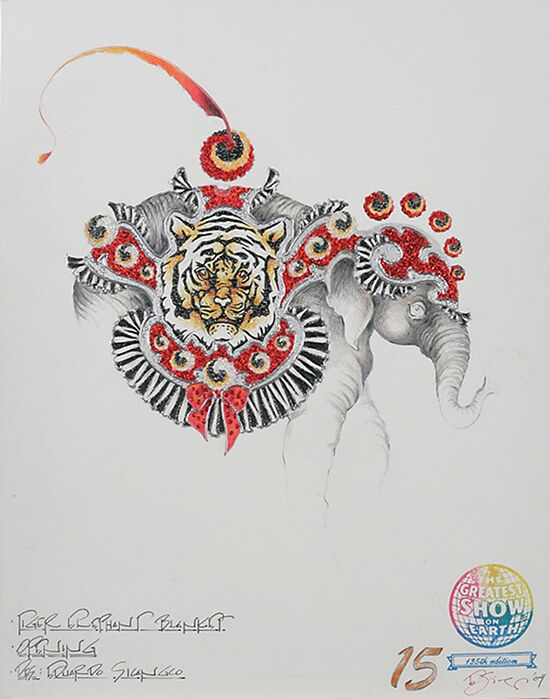
Along with Butch Lengson—another Filipino and former apprentice of Badong—Toto penetrated the live entertainment industry in the US. His innate ability to conjure magical scenery and storytelling was perfectly aligned with the ethos of Feld Entertainment, which produced large-scale ice spectaculars and circuses. Soon after, Toto was designing for Disney on Ice, The Greatest Show on Earth!, Ringling Bros. and Barnum & Bailey, and spectacles at Radio City Music Hall.
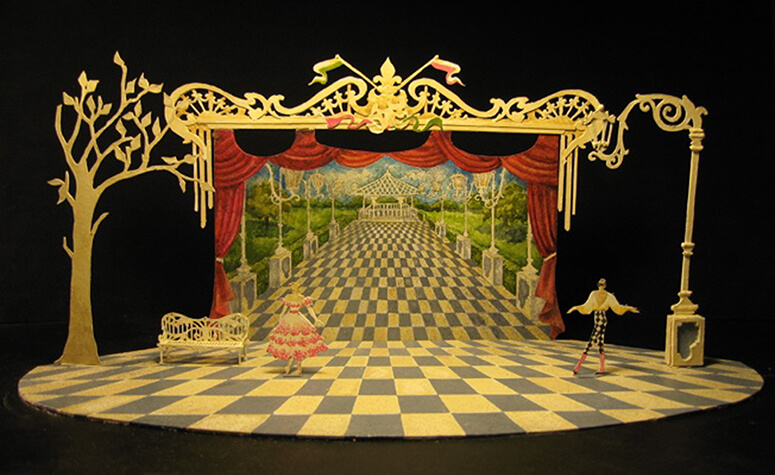
Even while working in these more popular forms of entertainment, Toto continued to design for the more classical genres of ballet and opera in America. His meticulous attention to costume and décor was especially suited to the proscenium stage—a theatrical form in which the audience watches the performance from one side, framed by the proscenium arch or portal. He delighted in lavishing detail on the “false portals,” those successive frames that create the illusion of depth. Whether Baroque, Rococo, Art Nouveau, or Art Deco, each style seemed to flow effortlessly from Toto’s pencil.
Meticulous renderings and scale models
With the rise of AI-assisted design, hand-drawn and hand-painted costume renderings are becoming increasingly rare. As recently as the mid-1990s, however, everything was still done by hand. At NYU, Costume Design students colored their sketches with real brushes, pencils, and pens. Beyond rendering classes, aspiring costume designers also studied figure drawing by sketching live models. Meanwhile, Set Designers spent hours on the streets of New York drawing buildings and monuments with China markers, which left no room for erasure or correction. In short, design once demanded painstaking effort to solve problems of proportion and form—whereas today, the process is increasingly shifting toward producing a desired effect merely through a series of prompts.
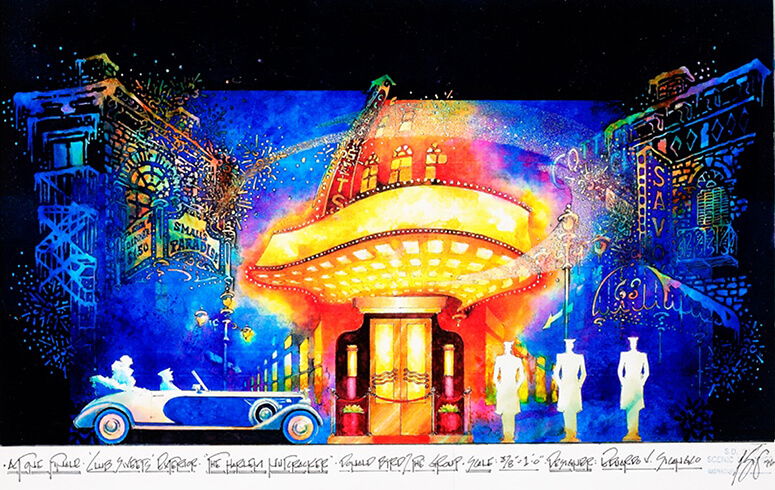
In this context, Toto’s drawings feel even more significant. Their value lies not only in being made by hand, but in how they translate a human vision directly onto paper. At a time when many designers can no longer render designs without the aid of technology, Toto’s drawings represent a peak in human creativity and skill.
CONTINUE READING BELOW

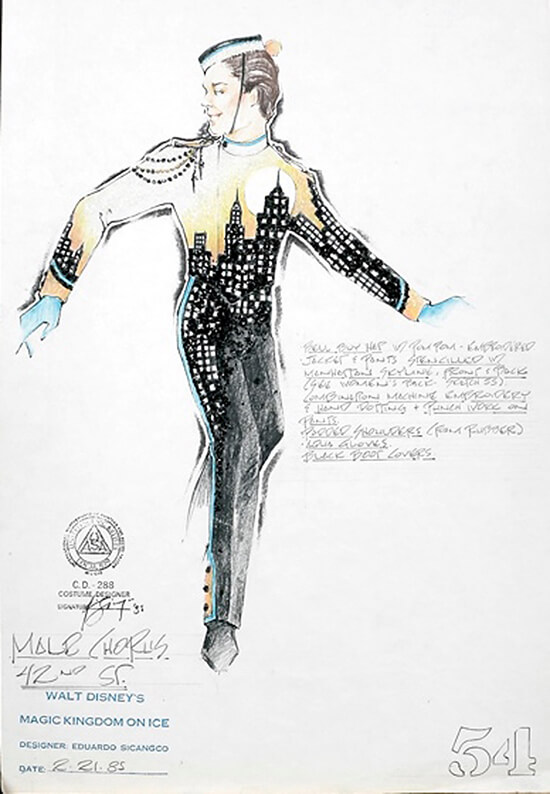
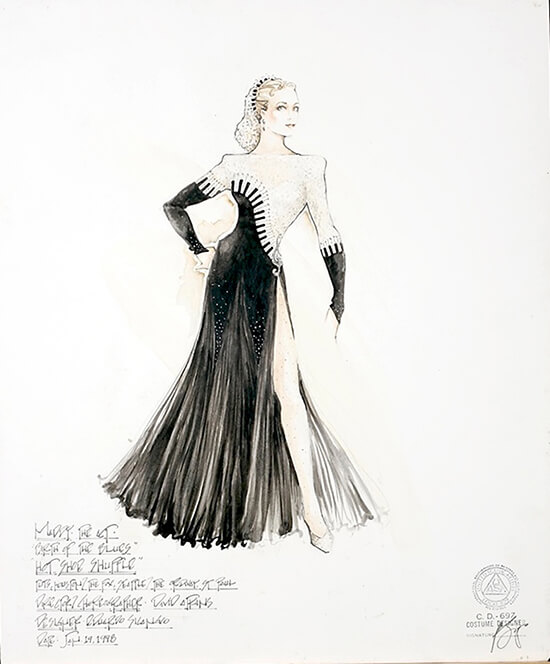
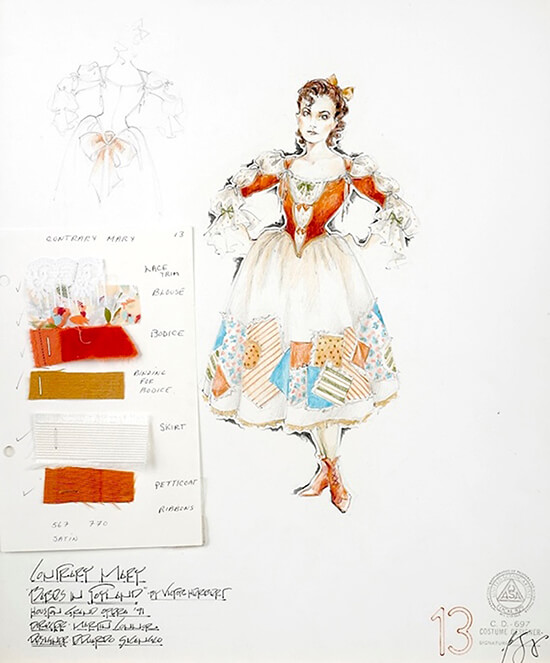
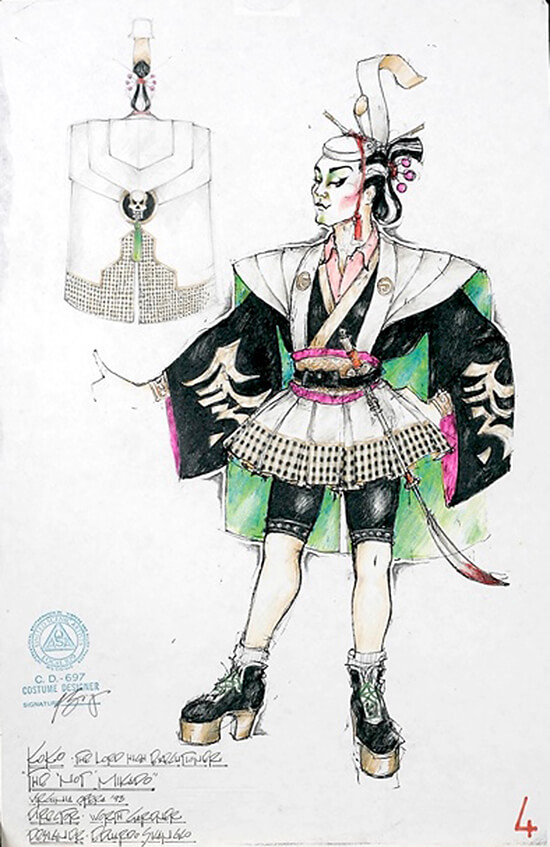
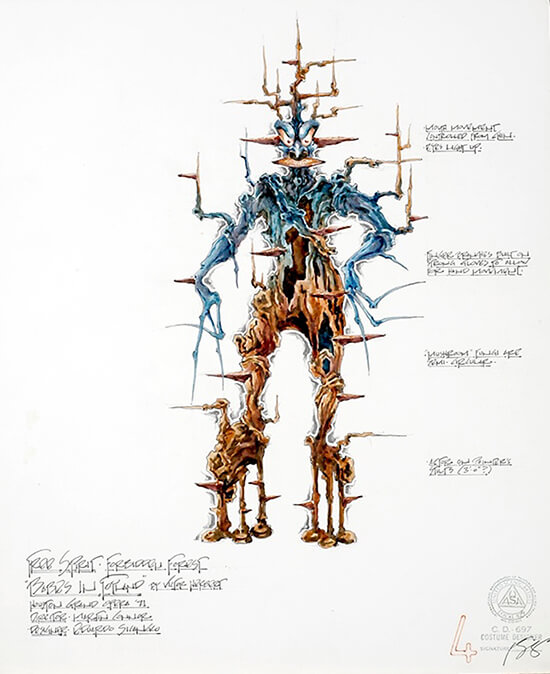
They also convey information that goes beyond choices of dress silhouettes and textiles. A Toto Sicangco rendering communicates character and personality much as a director shapes casting choices. Costume shops also valued the comprehensiveness of his drawings. His handwritten instructions on materials and construction leave little room for reinterpretation.
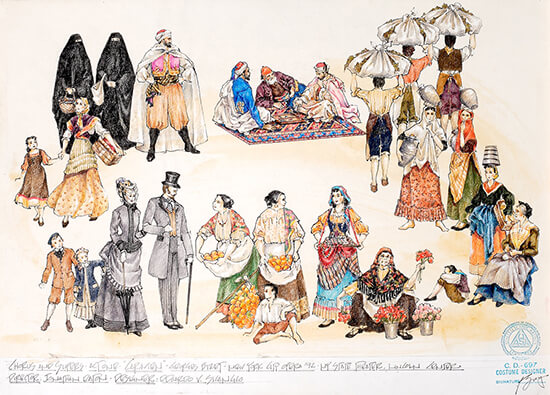
At the turn of the millennium, computer drafting entered NYU’s design curriculum, though students were still required to study hand drafting under Leigh Rand. Today, digital drafting and rendering are industry standards. Yet however precise CAD may be, it still lacks the clarity of intent and personality of hand drafting. Looking at Toto’s hand-drafted plans today, one still sees why machines cannot fully replace human skill. His drawings do more than convey measurements: their lines suggest ease or tension, fluidity or rigidity. They also carry an emotional charge —an essential guide for artisans translating the work into three-dimensional form.
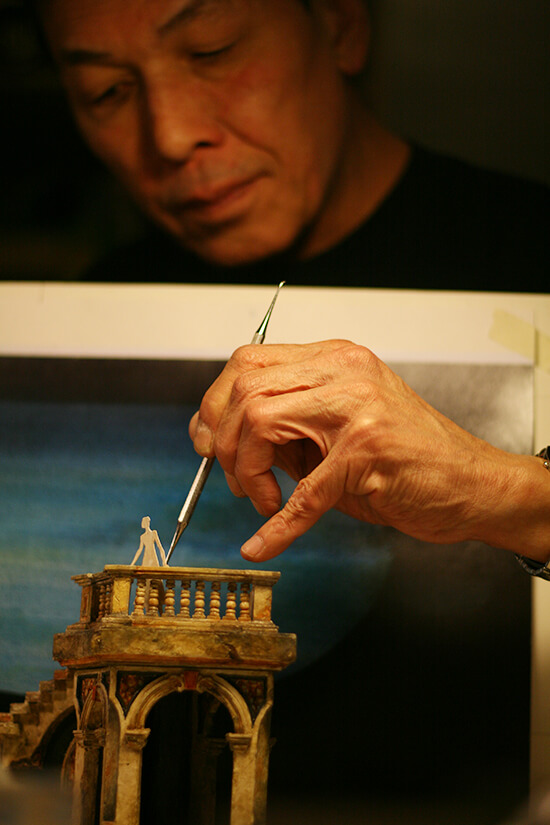
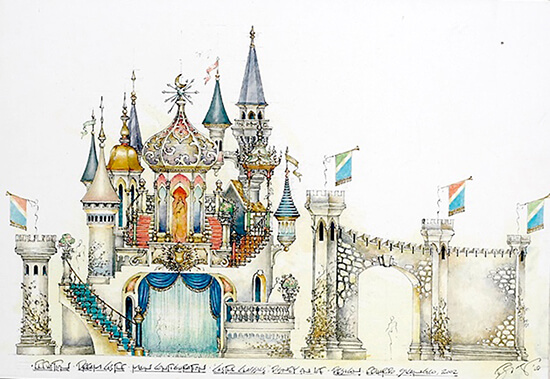
While the industry increasingly relies on 3D printing and glossy digital renderings, Toto’s scale models, or “maquettes,” were built and painted by hand. Every miniature stone, cornice, tile, vine and lamp reflected the care and craftsmanship he brought to his work. Beyond their seductive beauty, these maquettes also served a practical purpose. Their painted surfaces and textures functioned as precise “paint elevations”—scaled guides for the finishes of set pieces and backdrops.
The ‘grand’ tradition
Until the late 1990s, NYU’s Design Department was shaped by two opposing schools of thought. One, led by the formidable John Conklin, embraced modernity and more experimental approaches to staging. The other, led by the great Oliver Smith, upheld classicism and the “grand” tradition of design. Toto inherited that latter tradition when he became NYU’s Master Teacher of Design, a role he held for eight years.
By the time I became Toto’s student in 2000, the balance had already begun to shift. More students, myself included, were drawn to more experimental forms of design. Although we still created traditional Rococo rooms as classroom exercises—essential training in design principles—we did not necessarily aspire to work in that style.
One morning, as Toto was critiquing our scale models, John joined the Set Design class after a brief introduction from the department chair. After that first visit, he became a recurring presence in Toto’s classroom, offering his own often “confounding” opinions in contrast to Toto’s more conventional approach to design.
I did not fully grasp the situation until 10 years later. While we were mounting Toto’s retrospective at the Ayala Museum, he confided in me about the awkwardness of that moment in 2000 and how deeply it had unsettled him. The fact that it happened just as I had finally become his student made it more uncomfortable for him. It affected him for some time, but with his characteristic tenacity, he eventually moved on and later became a beloved professor at the University of North Carolina School of the Arts.
A young American designer once told me that he considered Eduardo one of the last great designers to work in the “grand tradition” of theater. He said there was much to learn from Toto and from the disappearing breed of artists he represented, and that we were privileged to have been exposed to his methods.
Design for showbiz
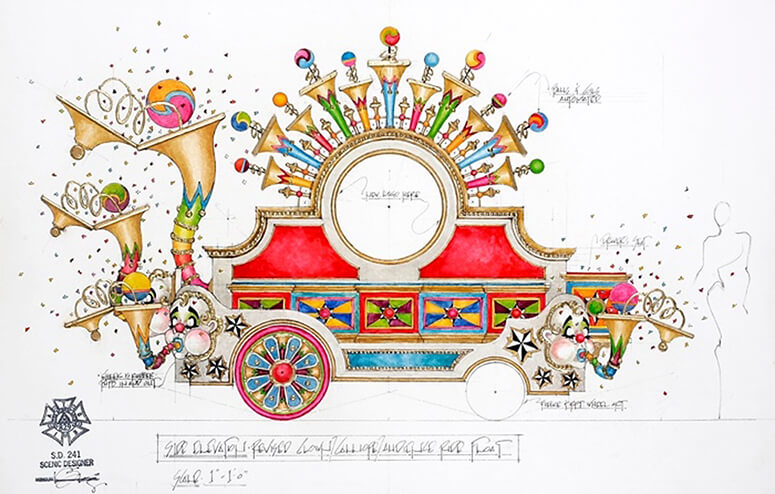
“It’s called show business; not show art,” Toto thundered back at critics.
He believed entertainment design should, above all, entertain—and saw nothing wrong in that purpose. He bristled at those who dismissed work meant simply to delight audiences, including his circuses and industrial shows. I suspect this was the same frustration he felt toward “elitists” who treated theater design exclusively as a higher calling, offered up, in their view, “as a sacrifice for the Temple of Art.”
As a young theater designer trying to make ends meet in the early 2000s, I took on industrial shows, or what we locally called “corporate events.” Our mentor Badong disapproved of this shift toward the more commercial side of design and made his reservations clear. I, too, felt a certain discomfort in accepting lucrative work that seemed to compromise my “higher” calling. Toto, however, was quick to insist that every kind of design deserved the same standard of excellence, whether for a play or a car launch.
As for the indignities such work sometimes required, “that’s why you charge insult money,” he quipped, raising an eyebrow.
He was equally unapologetic about his demands on producers. Whenever he was in Manila, he stayed at the Manila Pen. “I feel like the whole lobby of the Pen is my living room,” he would say, with characteristic Negrense panache. He also insisted on an open tab. In a production culture where biscuits and 3-in-1 coffee were the norm, his requirements left me stunned… and delightfully amused.
Toto also believed a design teacher should “demystify” the creative process, unlike educators who make it seem like a rarefied profession. Yet in many ways, his own talent truly was exceptional. Few today can draw, paint and sculpt with such mastery—or with the same flair. He possessed all of those gifts and could articulate his ideas with equal skill.
Homecomings
In the mid-1970s, Badong gathered his first group of apprentices: Toto, Winky Maramba, who later became a graphic designer in Switzerland, and Rafael del Casal, who went on to become a sculptor and painter.
While they were working on the sets for Ballet Philippines’ Rajah Sulayman at the CCP loading bay, Rafael approached Toto, who was carving a chest with his usual maximalist flair. “Aren’t you overdoing it?” Rafael commented. Toto was not amused!
However, the line later became a running joke between Toto and Butch Lengson during their halcyon days in New York. Years later, at Butch’s deathbed during the height of the AIDS pandemic, as Butch said his final goodbye, Toto quipped, “Aren’t you overdoing it?” It was quintessential Toto: wit delivered with perfect timing, capable of either diffusing or sharpening the tension of a moment.
On rare occasions, Toto returned to the Philippines to work on local productions. In 1997, when his sister Cecil Sicangco danced Juliet in Ballet Philippines’ Romeo and Juliet, he agreed to design the sets and her costume. He always had a soft spot for “Cecilia” and could not refuse her. The result was one of Ballet Philippines’ most beautiful productions, rendered in a distinctly painterly style. Toto even painted the scenery himself with scenic artist Francisco “Junior” Galvero in the CCP scene shop.
That was also the first time I met Toto, at Badong’s house in Cubao. Badong was urging him to take me on as a student at NYU, but Toto was straightforward enough to say that I “was still a baby.” Offensive as it felt at the time, he was right. I simply wasn’t ready for serious graduate study, and I needed more work experience.
He also designed “The Venus Ball” for the Belo Group in 2008. He insisted on hiring me as his assistant, and I reluctantly agreed, knowing how he could be equally charming and demanding. He dressed Anne Curtis in a gold breastplate and situated her on a Baroque shell from which she emerged like Venus in the Renaissance painting. He and Dita Von Teese clicked so well on the project that he later parted with one of his rare feathers as a gift to her.
In 2009, Ayala Museum mounted a retrospective of Toto's work with the help of Tats Manahan. I was asked to design the exhibition space. The experience gave us a rare chance to see his work up close, including beautifully made costumes from various productions. It also gave me a front-row view of someone going through what he called a midlife crisis. Looking back now, I have a better understanding of him, having reached the same age myself.
In 2019, Rafael and I met Toto and his family at the Westin Philippine Plaza. He embraced us quietly, and we all understood it as a final farewell. It felt like the right moment to tell someone who had spent his life overdoing everything, “Aren’t you overdoing it?”
