

Yemaya’s tides of myth and poetry
There couldn’t be a more compelling reason for Ed Lacson Jr. to return to the theater than Yemaya. It’s not often that a director is given carte blanche to stage a play of his choice and assemble his dream team, an accommodation given enthusiastically by producers Santi and Anna Sta. Maria of 9 Works Theatrical. Who could blame the couple when their last work together was in 2018 for the unforgettable Himala: Isang Musikal, the big winner of the 11th Philstage Gawad Buhay Awards, garnering eight trophies.
This is huge for Lacson who worked on cruise line productions during the pandemic when he read through various scripts and singled out Yemaya’s Belly by Pulitzer Prize-winner Quiara Alegría Hudes, better known for In the Heights with the music of Lin-Manuel Miranda. Being an OFW in the middle of the ocean made this drama about a young boy’s journey of searching for his place in the world under the spell of the marine deity just too good not to take on.
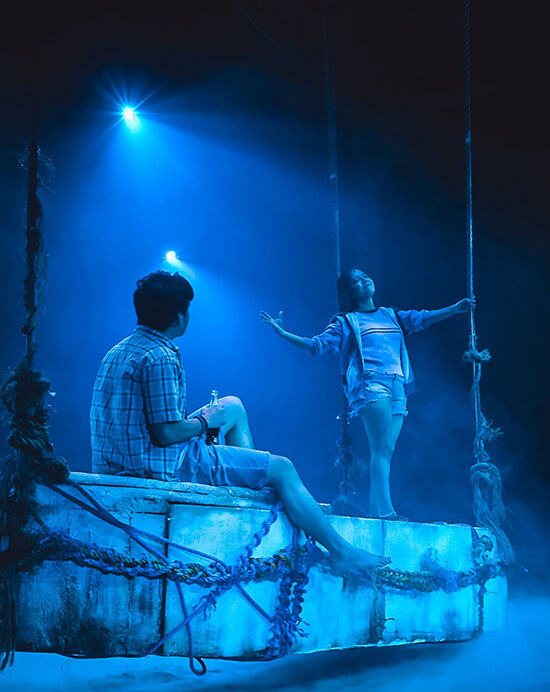
It was right up his alley, given the religious and mystical themes of his last work and although this is not a musical, the poetry and rhythm of the script by Hudes, who actually took music composition in college, was rich material for Lacson’s imagination, transformed into dreamlike tableaux punctuated with magical realism that audiences in the intimate Proscenium Black Box theater could immerse themselves in.
The translation to Pilipino by Eljay Castro Deldoc bridges the Hispanic background of the original with our shared archipelagic and folkloric experiences, allowing the themes of migration, longing, family and destiny to resonate with unmistakable immediacy. Although the setting is in Cuba, it is never mentioned, giving it more universality.
Bituin Escalante as Yemaya/Inay anchors the drama with warmth, gravity, and mystery while embodying the maternal and mythic dimensions of the character, making her both an earthly mother and a larger spiritual being. Even when not singing or talking, her presence is formidable, lending the production a pulsating emotional center so that whenever she appears, the play’s disparate currents seem to converge.
Cinemalaya Best Actor winner Tommy Alejandrino is a natural as Jesus/Mulo (alternating with Benedix Ramos), the 12-year-old farm boy dreaming of going to America to meet President Trump. He captures the restless curiosity and vulnerability of youth with remarkable sincerity, pulling us in to make his journey ours as well. Maya, the girl he meets to embark on their trip on the high seas, is played by Ness Roque (alternating with Sheena Belarmino) with vitality, creating a character who is both companion and catalyst, illuminating the play’s exploration of human connection. Roque’s chemistry with Alejandrino is spontaneous and lived-in, giving the story much of its momentum.
CONTINUE READING BELOW

The supporting cast contributes richly to the world-building. Herbie Go lends Tico a grounded wisdom while Tony Falcon as the protective Jelin adds sprightly energy. Sheenly Gener’s Lila provides moments of tenderness and resilience. Together they create a believable community through which Jesus moves, ensuring that the play’s fantastical elements never drift too far from recognizable human experience.
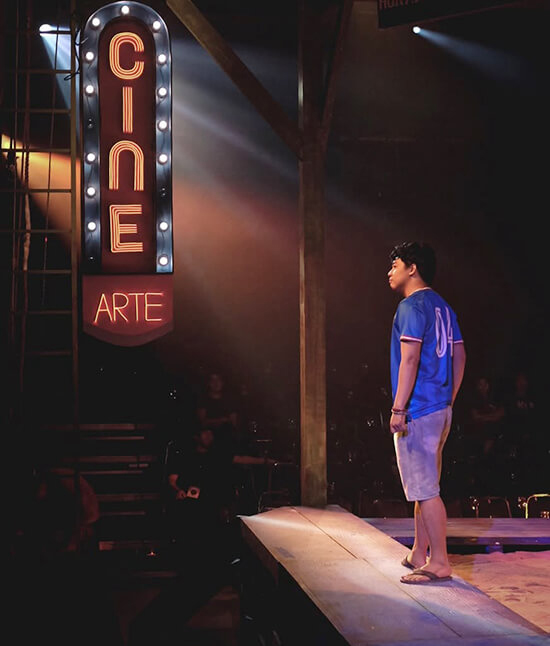
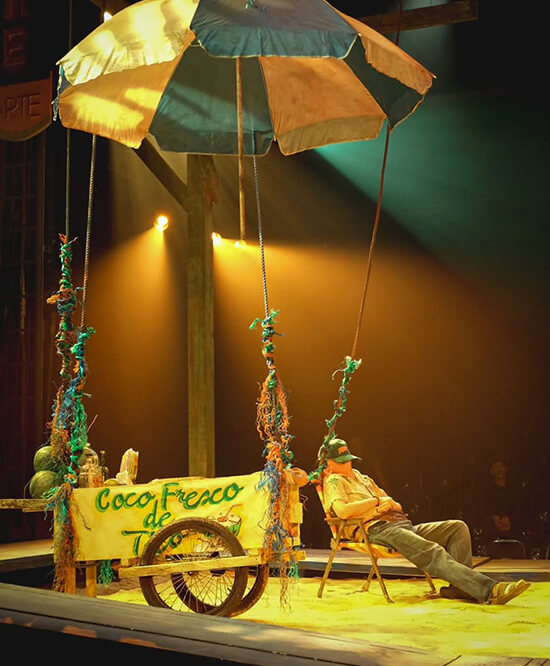
The production’s greatest strength, however, lies in its confidence in the audience’s imagination. As both director and set designer, Lacson creates an environment suspended between dream and memory—a literal sandbox in the round for him to build his castles, shifting oneirically as land, sea, sky and fable coexist. Rather than spoon-feeding us with literal representations, the director trusts us with suggestion and metaphor.
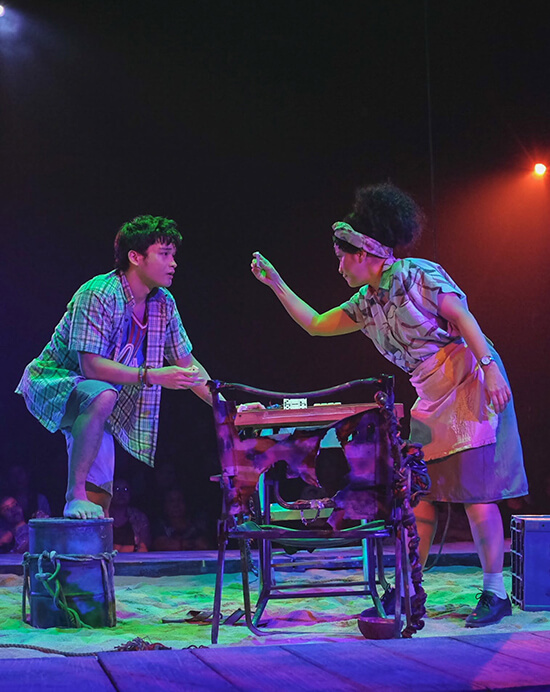
Scenes shift with the minimal use of elements like signage, furniture and props. The lighting design of Jethro Nibaten is an indispensable ally, accomplishing what elaborate scenery might otherwise attempt, transforming the venue into a mutable landscape of possibility. The music and sound design of Teresa Barrozo is just as crucial, an active storytelling force as waves seem to breathe through the theater, memories acquire sonic textures and transitions flow with dreamlike inevitability. The acoustics in this theater are a godsend and Barrozo’s audio design makes every word land with precision.
Movement director JM Cabling devises a physical vocabulary that enhances the magical realist atmosphere as bodies become currents, tides, and emotional states, deepening the storytelling and reinforcing the play’s recurring imagery of water and transformation.
Athough Hudes’ original script occasionally favors poetic abstraction over dramatic clarity, with certain symbolic passages feeling more evocative than fully developed, Lacson’s direction mitigates these shortcomings by emphasizing emotional truth over narrative explanation.
What ultimately distinguishes Yemaya is its sense of wonder, asking us to surrender to imagination in a production of considerable beauty—a theatrical experience like that moment between dreaming and waking, reminding us that theater’s greatest magic emerges not from what is on the surface but from what you have to plumb the depths for.
* * *
Yemaya will run at the Proscenium Black Box Theater until July 5. Follow @9workstheatrical.

WATCH: Can you still trust someone who betrayed you? (Generations Ep. 22)
September 23, 2026