

It’s the small moments that wreck us in ‘The Mandalorian and Grogu’
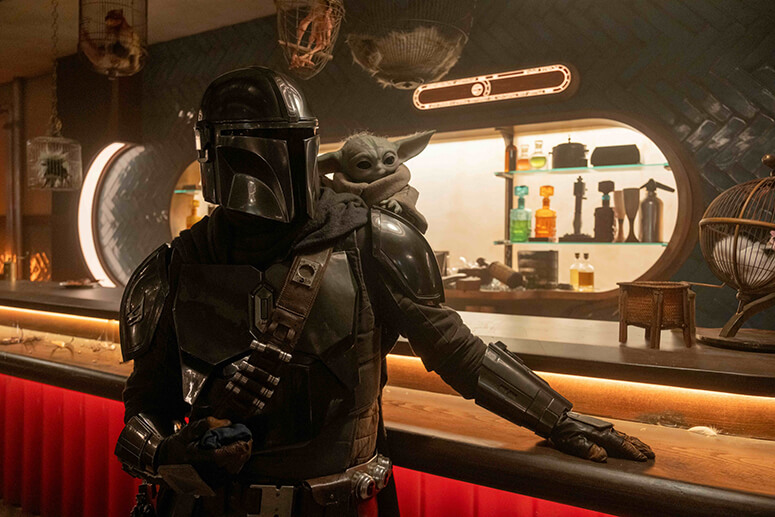
When The Mandalorian premiered on Disney+ in 2019, it had me at the final shot of the first episode: a wide take of Pedro Pascal standing next to a hovering pod bearing a green puppet. That a 30-minute streaming series created by Jon Favreau could do so much with such small things perhaps explains why a big-screen version pairing a bounty hunter and a Yoda-like toddler actually works as well as it does.
Episodic, with Pascal as helmeted Din Djarin escorting a pea-sized but incredibly expressive puppet through constant hand-to-hand battles, escapes and rescue missions, Star Wars: The Mandalorian and Grogu plays like four half-hour streaming episodes back-to-back. Is that a bad thing? Star Wars fans are divided. Drawing on the energy of old-time movie serials like Buck Rogers that cut to the chase and deliver in short doses (the very things, among others, that inspired George Lucas to create Star Wars), Favreau’s big-screen take doesn’t require intricate plots and knowledge of Star Wars chronology; it’s a standalone adventure relying on a father-kid tandem that’s been a staple of Hollywood since, well, Chaplin’s The Kid. It draws on the reaction takes and silences of, say, Bogdanovich’s Paper Moon (with real-life father-daughter Ryan and Tatum O’Neal) to draw us into the bonding.
It also relies on some inspired voice talent, like Martin Scorsese cast as a four-armed deli truck owner on the planet Ardennia who’s reluctant to sell information to Mando. Or Jeremy Allen White (The Bear) as Rotta, the son of Jabba the Hutt, trying to make a living as a slave gladiator in the Outer Rim. That both these actors are unrecognizable beneath the CGI makes their voices all the more important.
It also relies on skillful puppetry, and this is perhaps a secret ingredient of films that still manage to pierce the heart of moviegoers. Earlier this year we saw Ryan Gosling share the screen with a rock-like alien in Project Hail Mary—a massive hit, in part because “Rocky” was operated by sticks, strings and animatronics, yet still manages to display more humanity than a team of CGI engineers ever could. It’s this human touch that people respond to: a handmade quality that resonates in The Mandalorian and Grogu. Grogu pads across the screen on tiny little feet, or tries to summon a bowl of snacks in his direction across the table, and it’s not just cute—it’s movie magic. To find moments in family-friendly movies now that are not cloying or manipulative is rare these days.
But wait: is Grogu manipulative? Maybe. Does he use his tiny little green hand to massage our hearts, the way he does The Mandalorian in one of the most affecting scenes of the movie? Yeah, a little. No more than Rocky made audiences tear up when he took a fireball to save Ryan Gosling. What we are focused on in these two movies is a relationship, and that’s what resonates.
For Star Wars fans, there’s lots of callback to fixate upon. The gladiator match that Rotta the Hutt (White) fights in with Mando is a dead ringer for the Dejarik (“Holochess”) board game that Chewie plays aboard the Millennium Falcon in Episode IV: A New Hope, down to the black-and-white dartboard layout and fanciful CGI creatures.
CONTINUE READING BELOW

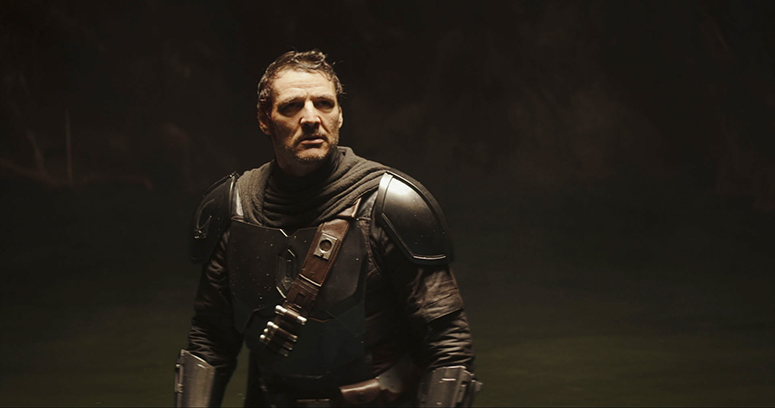
Sigourney Weaver, who is doing her damnedest to straddle as many iconic sci-fi franchises as possible (Alien, Avatar, Star Wars), turns up as a New Republic commander who sets Mandalorian off on a mission: get information from the Hutts to retrieve their nephew Rotta and track down another target in the card deck of Galactic Empire remnants. Mandalorian recovers from one “messy” encounter, Grogu strapped to his back, only to set off on another one. And another one. In the process, there are nods to Apocalypse Now (that flaming orange sunset silhouetted by New Republic fighters), Blade Runner (the urban noir world of Ardennia), and even bits of Star Wars (the arrival of New Republic pilots in a classic cockpit crosstalk scene). There are nods to The Empire Strikes Back as Mando, sans helmet, is tossed into a swamp pit encircled by sea creatures, and forest chases that take us back to Return of the Jedi.
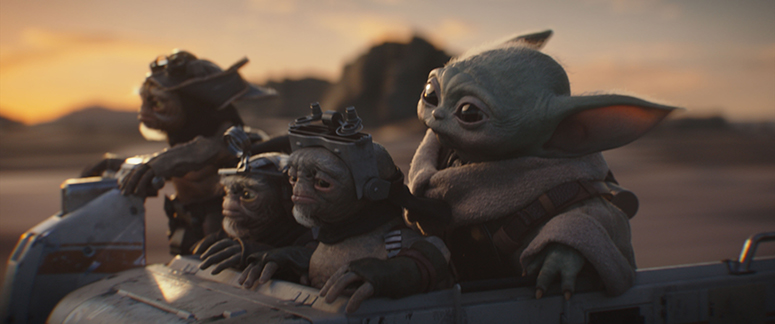
But it’s little moments that kind of leap off the screen in The Mandalorian and Grogu. The tiny cadre of mechanics (Anzellans, we’re told by Wookiepedia) who arrive with Grogu in a tiny spaceship on Nal Hutta, and their tiny little mission. It’s the parade of bugs that sets upon The Mandalorian’s prone body, as he recovers from a swamp snake bite on a forest floor, the camera zooming in on their intricate CGI details. It’s the quietly determined Grogu trying to move Mando’s body into a safer mud hut to recover, only to hear his helmet clunk repeatedly, because the mud hut isn’t long enough for his entire body. Little bits of physical comedy go far in this episodic blowup to the big screen.
It is rare to still find such moments in Hollywood movies, which tend to rely on fan servicing, ADHD appetites, and a tendency to decorate the screen with huge explosions and even bigger monsters destroying human-scale cities. Here, it’s the tinier scale of things that wins us—and completely wrecks us.

WATCH: Can we talk about death and grief? (Generations Ep. 25)
October 14, 2026