

Markus Jentes paints quiet collisions in a fractured calm
The ongoing one-man show of Peter Markus Jentes, entitled “Quiet Collisions: Geometrics of a Fractured Calm,” invites you to step out of the frazzled Makati traffic and into the calm space that is occupied by the smaller of two Altro Mondo galleries. Tucked away on the second floor of the Picasso Boutique Serviced Residences, there is no better location for this abstract artist and his current exhibit, which dwells precisely on the duality of life that is chaos and calm.
The artist himself has found that his art has evolved as he moves from a more rigid geometry as seen in his breakout exhibit “Miami,” to a stance that is more vulnerable and less controlled. From Miami to the Rothko-inspired “Impression Expression” to the floral speckled “Re Circulation,” and now to “Quiet Collisions,” precision gives way to emotion and introspection.
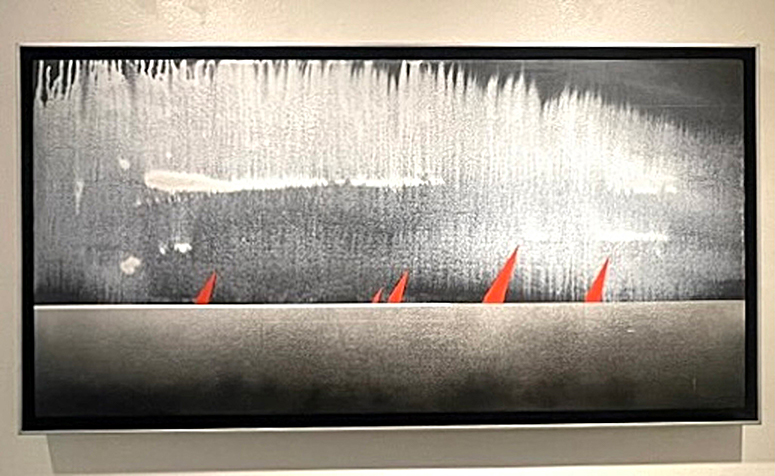
The defining line in the current exhibit is precisely a line—the horizon—which becomes the artist’s metaphor for the dual reality of life. Much as we try to control what happens around us and our circumstances, the messiness of living will always turn our carefully laid plans upside down. Those who worship control are bound to be frustrated, while those who sit back and accept that it’s okay to have both calm and chaos every day, sometimes every hour, will find that this is a much more livable prospect. It’s when one accepts that mistakes, collisions, setbacks and messiness are bound to occur that a true peace and a true calm can descend.
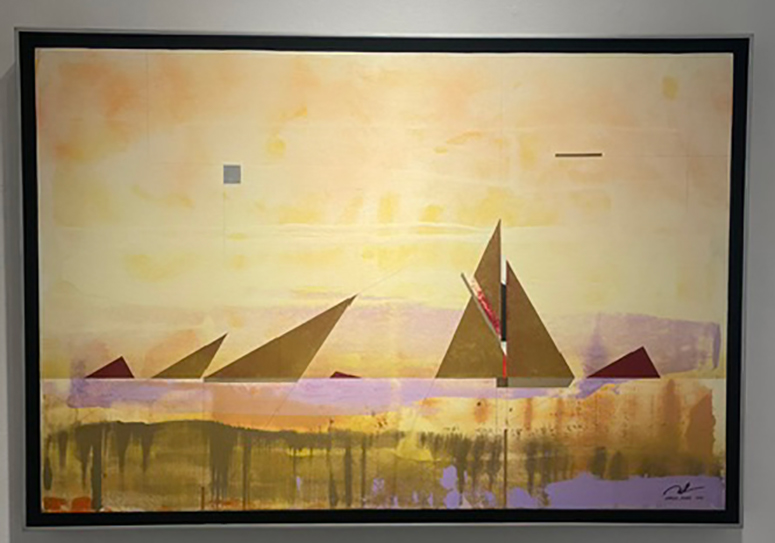
The first works that strike me are those that have triangles that look like sailboats—golden sails that are in the midst of an “Eruption in the Badlands,” which is “Dystopian Landscape No. 10”; or the five sailboats heading incongruously to the Artic (literally “5 Sails to the Artic”) in the midst of what looks like a descending storm. Yet I can picture Markus, who lives in Subic and is often out on the water, contemplating the horizon that is ever before him, dividing sea and sky, and either or both can be still or stormy.
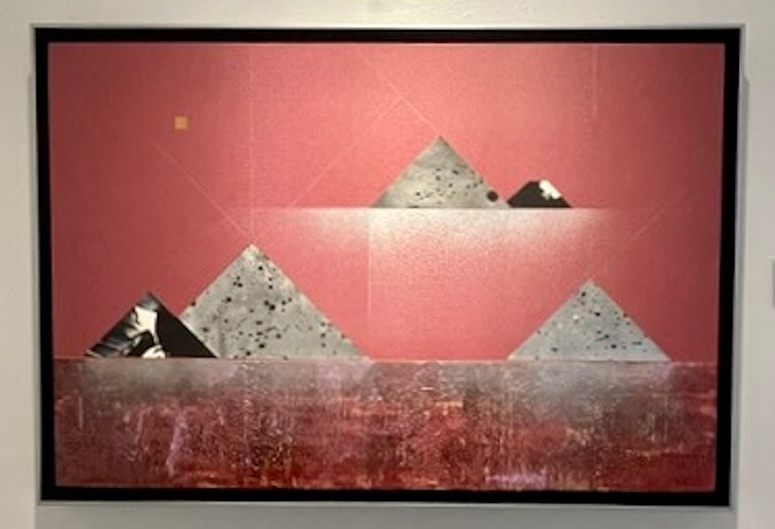
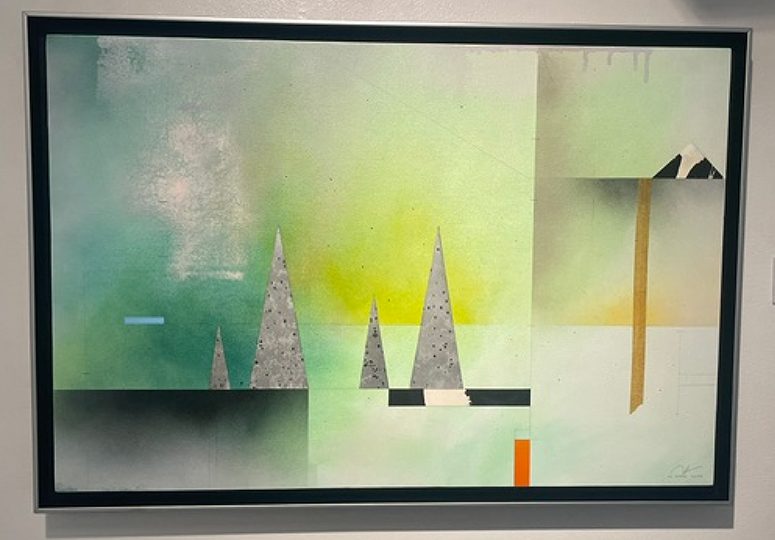
In the Dystopian Landscape series, what look like pyramids could actually be dunes or mountains, withal that those imply: mountains you need to scale, dunes are ever-shifting piles of sand your feet sink into. The “Fractured Calm” series has the spills that look like small explosions that anchor but do not take over the entire canvas. These are the collisions that fracture the calm, and yet the horizon line itself (which is vertical in some paintings) can anchor you in the same way that a horizon gives you a fixed point of reference when you are out on the seas of life.
Markus is the son of two known personalities in Manila; his father was the late Peter Jentes, former GM of the Hyatt Regency Hotel on Roxas Boulevard (now the Midas) and beauty queen Minnie Cagatao-Jentes.
CONTINUE READING BELOW

“Mom was into art,” Markus tells me. “Dad had a gallery in the early eighties and pushed a lot of artists like Luz, Castrillo and Orlina.”
He says it was the combination of the two that “Brought me into this world; Mom was into technique while Dad was into understanding the world of art, the gallery, the experience, visiting art fairs, looking at different kinds of art styles. Eventually I ended up taking this in college.”
He took up Fine Arts at Pepperdine University, but after college went into multimedia and design, eventually leading himself into the world of advertising, graphic design, and communication.
“I was always putting art on hold but eventually I wanted to go back into it full-time. It took a little time, obviously, because I had a commercial career in design and advertising for 19 years. On the side was photography work and art but towards 2013. that’s when I started to change. I said to myself I better start doing this before it’s too late, and by 2019 I closed my firm.” The timing was perfect because his partners wanted to retire or go freelance. “It was the perfect time to go pro.”
Markus says the vision is a direction but not the finished product, what comes about along the way. He defines his style as linear and how it intersects with fluidity and expressionism: “The bigger picture is taking on deeper introspections, things I’ve never actually looked at before within myself, to bring it out. It was always outside inspirations or things that made me happy.
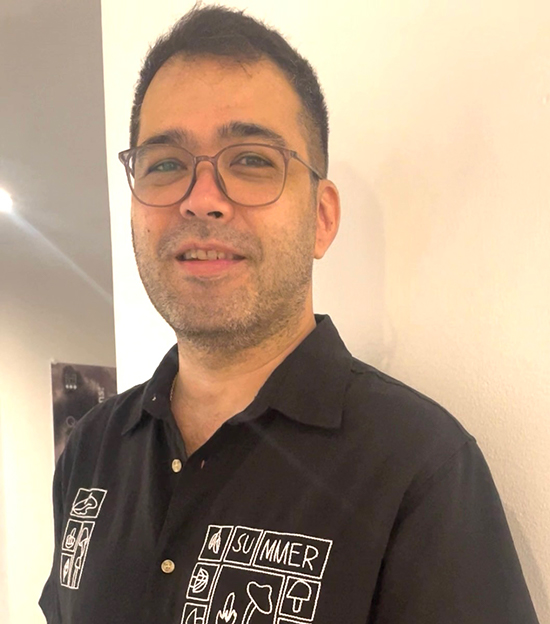
“But there was a rough time in my life when I said, I think I should look inside and reflect on what it is that I went through, what’s happening and why I feel this way. The moment I figured out how to bring them out, it began to create much more meaningful works of art. Even to me, without my going there, I don’t think I would have ever made this kind of work that is this strong, this impactful.”
What goes into the works now are “Coffee, spills, varnishes and in this way I let things go and let it take its own shape. I never know how these things will ever turn out. It’s more about how things work together when they are applied.
“I work, I let it happen then I come back to it and see where else I can push, pull, take away, maybe even erase and come back again, turn it upside down, try it again. These are all deep experiences that are coming out visually, a lot of times they may not even have subjects. It’s really more a feeling or a mood or something that I think is an experiment that will be beautiful so it’s hard to define. But where it comes from, it comes from a lot of deep introspection.”

WATCH: Discovering Vietnam in three days
June 9, 2026