

REVIEW: 'Blade Runner 2099' is a brooding, brilliant, beautiful dystopian sci-fi
Blade Runner 2099 is set in the universe first introduced in Ridley Scott’s classic Harrison Ford starrer, memorably followed up in 2017 by director Denis Villeneuve with Blade Runner 2049. This time around, the plot unfolds across eight episodes streaming on Prime Video, top billed by superstar Academy Award winner Michelle Yeoh and Euphoria’s Hunter Schafer as the titular Blade Runners.
Set 50 years after 2049, the series continues to examine the struggle between humans and their synthetic counterparts, the replicants. In an inspired move, executive producer Scott and showrunner Silka Luisa have flipped the script, with humans now serving as the underclass being hunted by the replicants who once served them. Yeoh brings her legendary screen presence to the part of Olwen, a former off-world technician who now serves as a Blade Runner for the Los Angeles Police Department. Fully aware of her built-in expiration date as a replicant, Olwen remains steadfastly dedicated to her duties.
On the opposite end of the equation, Schafer plays Cora, a human laborer seeking visas for her and her disabled brother Elias (Lewis Gribben, Generation Z) to Mexico, where humans are believed to live free. The cost of safe passage will require Cora to go undercover as a Blade Runner, a task made infinitely more difficult when she’s partnered with Olwen. When the unlikely partners uncover a conspiracy that threatens to tear their society apart, Olwen and Cora will need to learn to trust each other in order to survive.
For the Manila premiere where Yeoh herself was the guest of honor, media and invited guests were shown the first two episodes, allowing us to experience Blade Runner 2099 in all its big screen-ready glory. As with past entries, the series is a visual feast, adapting and updating Scott’s iconic vision of a rain-drenched neon dystopia, an overpopulated world of decaying skyscrapers, flying cars (spinners) and an overall sense of society on the edge of collapse. The devastated extraurban areas introduced by Villeneuve's 2049 are even more derelict here, with humans struggling to survive beyond the purview of their synthetic overlords.

CONTINUE READING BELOW

Yeoh is perfectly cast as the ice-cold Olwen, performing her part with ruthless efficiency. From the moment she appears on the scene in her duster jacket, Olwen’s no-nonsense demeanor and precise physicality are on full display. The elements that humanized Ford’s Deckard and, later on, Ryan Gosling’s K, as past Blade Runners are nowhere to be found; Olwen doesn’t waste time with streetside noodle breaks or questionable relationships with AI companions. As a result, 2099 serves up an even bleaker future than before while revealing aspects we haven’t seen before.
Schafer’s take on Cora will ultimately prove divisive, as the performer’s relative inexperience is obvious in her scenes with Yeoh, despite being well in line for the character she’s playing. Objectively, the awkwardness works in the context of Cora’s growing desperation (even if her ability to stay undercover for so long does become questionable). But then, Olwen is six days from dying when we meet her, so she can be forgiven for not immediately sensing her new partner’s humanity.
Overall, Schafer’s performance is compelling, encompassing Cora’s resolve to liberate herself and her brother, as well as the confidence she gains throughout the series’ run. By the time we get to the finale, she’s grown from the naive fugitive we met in the pilot, and it’s a journey well earned.
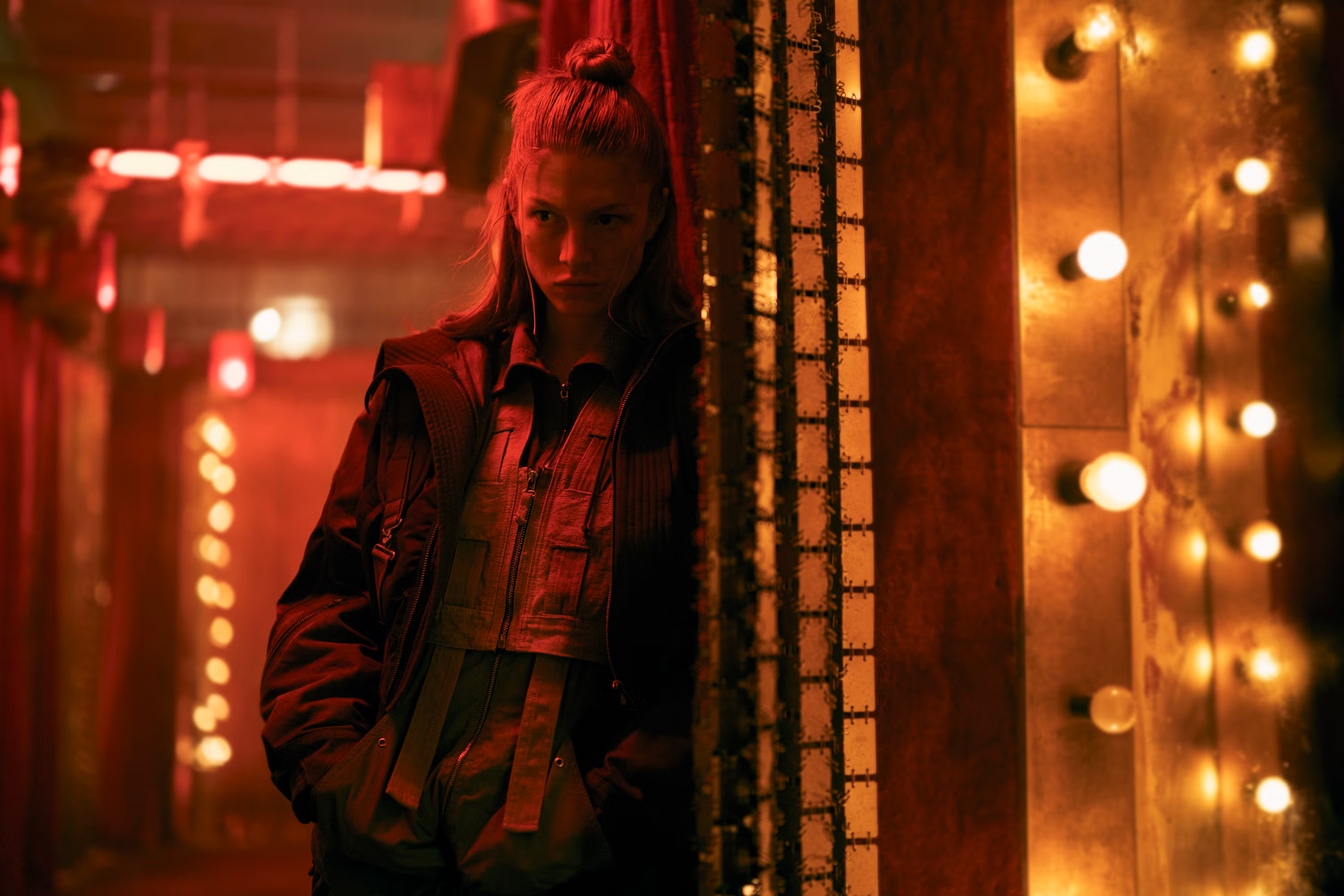
If Blade Runner 2099 had concentrated solely on Olwen and Cora’s dynamic, we’d have little to complain about, but the series falls prey to the need for an overarching villain and his (yawn) evil plot. As far as bad guys go, Julius (Tom Burke, Furiosa: A Mad Max Saga) is underwhelming, with an overly convoluted plan that doesn’t entirely go against the protagonist’s goals, to the point that everything probably could have been resolved with a conversation. It feels almost unfair to compare Burke to the all-time great villain Rutger Hauer played in the original film (or even whatever the heck Jared Leto was attempting in 2049), but here we are. It also doesn’t help that Burke’s natural English accent betrays his character’s neutral American twang at times, but the need for an action-packed “good versus evil” climax is all but mandatory these days. Even Julius’ psychopathic sidekick Clotilde (Scottish actor Amy Lennox, also affecting an American accent) feels like a lesser version of similar characters played in the past by Darryl Hannah and Sylvia Hoeks.
By far, the least interesting element of the show is Cora’s ostensible primary motivator, Elias, who seemingly exists solely to make the most boneheaded decisions at the worst possible times. Where Cora earns our sympathies by being endlessly dedicated and resourceful, Elias’ only narrative contribution is to provide repetitive cliffhangers between scenes. More often than not, Elias is paired with Cora’s go-to forger, Bebeto (Dimitri Abold, The Ballad of Songbirds and Snakes), a man possessed of seemingly unlimited patience, given the crap he’s forced to endure.
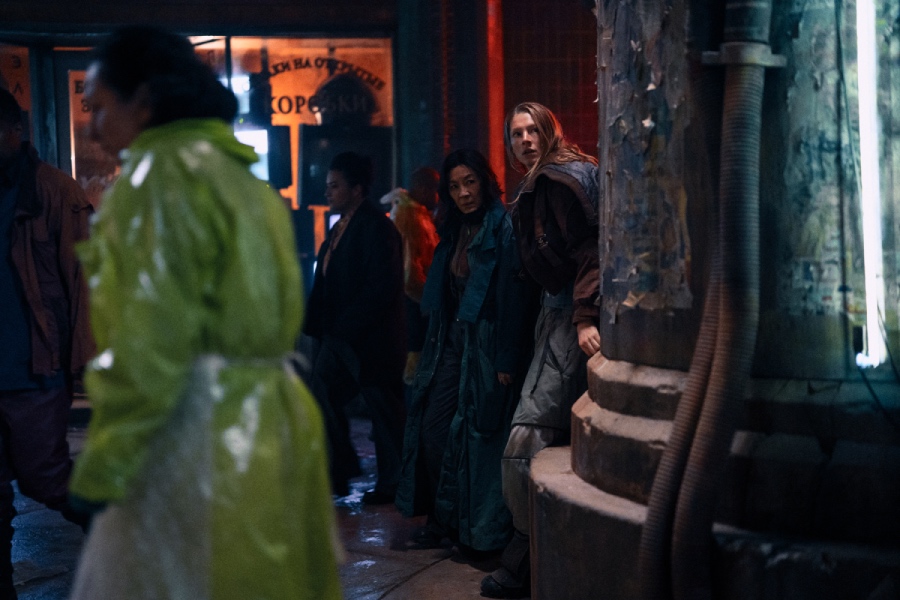
The series excels when it delves into the franchise’s signature questioning of humanity and mortality, especially as they concern the leads. Viewed through the lens of an unfeeling replicant with a predetermined death, the notion of what gives life meaning takes on new weight, especially when compared to Cora’s bid for survival. The Voight-Kampff test to determine humans from synthetics (based on their emotional responses) has been given a sadistic twist, now being used to ensure replicants’ lack of empathy, versus evaluating their (supposed) humanity. It’s a clever spin on what we’ve seen before, and the new elements play well with the multiple shoutouts and Easter eggs that will have fans poring over screenshots for ages—even Philip K. Dick’s source novel, Do Androids Dream of Electric Sheep? gets referenced here in welcome and surprising ways!
Overall, 2099 is a well-crafted franchise expansion that never quite reaches the hauntingly beautiful highs of 2049, or even Scott’s own Blade Runner Final Cut (2007), but Yeoh and Schafer make a brilliantly watchable duo that the show wisely leaves the door open to future adventures.
Indeed, given the events that take place in the last three episodes, there’s no shortage of storylines that can be explored, assuming the show performs well enough to do so. Hopefully, if and when a new season arrives, there’ll be more focus on these characters, their world, and their respective moralities than, say, another cookie-cutter villain with a plan for world domination.
All eight episodes of Blade Runner 2099 are available to stream on Prime Video, along with the original Blade Runner. Blade Runner 2049 arrives on the platform in December.

WATCH: Good parent ka ba? (Generations Ep. 28)
November 4, 2026