

Spotting online scams: AI tools and tips you need to know
Have you ever received messages that felt suspicious or even too good to be true in the last 48 hours?
Online scams have not only increased but have become more sophisticated in the last couple of years, mainly due to the use of artificial intelligence. Gone were the days when it was easy to spot fraud by just checking the sender’s contact number or e-mail address or simply doing a grammar check. Nowadays, people really need to exercise sound judgment and common sense to avoid falling for scams or having their private data compromised.
Using AI to fight against scams
But what if AI—the same technology that has helped scams spread faster and wider—could also be used to detect and prevent them?
During the 2026 Safer Internet Day event, Google Philippines Head of Communications and Public Affairs Mervin Wenke shared AI-powered tools and practical tips to help Pinoy netizens stay safe online.
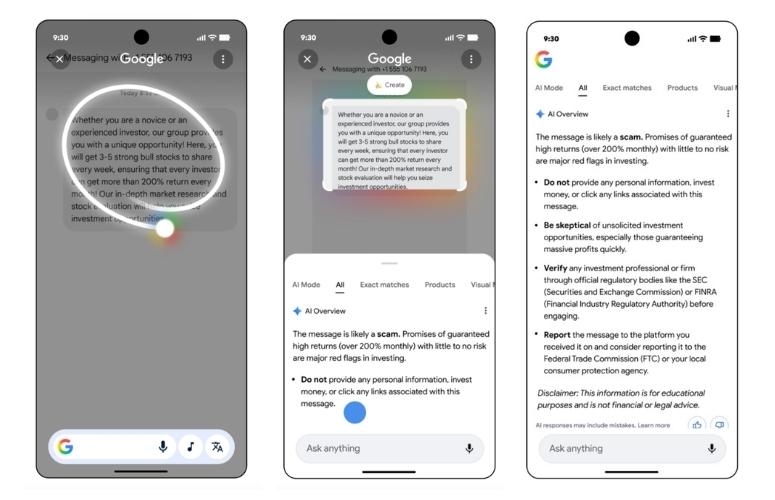
Google has recently enhanced Google Lens and Circle to Search to help users spot scam messages.
If you receive a suspicious link or text, you can take a screenshot and use Google Lens to scan it, or long-press the home button on your device and circle the text. Google’s AI then analyzes the content in real time and alerts you if the message is likely a scam, helping you avoid falling victim to fraud.
Love scams on the rise

With Valentine’s Day just around the corner, the search for love has unfortunately made some people vulnerable to scams. Cybercrime Investigation and Coordinating Center Usec. Aboy Paraiso noted a rise in “love scams” in the Philippines, many of which now exploit AI technology.
Scammers can now easily create AI-generated photos to present themselves as the perfect catch, making it harder to tell who’s real and who isn’t. That’s why being able to spot AI-generated media has become an essential life skill.
To help, Google recommends the “SIFT” method—Stop, Investigate the source, Find better coverage, and Trace claims—when evaluating information online. Google also provides tools to make this easier: About this Image, a Search feature that shows where an image came from, and SynthID, a technology that embeds digital watermarks in AI-generated content to help identify deepfakes and manipulated media.
Brushing: the scam hitting your doorstep
Another common scam today is called “brushing”, where individuals receive items they never ordered. While it might seem harmless at first, it actually signals that your personal data has been compromised. Scammers often use this tactic to boost fake sales reviews online or even gather more personal information for future attacks.
With scams evolving so quickly, staying alert, verifying information, and using AI tools responsibly have never been more important.

WATCH: How does impeachment in the Philippines work?
May 19, 2026
WATCH: Can you still trust someone who betrayed you? (Generations Ep. 22)
September 23, 2026
WATCH: Pixar Summer Fest adventure at Hong Kong Disneyland
August 10, 2026