

Summa cum fashion
During these times when everything is turning more casual, both in manner and in dress, one wonders, why is it still so important for graduation attire to remain so formal and traditional?
To answer that, one must ask: why are traditions so important in the first place? Perhaps it all boils down to how they define us as a people, as a civilization, and how we have evolved and distinguished ourselves through time. For the school graduate, it’s how he has cultivated himself to join the ranks of the educated, ready to serve the community in nation building.
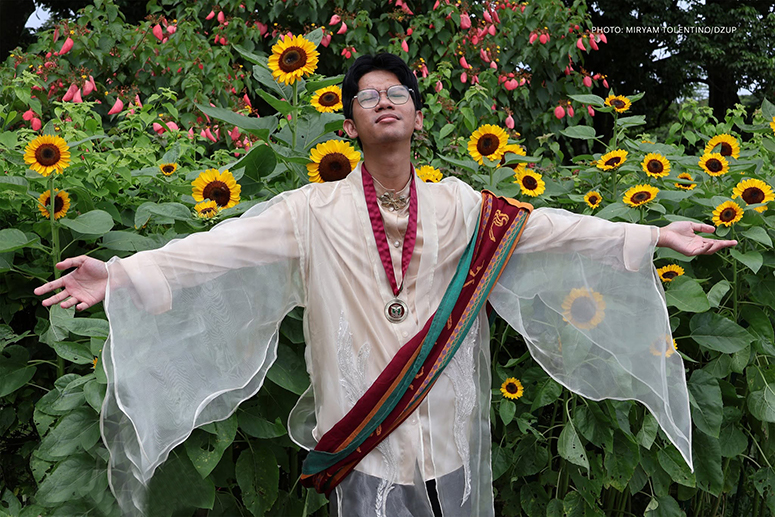
At the recent University of the Philippines Commencement in Diliman, over 5,000 graduates proudly shifted their sablay from the right shoulder to the left, a symbolic rite marking their transition from students to alumni. Their readiness to serve the nation as concerned citizens was most certainly evident as they wielded placards and streamers, even umbrellas, in protest, calling attention to a variety of issues, from the current local issues of “Impeach Sara” and “End Corruption” to international ones like “Free Palestine.”
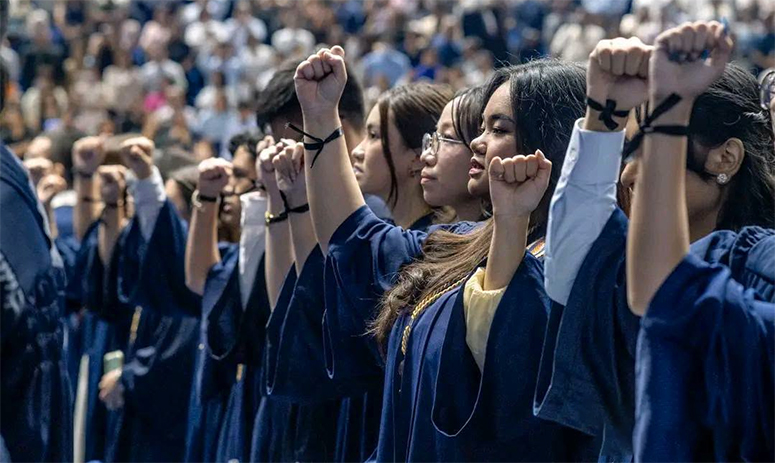
At Ateneo de Manila University, where graduates wear togas, they also made their own political statements of protest by wearing black armbands accompanied by a community-wide walkout to call for transparency, accountability and justice regarding the controversial handling of the deaths of student-athletes Rene Baterbonia and Divine Adili.


These protests made the commencement exercises more dramatic than the usual, but even during calmer times, the seriousness of the event cannot be emphasized enough for the simple reason that it is a traditional “rite of passage” with a long history that blends hundreds of years of academic tradition with the emotional weight of individuals transitioning to new life stages.

The formality of caps, gowns and academic processions stems directly from medieval European universities. In the 12th and 13th centuries, scholars were often clerics, and these robes symbolized scholarly dedication and entry into a highly respected, learned community. Institutions use this historical pageantry to maintain a sense of dignity, continuity and prestige. The event functions as a public recognition of years of personal sacrifice, with the quiet focus during the conferment of degrees, demanding respect for the immense effort that graduates and their supporting families have invested to get there.
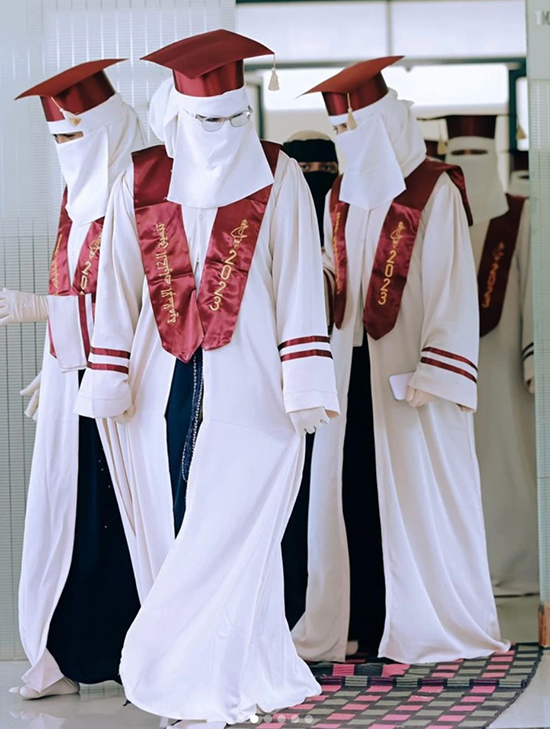
The very word “commencement” means beginning, making the ceremony a deliberate threshold, a liminal space where the graduate officially ends one status as a student and signals the beginning of professional adulthood.

The traditional graduation attire, also known as academic dress, consists of a gown or robe with a separate hood and a cap, used in most universities in the Commonwealth of Nations and the US, derived from Oxford and Cambridge which in turn developed theirs from those at medieval European universities.

In the Philippines, most schools use the hood and gown or toga in their own signature colors, together with the mortarboard (similar in appearance to that used by brick masons to hold mortar, consisting of a horizontal square board fixed upon a skull cap with a tassel at the center).
At the University of Santo Tomas, there’s the Spanish academic attire of mozetta cape and biretta cap. Even within a school, there are different variations signifying different degrees. That’s why there was a big ruckus when Mariel Padilla, wife of Sen. Robin Padilla, wore a toga for doctorate degree holders when she represented her husband at the commencement of Teodoro M. Luansing College of Rosario in Batangas. She was questioned for wearing the academic regalia despite not having earned the corresponding degree for which the attire is prescribed.

In 2000, UP officially replaced the toga and mortarboard with the sablay, designed by former UP president Emil Javier in coordination with the university’s Center of Ethnomusicology to symbolize nationalism, decolonization and the celebration of indigenous Filipino culture. The word sablay refers to an indigenous loose garment used for formal occasions. As a verb, isablay means to put a precious object, like a piece of cloth or garment, upon one’s shoulder, as a way of giving value and respect. This sash is adorned with ukkil representing growth of knowledge, together with geometric design elements from different indigenous Philippine cultures and the university’s acronym U.P. as a symbol based on the ancient pre-colonial baybayin. The sablay is worn over an ecru terno or barong.
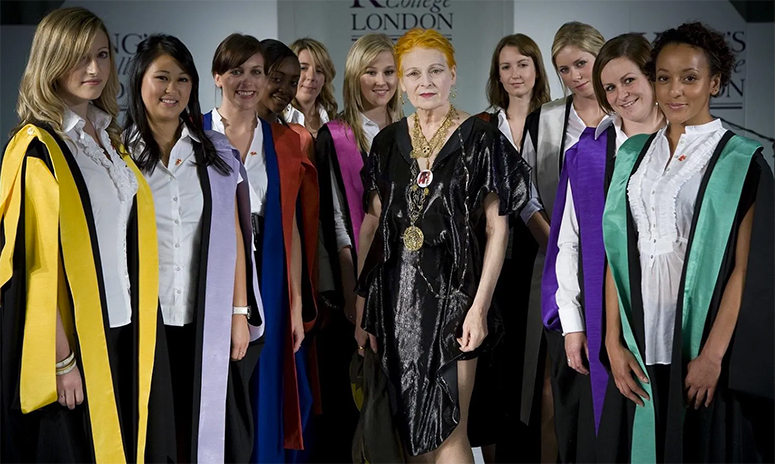
In the UK, they also innovated the graduation attire at King’s College London when they asked Vivienne Westwood to design for them in 2008. She opted for flowing forms to allow ease of movement, a gold button on each shoulder to represent the King’s lion mascot which represents strength, and brightly colored sleeves—each of which represents a different subject faculty. “Through my reworking of the traditional robe, I tried to link the past, the present and the future. We are what we know,” Westwood said at the time. Although she still paid respect to the academic gown’s origins, she abandoned its rigid constraints, utilizing medieval-inspired cuts to allow more freedom while celebrating distinct faculty identities.
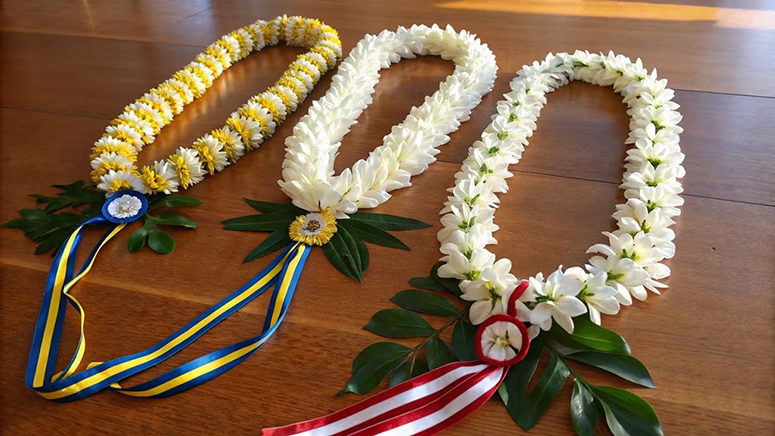
Graduation leis. Photo from @rosetteleis

Graduates in Valenzuela, Bulacan. Photo from @valenzuelacity

BINI members Sheena Catacutan and Stacey Sevilleja

Xian Lim graduating at De La Salle Saint Benilde. Photo from @xianlimm

Krina Cayabyab at the University of Edinburgh in Scotland. Photo from @myronetorsa

A UP graduate wearing the sablay with her terno. Screenshot from tiktok/@duranbianca

Ateneo graduates. Photo from @ateneo.edu

Education Secretary Sonny Angara with graduates. Photo from @deped
Graduation leis. Photo from @rosetteleis
Graduates in Valenzuela, Bulacan. Photo from @valenzuelacity
BINI members Sheena Catacutan and Stacey Sevilleja
Xian Lim graduating at De La Salle Saint Benilde. Photo from @xianlimm
Krina Cayabyab at the University of Edinburgh in Scotland. Photo from @myronetorsa
A UP graduate wearing the sablay with her terno. Screenshot from tiktok/@duranbianca
Ateneo graduates. Photo from @ateneo.edu
Education Secretary Sonny Angara with graduates. Photo from @deped
CLOSE
Just like the innovation done at UP and in various iterations of graduation attire all over the world, history and identity is made relevant for the modern age as graduates are transformed from their former selves into educated professional citizens ready to render service and take part in making the world a better place.
