

Once not expected to live, Fil-Am graduates from Columbia—on a scooter
Sometimes, the miracle you’re hoping for is in you.
When Lilian Grace “Lily” Brasch was born, her parents were told by doctors that she was not likely to live past the age of four. She did, anyway.
At 26, she crossed the stage at Columbia University in New York.
At the age of 16, Lily, who was born to an American father and a Filipino mother in Chicago, where she was also raised, was diagnosed with a rare muscle condition, non-progressive muscular dystrophy. She decided she was going to walk, anyway.
CONTINUE READING BELOW

“Every step forward represents a refusal to let someone else’s expectations become my reality,” says Lily, a recent graduate of Columbia University, where she took up pre-law and psychology.
She recalls doctors hesitantly telling her when she was 16, after a muscle biopsy, “that they are not certain of my diagnosis but that from what they knew, I would not get stronger even if I tried. I remember sitting on an examination table with my legs dangling as I asked if I could get stronger through training. The response was essentially, ‘not likely.’”
Her father, a doctor himself, responded differently. Dr. Joel Brasch encouraged Lily to believe that improvement was possible and supported her determination to try. With such a staunch cheerleader, from that day forward, Lily began strength training thrice weekly.
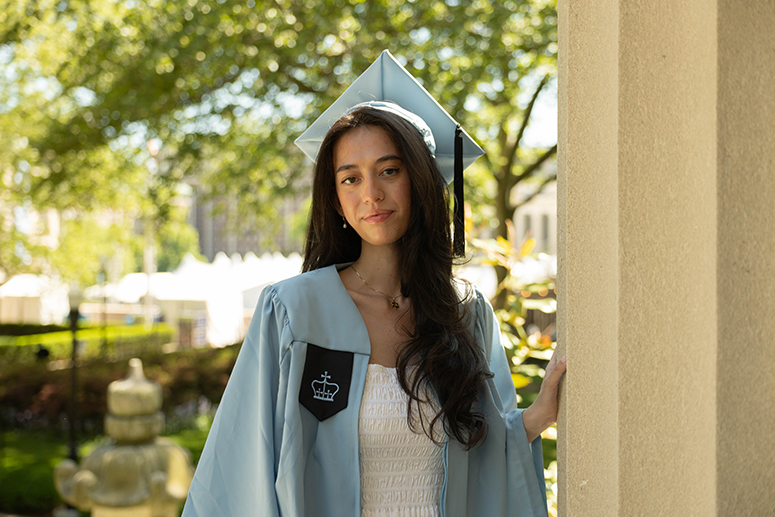
Her scraped knees were badges of honor.
“My journey has included falls, scraped knees, and moments where walking felt especially tiring, but I have never allowed the limits of others to define my capabilities,” shares Lily, who is proudly half-Filipino. Lily’s mother Mary Anne Tamayo Brasch is my first cousin.
“My family has always been my greatest source of strength, especially my parents,” says Lily. “My father taught me to challenge limitations rather than automatically accept them, and my mother has led by example my entire life. My Filipino mother is the most confident and self- assured human I know. My mother always believed in taking control of whatever life throws your way and finding the good.”

“It’s not what happens to you, it’s what you do with what happens to you,” she quotes her mother’s daily reminder. They constantly remind her, like a Post-it note on her bathroom mirror, “that a simple perspective shift can determine the type of life that you build for yourself.”
Her parents were the firm hands that fortified the unseen ladder that Lily held on to as she was growing up, and then navigating university life away from home.
“One of my favorite sayings is, ‘The ladder is stronger when more hands hold it.’ My parents built the foundation by giving me confidence and teaching me not to define myself by limitations. My sisters have provided endless encouragement and laughter. At Columbia, I was fortunate to have professors, mentors, and an incredible disability services team who believed in me and helped me navigate the challenges of higher education. There were many moments where support, understanding, and encouragement made all the difference.”
Laughter is also her elixir.
“Life is more beautiful with my three sisters by my side,” says Lily, who also has two brothers.
“No matter what is happening in life, they can make me laugh. They have a way of turning stressful moments into funny memories and reminding me not to take myself too seriously.
“What I love most is that they don’t see a diagnosis, a disability, or an inspirational story. They just see Lily. Whether we’re teasing each other, sharing old stories, or laughing about something completely ridiculous, they keep me grounded.”
Her late Filipino grandmother Coney Tamayo, my late father Frank Mayor’s sister, was a well of strength that she still draws from.
“My Grandma Coney from the Philippines was a strong force of resilience that I had the blessing of growing up with. Grammy was my role model as a young girl, and her love, resilience, and strength remain a part of what I hope to pass on to the next generation. I think of and miss Grammy every day,” says Lily.
Lily also found purpose in her physical condition, and turned it into a sturdy rod for others who may be wobbling emotionally or physically.
“Over the years, I’ve realized that my strength also comes from purpose. Early in life, I spent a lot of time trying to prove I was worthy. Eventually, I learned something far more important: ‘You are here, therefore you matter.’”
Lily also draws inspiration from people who refuse to give up despite overwhelming circumstances. “I think about the next student with a disability, the next child sitting in a hospital room, the next person questioning his or her future.”
During her graduation, Lily used a mobility scooter to traverse the stage. At first, she was hesitant about calling attention to herself, but then again, her years of breathing the can-do, will-do air enabled her to go through with it. Perhaps she knew that stage didn’t just belong to her. It belonged to all those who had held her ladder when she was battling the odds—and to all those who need a hand with their own ladder. On that stage, and in life.
“If my story helps even one person believe in oneself, then every obstacle was worth it.”

WATCH: Can we talk about death and grief? (Generations Ep. 25)
October 14, 2026
WATCH: Is OPM still as good as it used to be? (Generations Ep. 20)
September 9, 2026