

Why are Philippine fuel prices higher than in other SEA countries?
Why are fuel prices in the Philippines notably higher than those of its Southeast Asian neighbors?
In a press conference held by the Department of Energy on March 24, Secretary Sharon Garin gave several reasons, including the lack of oil sources within the country.
"Wala tayong mga indigenous source. We don't have oil in this country," she said, adding that the Philippines imports 99% of its oil.
"Ang ginagamit natin sa mga sasakyan natin, galing ibang bansa 'yan," Garin continued.
Along with its lack of control over supply, the Philippine government cannot control fuel prices, either.
"This (oil) is an unregulated industry because of the oil deregulation [law]...We leave it to the [fuel] companies to determine the price...Government does not dictate the price, it is competition among companies ang nag-de-determine, nagpapababa ng presyo," said Garin.

The oil deregulation law prohibits the government from controlling fuel prices, liberalizing the oil industry so that prices are dictated by the market instead.
"Added to all the factors...we also charge excise and VAT and all the others, so then they increase [the fuel prices]," said Garin.
She added that the government does subsidize fuel.
"'Pag bumibili ka sa gas station, may binabayaran din ang gobyerno diyan para hindi ganoong kataas 'yung presyo ng bibilhin mo," she said.
The government's hands are tied for now, added Garin, when it comes to controlling fuel prices.
"There are long-term reforms we need to do in the oil industry. But right now, this is what we have. There needs to be legislative action if we want more control over the price," the secretary said.
Fuel prices in other SEA countries
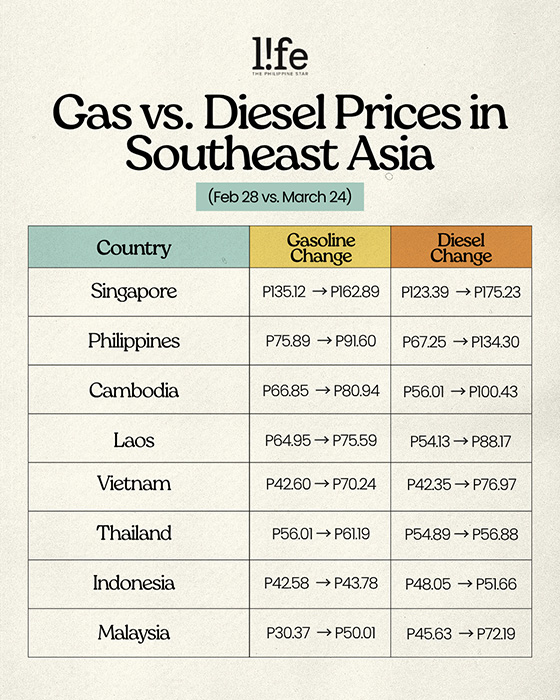
The Philippines continues to experience one of the steepest increases in the region in terms of diesel, with an inflation rate of 99.70%. The price rose from around P67.25 per liter on Feb. 9 to P134.30 per liter of regular diesel on March 24.
Malaysia also has one of the highest inflation rates for gasoline at 64.7%, with prices moving from RM 1.99 (P30.37) on Feb. 23 to RM 3.27 (P50.01) by March. For diesel, the country saw a price of RM 2.99 (P45.63) per liter increase to 4.72 RM (P72.19), representing a 58.2% hike.
Meanwhile, Cambodia and Laos followed similar trajectories of extreme diesel inflation.
In Cambodia, gasoline prices started at 4,451 riels (P66.85) and rose to 5,400 riels (P80.94), while diesel surged from 3,609 riels (P56.01) to 6,700 riels (P100.43), a significant 80.2% increase.
Laos saw gasoline prices rise from 23,260 kip (P64.95) per liter in late January to 27,070 kip (P75.59) per liter in March 9, a 16% jump, while diesel prices surged from 19,460 kip (P54.34) to 29,310 kip (P81.85) per liter. According to AFP, diesel was priced at KIP31,560 (P88.17) on March 16.
Vietnam, meanwhile, saw a staggering 80.6% hike from February, when the country mandated prices not exceeding 18,634 VND (P42.60) for gasoline and 18,525 VND (P42.35) for diesel. On March 20, the government increased the price of gasoline to 30,960 VND (P70.38) and of diesel to 33,420 (P75.97).
Thailand recorded a 9.3% increase for gasoline, reaching 33.5 baht (P61.19) from 30.55 baht (P56.01) in February and a very stable 3.6% increase for diesel, moving from 29.94 baht (P54.89) to 31.14 baht (P56.88).
Indonesia saw modest increases, with gasoline rising from Rp 12,050 (P42.58) in February to Rp 12,390 (P43.78) in March, and diesel rising from Rp 13,600 (P48.05) to Rp 14,620 (P51.66).
On the other hand, Singapore remains the most expensive market in the region for fuel, despite experiencing a more moderate inflation rate compared to its neighbors.
Gasoline prices in the Lion City stood at S$2.88 (P135.12) per liter on Feb. 23, climbing to S$3.47(P162.89) by March 23—an increase of 20.6%. The impact was felt more significantly at the diesel pumps, where prices surged from S$2.63 (P123.39) in late February to S$ 3.73 (P175.23) by March 21. This represents a 42.0% inflation rate for diesel.
Fuel prices across the globe have been skyrocketing since Iran closed the Strait of Hormuz to most traffic, cutting off about a quarter of the world's sea-borne oil supply. This, in retaliation for the continuous attacks from the US and Israel, which began on Feb. 28, 2026. (with reports from John Patrick Magno Ranara)

WATCH: Is OPM still as good as it used to be? (Generations Ep. 20)
September 9, 2026
WATCH: Pixar Summer Fest adventure at Hong Kong Disneyland
August 10, 2026
WATCH: Do you still believe in marriage? (Generations Ep. 17)
August 19, 2026