

Is it too late to graduate?
I recently went back to my soul’s home, the UK. The Philippines will always be home, HOME, but if I were to be asked where I would spend the rest of my immobile days, I would love to spend them in the UK, traipsing around the countryside by train, exploring Wales, Ireland, and Scotland with as much abandon as Marianne Dashwood running across the moors looking for Willoughby. Oh yes, I went there.
The UK is my soul's home because that is where I found myself whilst studying for my postgraduate and my failed attempt at law school.

This trip was not done with such abandon. Instead, it was planned with almost military-like precision. Almost.
Months and months went into planning it because this trip held two very significant events—and, later, one amazing bonus event—within its timeline. One was my graduation from the master’s program I had been doing for the last two years. The second was the more personal milestone of our tenth anniversary. The latter is way too personal for me to write about here, and it involves someone else whose personal space I do not want to encroach upon whilst trying to fill a word count.
So let’s talk about the first one.
And if one day I do finally become that doctor of literature, I know exactly what my mother will say. ‘See? You should have just gone into medicine.’
I had actually been dreaming of getting a master’s degree, though in literature, since I was fresh out of undergraduate. The stars were not aligned then, and neither were my priorities, truth be told, so that hope got lost somewhere in the frenzy and bravado of youth.
CONTINUE READING BELOW

Then life happened. Careers happen. Families happen. Bills most definitely happened and were due. Eventually, the things you once thought you would “get around to” become things you quietly assume you probably never will. And, let’s be honest, education is and can be expensive. As practicality and the reality of finances reared their cautious heads, graduate school at any level became increasingly difficult to justify. Tuition at many institutions amounted to money that could keep a household running for months. There was always something more sensible to spend it on.
Then, in my 40s, the opportunity presented itself again. And I thought: Why not? I was in the right headspace, it felt like the right time. And really, why not?
Of course, the usual doubts surfaced, as doubts are wont to do, because they’re not heavy enough to do anything useful like sink. They just float about and disrupt your view of where you want to go. Did I have enough time? I have a career, a company, a household, a family and an actual life to juggle. Could I justify the expense? Was I being selfish? Was this something I actually needed, or was I indulging the ultimate nerd dream I had been carrying around since my 20s? Does my business need this upgrade? More importantly, can I afford it?
I mean, really, who in their right mind thinks, “Yes. That is my ultimate life goal. I would like to become a doctor of literature so I can finally advance myself in my Asian parents’ eyes”? I can already hear my mother: “Well, if you’re going to be a doctor, why didn’t you just go into medicine?”
Tama naman.
But I remembered a question that has driven me through much of my adult life, one I learned from my sister-in-law: “How much do you want it?”
Once I asked myself that, things began falling into place.
I discovered I had saved enough without messing up rent schedules or leaving my family starving and destitute. My partner and son gave me the supportive prodding I probably needed. And somewhere along the way, I realized that I had spent years thinking of education purely as an expense when perhaps I should also have been thinking of it as an investment; not simply in my career, although there was that. Not simply in the business I had built, although there was that too.

An investment in myself. Once I convinced myself of that, I went for it.
Naturally, once I signed up, an entirely new barrage of floating doubts arrived.
What if the other kids don’t like me? I’m kidding.
I went into the program thinking I would be nervous about the work. Instead, somewhere in my brain apparently lived a 13-year-old girl terrified about her first day at a new school. Would everyone be younger than me? Would I have anything useful to contribute? Would I become a nuisance to my groupmates? When group work began, would I be an asset or a liability?
And, most importantly, could this old crone still hack it?
I have been in the digital business for two decades, but anyone in this field worth their salt will concede that, at the speed it moves, there is always something new to learn. It is not an industry for anyone who wants to stay steady and still.
We used to say digital changed by the week. Then it changed by the day. Now it can quite literally change by the hour. It is also precisely why I love it.
The industry has kept me on my toes for 20 years. It has repeatedly shoved me into uncomfortable places and forced me to learn my way out of them. To be resourceful and think on my feet, and try to see challenges in other angles instead of trying to solve things head on. Going back into academia turned out to be another one of those uncomfortable places.

Stay stagnant and you’re out of the game.
I knew I still had a few punches left in me. More importantly, I was willing to get punched a few more times if that was what it took to learn something new. The program I found was largely online, with two mandatory periods when we needed to be physically in class. As an aside, this is one thing for which I remain oddly thankful to COVID: it showed us that boundaries can be firmly kept and, at the same time, overcome. Geography suddenly became less definitive.
Ah, another train of thought for another article. Again, I digress.
After a couple of online meet-and-greets, tickets were booked and, before I knew it, I was on my way for the first time ever to Stockholm, Sweden. That was when the trepidation (fright) really started. What if I did not have enough experience to contribute anything? What if everyone else knew more than I did? What if I discovered that two decades of actually working in the industry had taught me less than I thought?
There is something profoundly humbling about voluntarily placing yourself in a situation where you might discover exactly how much you do not know.
It is also exhilarating.
Because a strange thing happens when you go back to school after decades of working: you do not return as the same student who left it.
At 20, I studied because that was what I was supposed to do. There were exams to pass, papers to submit, grades to chase and a degree waiting at the end.
In my 40s, I studied because I wanted to know. And that difference is enormous.
Experience did not make the work easier. If anything, sometimes it made things more complicated because I had years of assumptions that needed questioning. But experience gave the theories somewhere to land. Things I had encountered in boardrooms, client meetings, campaigns and business decisions suddenly had names. Academic ideas stopped being abstract because I could connect them to people, mistakes, successes and decisions I had actually lived through.
And my classmates? They liked me just fine. It seems like people think I’m hilarious in numerous backgrounds. More importantly, I liked them.
The age difference that had seemed enormous inside my head became irrelevant once the work began. Everyone brought something to the table. Their perspectives challenged mine; mine challenged theirs. I was not the old crone dispensing wisdom from the end of the table. I was a student contributing to groupwork and growth. That may have been the most liberating discovery of all.
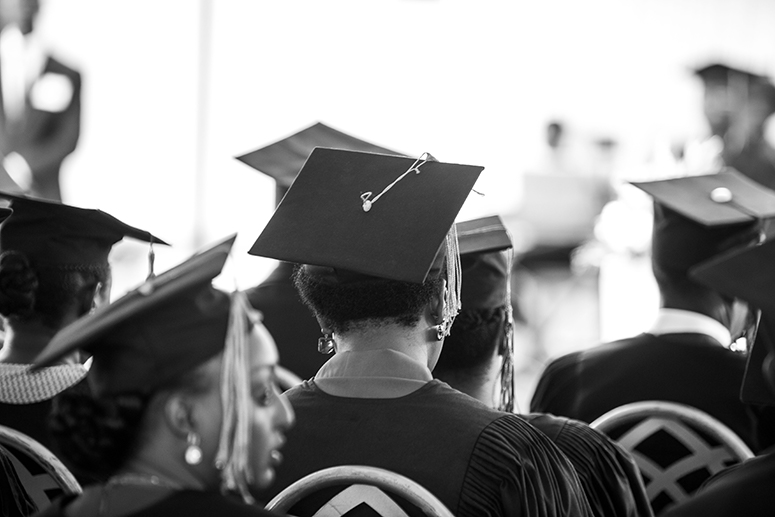
For two years, I worked, studied, submitted papers (a fact that I completely forgot about embarking on this!), met deadlines, ran a household, remained a partner and mother, and continued doing all the ordinary things life requires whether or not you happen to be pursuing a graduate degree. And then, somehow, there I was back in the UK for graduation.
This time, not simply because it is a place I love. I was there to graduate.
There is a peculiar feeling in putting on academic robes in your 40s. You are old enough to understand exactly what it took to get there. The moment is no longer just about the degree. You can see all the invisible scaffolding holding it up: the work rearranged around deadlines, the money deliberately set aside, the family members who made room for your ambition, the evenings when you would rather have done absolutely anything other than open another journal article. And perhaps that is why graduating later felt different from graduating young.
Youth teaches us to think of life as a sequence. School, career, marriage, family, success, retirement; you tick the boxes in roughly the correct order and preferably within the socially approved timeframe. But the older we get the more we know that life is not interested in our timelines.
Sometimes the dream you had at 22 comes back at 40-something and asks whether you still want it. Sometimes the answer is yes.
The master’s degree was not in literature yet, as my younger self imagined. Life took me somewhere else first. But that old dream did not disappear entirely. It simply changed shape. And now, perversely, completing this degree has made me want to study even more.
Apparently I learned nothing about sensible financial decisions.
There are still books I want to read, questions I want to ask, places I want to study, and yes, that ridiculous dream of a doctorate in literature still raises its head; which I think I now cannot cut off as it’s a hydra.
And soon I will answer it. Because if there is one thing graduating in my 40s taught me, it is that we put expiration dates on ourselves far earlier than reality actually does. We say it is too late to study. Too late to change careers. Too late to learn something difficult. Too late to become a beginner again. Maybe what we really mean is that it is uncomfortable.
Being a beginner is uncomfortable. Wanting something impractical is uncomfortable. Spending money or time on yourself when you have spent decades measuring both against the needs of everyone around you is uncomfortable. But uncomfortable and impossible are not the same thing.
So, is it too late to graduate? Apparently not.
And if one day I do finally become that doctor of literature, I know exactly what my mother will say. “See? You should have just gone into medicine.”

WATCH: How to experience Bangkok and Kanchanaburi in one trip
October 21, 2026
WATCH: Is OPM still as good as it used to be? (Generations Ep. 20)
September 9, 2026
WATCH: Can you still trust someone who betrayed you? (Generations Ep. 22)
September 23, 2026