

UPCAT 2026 results are out
Are you a future isko and iska?
The University of the Philippines College Admission Test results for AY 2026–2027 have been released.
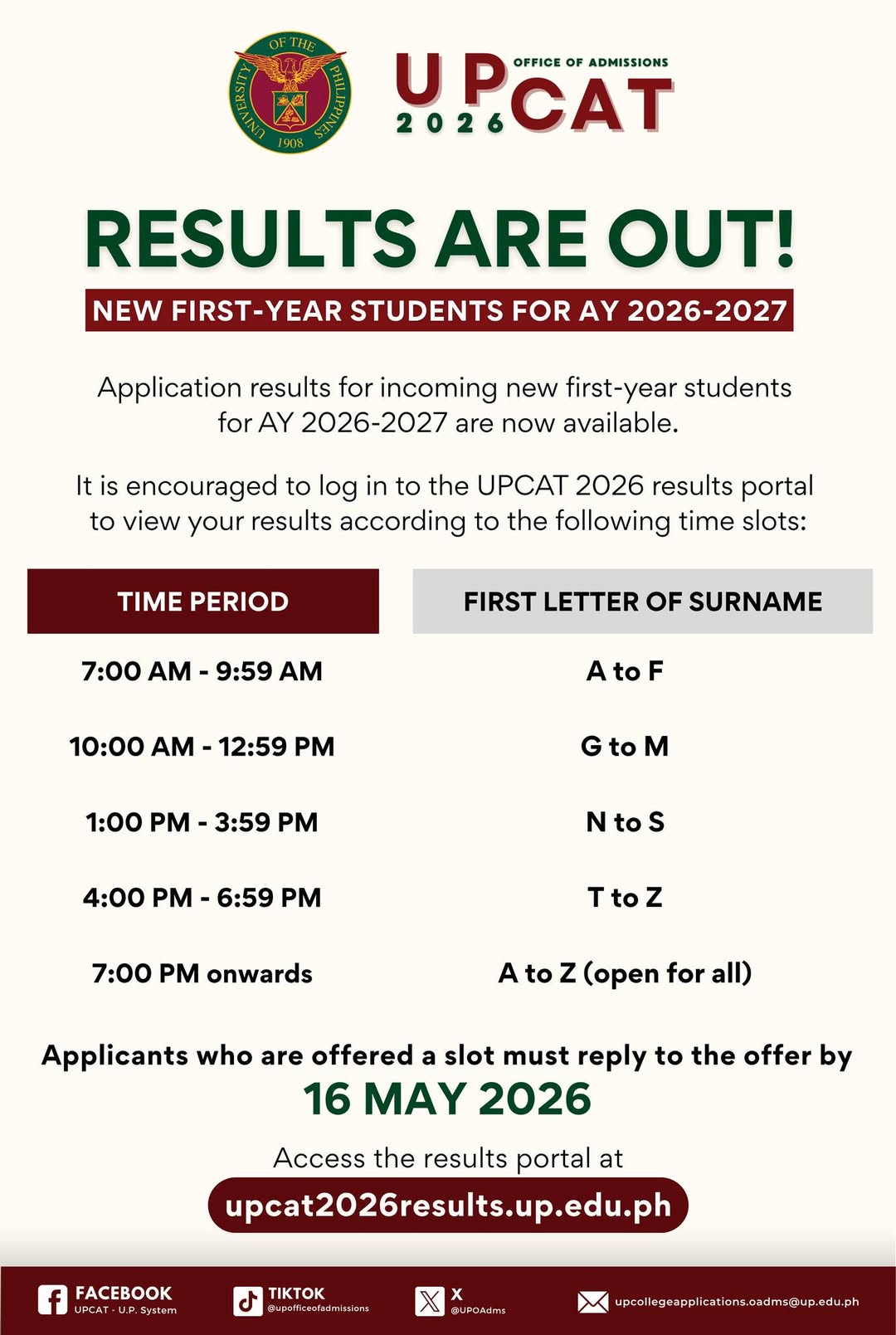
To check your status, log in to the UPCAT 2026 results portal using the same login credentials for your application.
The university encourages applicants to check their results in batches according to pre-selected time slots.
If your surname begins with A to F, log in between 7 a.m. and 9:59 a.m.; G to M, log in between 10 a.m. and 12:59 p.m.; N to S, log in between 1 p.m. and 3:59 p.m.; and T to Z, log in between 4 p.m. and 6:59 p.m.
CONTINUE READING BELOW

From 7 p.m. onwards, the portal is open for all.
Successful applicants must reply to the acceptance by May 16.
Steadily improving numbers
During a press briefing later in the day, UP president Angelo A. Jimenez said there were 18,350 passers, or 12.44%, among the 147,437 applicants this year. These include those admitted to degree programs and those on the waitlist.
Compared to last year, there were more applicants and successful examinees this year. In 2025, across 117 testing centers nationwide, there were 135,236 hopefuls who took the UPCAT; 17,996 passed.
"What we find encouraging is not only the growth in numbers but in what those numbers represent," said Jimenez.
Students from public schools, including public science high schools, comprise 57.1% of UPCAT qualifiers this year. Applicants from private schools make up 42.5% of the passers.
Jimenez shared that the number of passers from public schools has steadily increased over the past few years. In 2022, qualifiers from public schools comprised 44%; private school UPCAT takers made up 56% of the group.
"This is an important development, given the uneven distribution of resources across our basic education system. This trend suggests that the steps we have taken to expand and democratize access to quality UP education are beginning to make an impact in meaningful ways," Jimenez said.
Based on data presented, 29.68% of the qualifiers are based in the National Capital Region; 18.77% hail from CALABARZON; 11.24% are from Central Luzon; and 5.28% from Central Visayas.
Additionally, there are more exam passers coming from the provinces this year; notably, from Central Luzon, Central and Western Visayas, the Davao Region, Ilocos Region, SOCCSKARGEN, Cagayan Valley, Zamboanga Peninsula, Cordillera Autonomous Region, and the Bangsamoro Autonomous Region in Muslim Mindanao. There was also an uptick on qualifiers from the Middle East—from .04% to .23%.
Of particular importance is the UPCAT's expanding reach. A new testing center in Marawi City, Lanao del Sur, fetched a 22% increase in the number of UPCAT passers from the city.
"Where access improves, participation follows. Where participation increases, opportunity becomes more evenly equally shared," said Jimenez.
There were 32.4% accepted into the UP Diliman campus; 22.6% into UP Los Baños; 8.5% into UP Manila; 7.9% into UP Cebu; 7.6% into UP Baguio; and 7.5% into UP Visayas. Other passers got into UP Mindanao, UP Tacloban, UP Open University, and the UP Diliman extension programs in Pampanga and Olongapo.
The UPCAT consists of four subtests: Language Proficiency, Science, Mathematics, and Reading Comprehension.
According to its website, the standardized scores on these subtests are combined with the weighted average of final grades in the first three years of high school to determine the applicant's eligibility.

WATCH: Can we talk about death and grief? (Generations Ep. 25)
October 14, 2026
WATCH: Do you still believe in marriage? (Generations Ep. 17)
August 19, 2026