

Preparing for Super El Niño: What food and supplies should you keep at home?
With a strong to very strong El Niño now active in the Tropical Pacific, Filipino households may want to prepare for months of warmer temperatures and possible water shortages. According to PAGASA, the phenomenon is expected to last until the first quarter of 2027 and peak before the end of 2026.
In an interview on The Philippine STAR's Truth on the Line, Social Welfare Secretary Rex Gatchalian said that the government has been preparing for Super El Niño as early as 2025.
Per Gatchalian, the Department of Agriculture has distributed agricultural inputs, including fertilizers, ahead of time and invested in cold storage facilities and warehouses to help build up food reserves good for up to 100 days. The Department of Energy, meanwhile, has been preparing for possible power supply pressures by investing in battery energy storage systems and deploying energy barges in island provinces. These measures are intended to help provide additional electricity when demand rises.
While government efforts are underway, this doesn't mean you should go ahead and panic-buy or fill up your grocery cart with supplies that may go to waste. There are practical ways to prepare without overspending or hoarding.
Here's what emergency preparedness and nutrition experts recommend keeping at home, how long these food items can last, and how to store them properly.
What food items should you stock up on?
CONTINUE READING BELOW

Arvin Janolo Catipon, a certified emergency manager from the International Association of Emergency Managers, told PhilSTAR L!fe that households should prepare for more than just hotter temperatures, as El Niño can trigger a chain of pressures on water security, food supply, public health, livelihoods, and essential services.
According to Catipon, household preparedness can be organized into four categories: water, food, health, and hygiene.
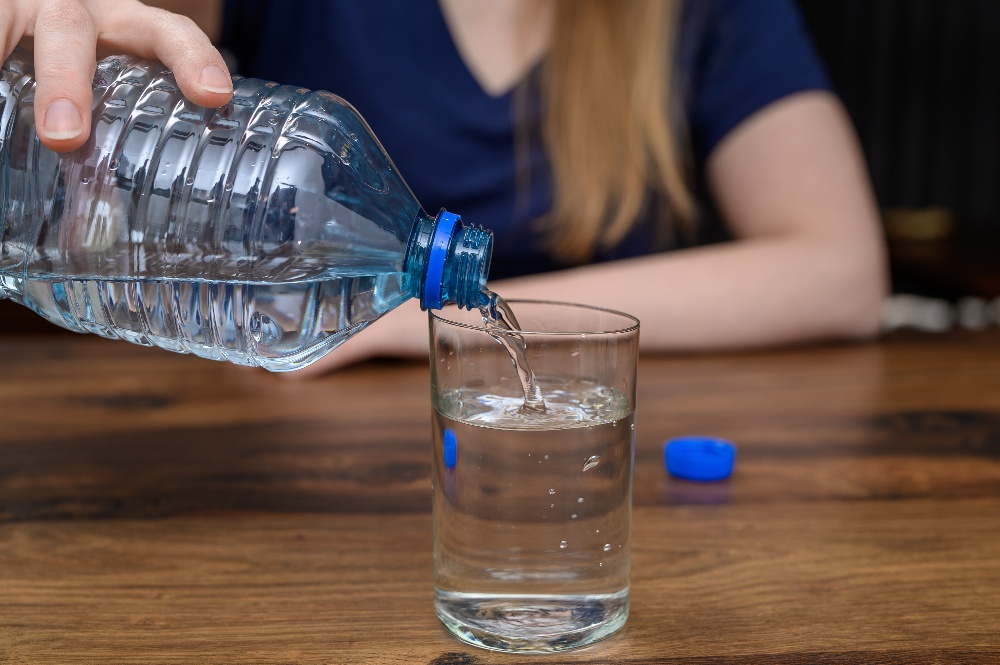
For water, it's important to store safe water for drinking, preparing food, and essential hygiene.
"Use sealed commercial water from clean, food-grade containers. And when we talk about water, at least four liters per person per day," he said.
"You can actually store more depending sa kakayahan ng pamilya," added Catipon. "It will really vary depending sa composition ng family. Whatever can sustain you for a couple of days or weeks, as long as hindi ito 'yung mga madaling masira."
Thinking of stocking up on bottled water? Find out how long bottled water lasts before it becomes unsafe to drink and what to keep in mind when storing your supply here.
When it comes to food, registered nutritionist-dietitian Mikaella Jeleene Asoy recommended affordable items that provide energy and other nutrients, can be stored without refrigeration, and require little water or fuel to prepare.
"Families don't necessarily need expensive products marketed as 'emergency food.' They can put together a practical, nutritious supply using familiar foods from their usual grocery list," she told L!fe.
"However, I would always encourage families to think about how they will prepare these foods. Even a large supply of rice will not be immediately useful without safe water and a way to cook it. That is why it helps to include ready-to-eat options," she added.
Below are some of the food items that Catipon and Asoy recommended and for how long they are best consumed:
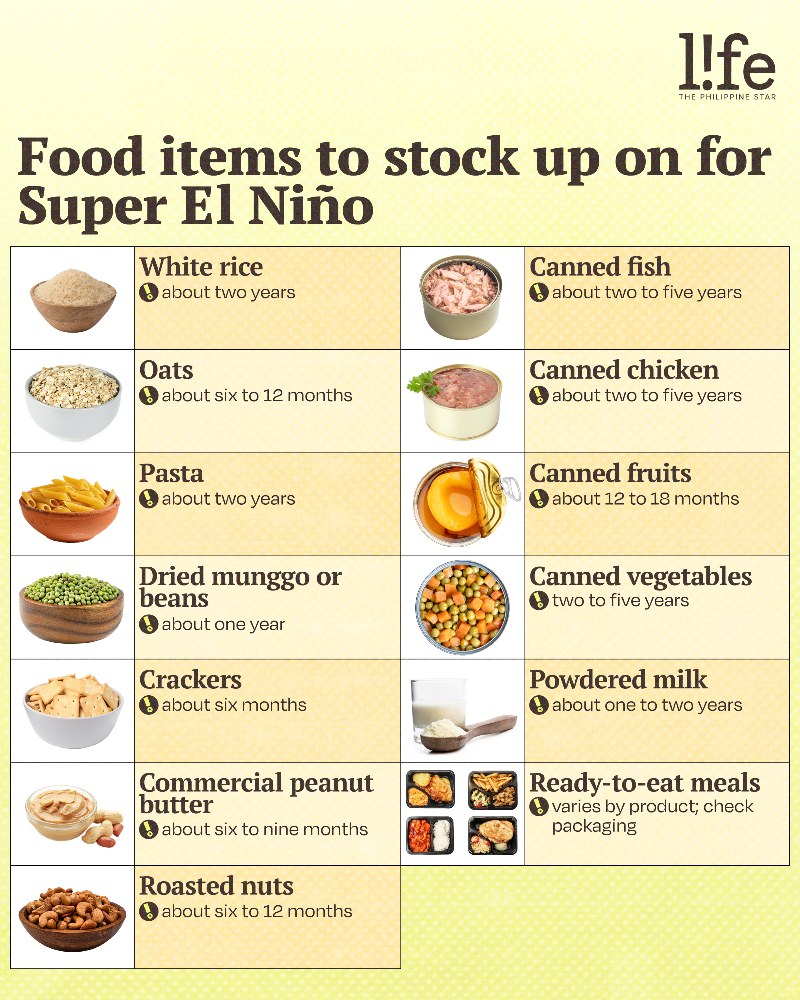
Asoy cautioned against buying large quantities of food that must stay refrigerated or frozen, especially if power interruptions are frequent and the household has no backup cooling.
"Filling the freezer with meat, fish, and frozen processed food may not be practical if there is no way to keep them safely frozen during an outage. It is better to keep manageable amounts and have alternatives that can be stored safely without refrigeration," she said.
Be wary of misleading packages as well.
"A product is not automatically suitable for pantry storage simply because it comes in a can, bottle, or vacuum-sealed pouch. If the label says 'keep refrigerated,' it still needs refrigeration," Asoy said.
When consuming food, Catipon advised eating the oldest item first.
"I would suggest na kahit hindi pa natin masyadong nararamdaman 'yung epekto, paunti-unti, magtabi tayo. And then kung wala pa rin tayong nararamdamang epekto, first-in, first-out rotation tayo sa mga naiimbak natin para somehow, napapalitan siya at hindi rin tayo nag-o-overspend," he said.
Asoy also noted that food isn't automatically safe simply because it has not reached its expiry date.
"Look for visible mold, unusual changes in color, unexpected stickiness or sliminess, and sour, rotten, or musty smells," she said. "For packaged food, broken seals, leaks, and bulging containers are warning signs. If you notice these changes, do not taste the food to check whether it is still safe."
She also gave a practical suggestion: "Check the stock at least once a month for moisture, pests, damaged packaging, and approaching expiry dates. If reliable refrigeration is unavailable, prepare only what the family can finish in one meal. Covering the plate protects food from flies, but it does not prevent bacteria from multiplying."
Asoy advised choosing the coolest, driest practical area in the house to store food. Avoid damp spaces such as the area under the sink and keep it away from direct sunlight and the stove.
"Store dry goods in clean, food-grade containers with tight-fitting lids. Keep both the containers and scoops dry. If buying in bulk, divide the food into smaller containers so the entire supply is not repeatedly exposed whenever you open one," she said.
It's recommended to keep hot food above 60°C, or promptly refrigerate cooked and perishable food, preferably below 5°C.
Nutritious alternatives to canned goods and instant food
While it's easy to rely on instant noodles, luncheon meat, chips, and sweets, eating only these items can pose a risk to one's health. Thankfully, there are several nutritious alternatives that you can choose.
"If safe water and cooking fuel are available, families can prepare munggo, beans, and oats. They can also keep manageable quantities of whole squash and sweet potatoes in a suitable cool, dry area," Asoy said.
It's better to treat these as foods to use and replenish regularly, rather than assume they will last for months in extreme heat.
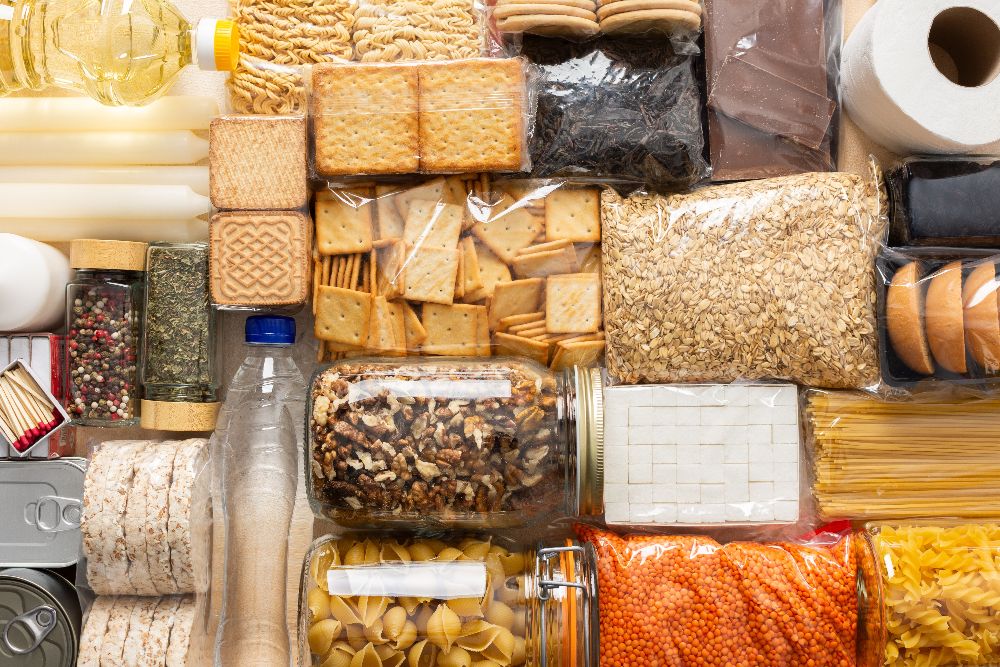
The Food and Nutrition Research Institute also cited dried legumes as alternatives to animal products and suitable dry storage for several vegetables and root crops.
"When cooking is not possible, options include commercial peanut butter that allows pantry storage, sealed roasted nuts or ready-to-eat roasted legumes, crackers, and dried fruit. Small cartons of shelf-stable milk can also be useful if appropriate for the household and consumed promptly after opening," Asoy said.
For cooked and perishable foods, remember the two-hour rule: Eat them or refrigerate them within two hours.
"I would give particular attention to rice because leftover rice is common in Filipino households. When cooked rice sits at room temperature for too long, it can become a source of food poisoning. Turning improperly stored rice into fried rice does not necessarily make it safe again. It is better to cook only what the family needs or promptly refrigerate any leftovers," Asoy advised.
How many days' worth of food and supplies should you have?
To prepare for Super El Niño, Catipon suggested keeping at least a two-week supply of essentials on hand. "It's a practical target, especially for households vulnerable to prolonged water interruptions or disruptions in food availability," he said.
This, however, doesn’t mean you should buy two weeks' worth of groceries all at once or stop replenishing your supplies afterward.
"As an example, for a family of four, a 14-day supply would mean approximately 56 person-days of food, or 168 individual meal portions if we assume three meals per person daily. The actual quantity of rice, canned goods, and other essentials should depend on the family’s normal consumption," he explained.
When planning quantities, Asoy advised thinking in terms of meals rather than simply counting cans.
"A family of four eating three times a day needs 36 individual meals over three days, aside from snacks. That does not mean buying 36 cans. It means checking whether the combinations and portions are enough for everyone," she said.
Other important things to remember
If you haven't started preparing for El Niño, Catipon underscored that the best time to start is now.
"It should really be like a routine for each Filipino family to work on their level of preparedness—not just for El Niño, but for all types of hazards," he maintained.
"The best time to prepare is not when the water stops flowing, hindi 'yung kapag wala nang tubig or kapag 'yung food prices tumaas na, or the heat becomes dangerous. It is while we still have time and options," he continued.
Apart from sustenance, other items that households should prepare include emergency go bags, important documents, and a clear evacuation plan in case they need to leave their homes due to hazards.
Since prolonged heat is a big concern, Catipon encouraged households to keep their homes as cool as possible and to prepare supplies like wet cloths, reusable cold packs, and the like.
"Gumamit ng mga shade, ng mga curtains against the direct sun, improve 'yung safe na airflow sa loob ng bahay, reduce 'yung mga unnecessary indoor heat sources, i-identify natin where a cooler public facility can be reached," he said.
At the end of the day, panic-buying is never a solution. Instead, you must consider your actual needs and financial capacity when building up emergency supplies.
"Most of us only have enough money to sustain our daily living. If we are not going to be logical sa pagbili or sa pag-stock ng mga basic needs natin to prepare for the effects of El Niño, ano na lang matitira sa panggastos ng isang normal na Filipino?" Catipon said.

WATCH: Why is it so hard to make friends? (Generations Ep. 26)
October 21, 2026