

Government workers prohibited from engaging in any form of gambling under updated policy
All government officials and employees are no longer allowed to engage in any form of gambling, in person or online, regardless of their location and time of day.
CSC Resolution No. 2600111, which was issued on Jan. 19 and published on April 23 in The Philippine STAR, applies to all government workers, including those who are of service to local government units, autonomous regional governments, state and local universities and colleges, and government-owned or -controlled corporations with original charters, unless otherwise provided by law. It will take effect 15 days after its publication in the Official Gazette or the newspaper.
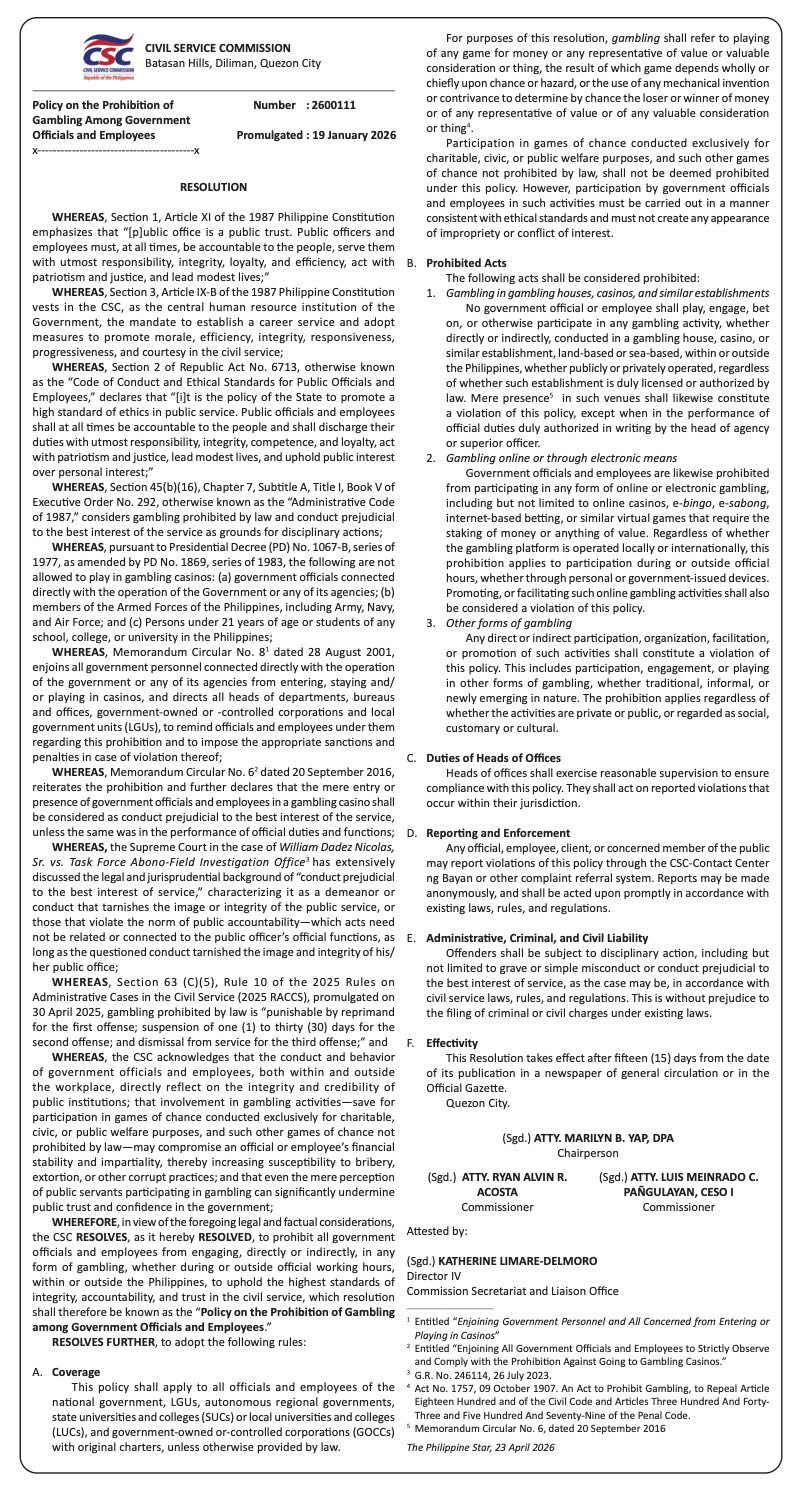
Gambling is defined as "any game played for money or value in which the outcome depends wholly or chiefly on chance, or the use of any mechanical device or contrivance to determine by chance the winner or loser of money," as stated in the resolution.
The prohibited acts identified by the CSC include entering or staying in casinos or gambling houses (including licensed establishments), whether land-based or sea-based, locally or abroad; online gambling via online casinos, e-bingo, e-sabong, and any internet-based betting; and organizing and participating in any other gambling activity, "whether traditional, informal, private, social, cultural, or newly emerging."
Per the CSC, mere presence in gambling venues constitutes a violation, "unless the official or employee is performing authorized official duties."
Games conducted exclusively for charitable, civic, or public welfare purposes remain permitted, provided they are legal and do not create an appearance of impropriety or conflict of interest.
CONTINUE READING BELOW

To ensure compliance, the CSC mapped out clear administrative penalties under the 2025 Rules on Administrative Cases in the Civil Service. First offense would be punishable by reprimand; second, a suspension; and third, dismissal from the service. It noted that these penalties are without prejudice to additional criminal or civil cases that may be filed under current laws.
Violations can be reported through the CSC Contact Center ng Bayan or other complaint referral systems. The Commission confirmed that even anonymous reports will be processed in accordance with existing rules.

WATCH: Discovering Vietnam in three days
June 9, 2026
WATCH: Why is it so hard to make friends? (Generations Ep. 26)
October 21, 2026