

We trained the AI that replaced us: Workers push back against AI in the BPO industry
More than a year ago, I was dismissed from a BPO company after giving an interview to an international publication about the risks that artificial intelligence poses to workers.
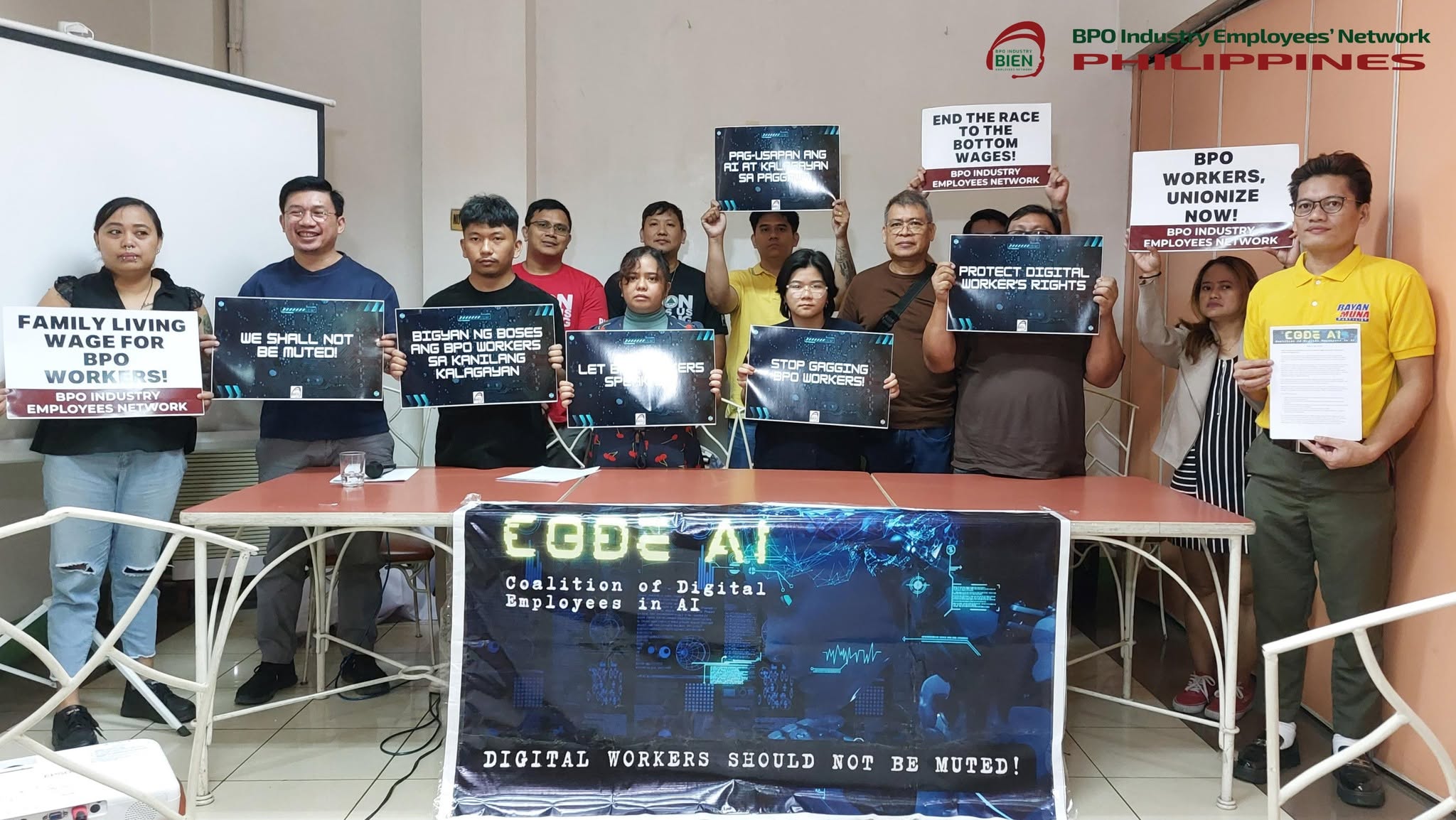
That experience became one of the driving forces behind the formation of CODE AI, the Coalition of Digital Employees-Artificial Intelligence, led by the BPO Industry Employees Network.
For many people, especially those fascinated by generative AI, it can be difficult to accept that this technology poses a serious threat not only to workers but to entire industries and communities.
For some, AI has become a researcher, legal adviser, therapist, friend, or even a lover. It is understandable why many see it as a helpful tool rather than a danger.
But for digital workers, the reality is different. We are increasingly being replaced by the very systems we helped train.
Last December, Quality Analysts at TaskUs were laid off due to AI adoption. These workers were responsible for evaluating the language, tone, and performance of customer service representatives. Their jobs were automated.

More recently, Meta announced the layoff of around 8,000 workers as it accelerates its AI investments.
The International Monetary Fund estimates that 36% of jobs in the Philippines are at high risk of AI-driven displacement, including the livelihoods of 1.6 million contact center workers in the Business Process Outsourcing industry. According to the Department of Trade and Industry, AI could replace up to half of all BPO jobs in the country.
And for those fortunate enough to keep their jobs, conditions are not improving.
AI tools are being used to intensify work through unrealistic productivity targets, hyper-optimized handling times, and automated scoring systems that continuously raise Key Performance Indicators without corresponding wage increases. Workers are expected to perform with machine-level efficiency while continuing to provide deeply human emotional labor.
At the same time, workplace surveillance has become far more intrusive. AI systems now monitor voice tone, typing speed, screen activity, facial movement, and behavioral patterns in real time. Workers are being subjected to constant algorithmic monitoring, often without transparency about what data is being collected, how these systems operate, or how AI-generated decisions affecting employment are made.
Worst of all, workers are not benefiting from the productivity gains created by AI.
Companies boast of improved efficiency, reduced costs, and higher output enabled by automation, yet these gains do not translate into higher wages, shorter working hours, or stronger job security.
A BIEN survey conducted from Jan. 22 to March 3, among 394 respondents across 56 BPO companies, found that 65% were earning below the family living wage, which stood at P27,196 per month as of January 2026.
In fact, BPO wages have regressed over time. In 2005, entry-level salaries ranged from P21,000 to P32,000 per month. By 2022, offers had fallen to between P13,000 and P28,000.
AI should serve humanity and uplift the dignity of work, not further deepen exploitation.
As AI intensifies exploitation, digital workers are finding even greater reason to organize, resist, and fight back.
CODE AI is campaigning to ensure that workers have a real voice in shaping the government’s roadmap for AI adoption.
We demand that AI-driven displacement be made visible. Companies should be required to notify workers and the Department of Labor and Employment before deploying AI systems that eliminate or significantly alter jobs.
We call for the creation of a Worker Displacement Fund financed through levies on AI-driven productivity gains, providing displaced workers with meaningful income support and retraining opportunities.
Workers must also have the right to know which AI systems govern their work, the right to contest AI-generated decisions through human review, and protection against covert algorithmic surveillance.
Beyond organizing workers on the ground, CODE AI and BIEN have participated in congressional hearings and gatherings organized by the International Labour Organization to raise awareness about the real impact of AI on labor.
And we are not alone.
Across the world, workers are organizing against the anti-worker use of AI.
The Japan Metal, Manufacturing, Information and Telecommunication Workers’ Union launched a petition against IBM over the use of AI in wage determination.
Amazon workers issued an open letter demanding the responsible rollout of AI technologies. Workers at Meta also protested software that tracks mouse movements and other forms of digital activity.
CODE AI stands with workers everywhere who believe that AI must have guardrails, and that workers themselves must have the power to shape how this technology is developed and used. AI should serve humanity and uplift the dignity of work, not further deepen exploitation.

WATCH: How does impeachment in the Philippines work?
May 19, 2026
WATCH: Do you still believe in marriage? (Generations Ep. 17)
August 19, 2026