

The weight carried by a slot in UP
Everyone deserves a slot in UP, even the burgis.
Every year, when UPCAT season arrives, a familiar storm brews. For students, it’s another surge of stress, sleepless nights, non-stop arrangement of documents, and long hours of prayer. For families, it is a shimmer of hope: for prestige, opportunities, and a brighter future. And for society, it is once again the spark for a never-ending conversation of who truly deserves to be in a state university long known for its quality education.
Like many others, I grew up being told that I should aim for the University of the Philippines. To pass UP meant wearing a crown of bragging rights, the honor of being counted among the “best and brightest,” and above all, the promise of learning without the chains of tuition weighing you down. UP is both a point of pride and financial relief. The students take the exam with the hope of a future within reach.
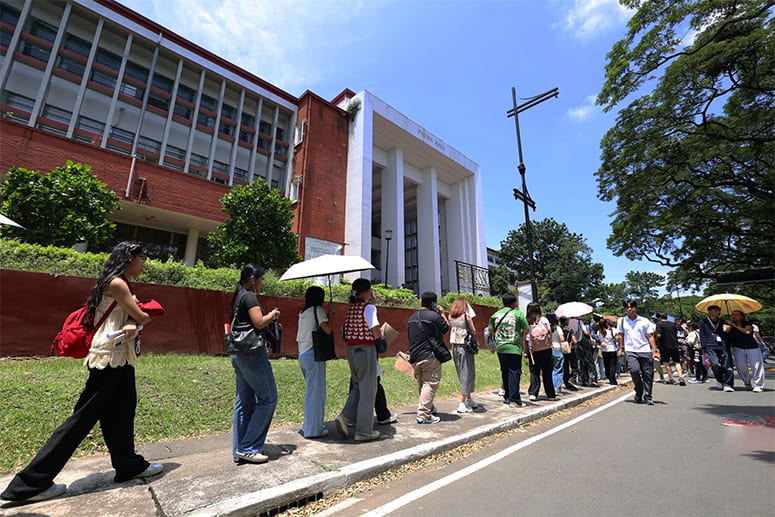
Considering the country’s ongoing struggle to provide quality education, UP’s prestige is undeniable. In fact, in the most recent EduRank report released last year, UP was ranked first in the Philippines, 366th in Asia, and 1348th worldwide.
But it is also precisely because of its prestige and being “open to all” that UP repeatedly becomes the center of heated debates. For instance, in a viral TikTok a few months ago, a UP freshman happily shared how his mother accompanied him to his first day of college. It was heartfelt—until he added, “She drove behind me in a separate car.” To many, it was a casual display of wealth, a reminder that some students can afford luxuries that contradict the very essence of a state university.
CONTINUE READING BELOW

At the heart of this debate lies the narrative of equality. UP, by design, is open to all, from the submission of grades to entrance exams. On paper, everything looks fair, given that all applicants experienced this at the peak of stress for a senior high school student: exams and thesis.
Those who pass are assumed to be intelligent, hardworking and deserving. That is why students from the middle class often defend themselves, saying, “We earned our slots like everyone else.” In a technical sense, they did. The competition was the same, the exam was the same, and the requirements were the same. In theory, everyone had an equal chance.
But was it really equal?
The truth is, not all students begin at the same starting line. Some are equipped with review centers, shelves of books, and parents who can afford to shield them from life’s harshest struggles—and there is nothing inherently wrong with that. Others walk into the exam room with nothing but knowledge from their previous classes, self-study sessions squeezed between part-time jobs, and a heart full of desperate hope. To pretend these two students competed under the same conditions is to ignore the reality of privilege.

And so, the real problem lies not in individual students, but in the system itself. Yet if you knowingly benefit from that broken system—if you take the slot of someone with fewer opportunities while you have the privilege to choose other schools—how are you any different from the corrupt politicians you so eagerly criticize, the very ones who exploit the less fortunate with empty promises to stay in power?
This is where the dilemma begins. When a wealthy student secures a slot, they do so with the comfort of knowing that if UP rejects them, they could still enroll in another top private university. For underprivileged students, however, UP is not just one option among many. It is often their only option. Beyond prestige, admission is survival. While other state universities offer free tuition, they continue to face the stereotype of being lesser than the Big Four. Hence, students chasing stability see UP as their only bridge sturdy enough to carry their families towards a life they have long been denied.
For some students, UP is just one of their options. For those not so privileged, it’s their only choice — and that’s why they deserve it more.
I think of this whenever I am asked why I refuse to apply for academic scholarships, even though my grades could qualify. My parents had enrolled me in a private school since preschool. It was not as prestigious as Ateneo, Poveda, or other big names, but still, it was a private school. When college applications came, I asked my parents if they could afford tuition at one of the Big Four universities. We do not live in subdivisions or carry generational wealth, so I knew the cost would be much higher compared to a smaller private school near our city.
My parents’ answer was simple: they could manage—not with full savings for all four years, but by working on it year by year. Their words brought me comfort. Our resources were not overflowing, yet they stretched far enough to keep doors open for me. The same doors that, for others, remained locked behind walls of steel, or were never built at all. That difference, the simple presence of an open door, was not just convenient but privileged.

To be honest, I sometimes imagine what life would be like if I became a scholar. If tuition were free, we could use the funds to travel, perhaps visit Japan or Thailand on holiday, or invest in other important things like expanding a business or building family savings. But each time that thought tempts me, I return to my parents’ answer. The security of options they worked so hard to give me is the very reason I cannot, in good conscience, take a slot meant for someone who has none.
Still, let us say a wealthy student truly dreams of UP, the culture, the activism, the identity it shapes. Then, at the very least, there must be sensitivity. The question has never been only about who passes through the gates, but about how they choose to walk once inside.
UP is not merely an institution of learning. It is a community forged in struggle. Parading wealth in such a space reveals cruelty beyond tone-deafness. It is to mock the resilience that UP students embody. This is why equality cannot simply mean “same exam, same process.” Equality also demands humility. It demands that those with privilege recognize their advantage and act within a community built for those with less.
So yes, everyone deserves a slot in UP, even the burgis. That, after all, is what equality should mean. But equality without sensitivity is an empty shell. If you insist on entering a space designed as a lifeline for many underprivileged students, then you must also bear the responsibility of respect and solidarity.
And if you cannot understand that equality demands these things, then the problem is not only the system. Perhaps it is also you.

WATCH: Can we talk about death and grief? (Generations Ep. 25)
October 14, 2026
WATCH: Pixar Summer Fest adventure at Hong Kong Disneyland
August 10, 2026