

A dinosaur egg? It’s asin tibuok!
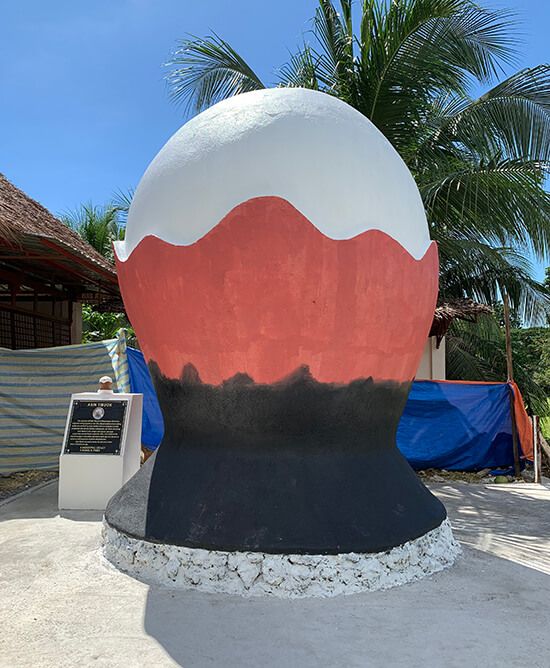
At first glance, the large white dome nestled inside a patch of brown soil looks like a dinosaur egg. In fact, that’s what the natives have come to call it: a dinosaur egg. What it really is, though, is a hardened mass of sea salt that had taken long months, laborious work, and a ton of patience to produce. It may not be as dramatic as the egg of a historic creature, but it does have a respectable history of its own, and a heritage to match.
Called asin tibuok, it has been produced in the province of Bohol since the 1700s or, as others believe, maybe even before the Spanish colonizers arrived in 1521. The making of it entails the distillation of earth, sun, sea, and fire, by skillful craftsmen who’ve devoted a lifetime to this ancestral legacy.
First, coconut husks are gathered, then soaked near the mangroves for three to six months in sea water, to give the resulting salt its distinctive taste. After being dried in the sun for several hours, the husks are heaped into a monstrous pile, then burned continuously by wood fire for several days, all the while being continuously splashed with sea water.
With fervor and ardor, the men keep vigil over the pyre, like devotees in a religious ceremony. They take turns sleeping and eating so that at least one, or some of them, can keep continuous watch.
The aim is to burn all the husks until they succumb into ashes. Called gazan, the ashes are pounded into powder, then packed into a funnel lined with buri and cogon grass. They are then bathed with more sea water, which becomes the brine that filters down into a container.
After enough brine has been collected, these are poured into clay pots heated by fire underneath, until the brine has hardened into salt and the pots are completely filled. When the bottoms of the pots crack, it’s a sign that the salt is now fully formed.
CONTINUE READING BELOW

The process of making this artisanal salt is so laborious and so tedious that for a time, it seemed to be doomed to extinction. Fortunately, renewed interest in recent years has convinced four families in the town of Alburquerque, Bohol to revive its production. Today, according to a video filmed by the National Commission for Culture and the Arts, asin tibuok has been recognized internationally and is listed in the Ark of Taste by the Slow Food Organization. In addition, asin tibuok has been added by UNESCO to the List of Intangible Cultural Heritage in Need of Urgent Safeguarding.
In the island of Panglao, along a highway surrounded intermittently by rice fields, a gigantic image of the dinosaur egg stands proudly beside a marker extolling its history. Nearby, a store sells retail portions of this heritage salt. One medium-sized “dinosaur egg” costs P400. It’s not exactly cheap, but considering that this is a consortium between fire, sun, sea, earth, and human labor, it’s well worth so much more.
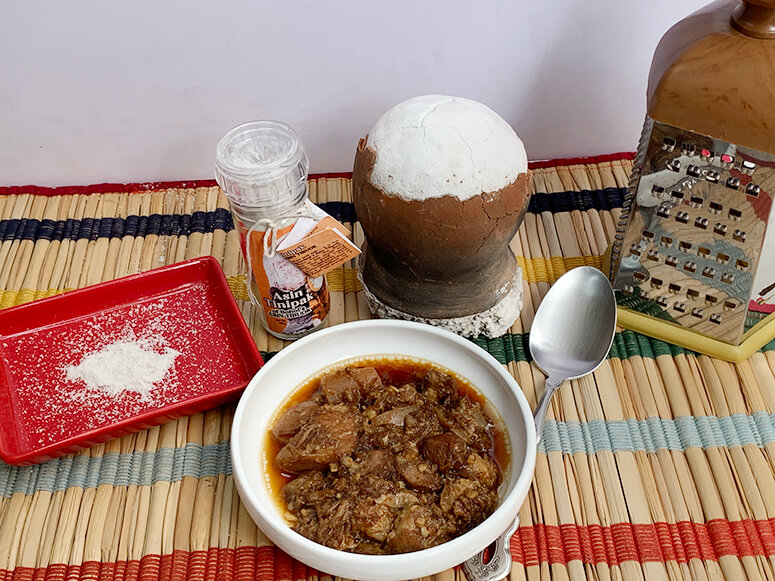
To use the “egg,” one has to grind the top of the dome, or scrape it with a scalpel, until one has collected enough granules of the salt. I quickly bought a few of these “dinosaur eggs,” only to find out later that they’re also sold in already grated form in bottles of salt grinders. Called tinapak na asin tibuok, it’s easier and more convenient to use. One bottle costs about P300.
In Bohol, people use the salt to cure meat and fish, to flavor their rice porridge, and to cook a dish called halang halang manok. “It’s considered a heritage. You can taste the ocean,” said writer and cultural development worker Procopio Resabal Jr., in the aforementioned video. On the other hand, chocolate maker Frances Macabenta said she uses asin tibuok to enhance the native chocolate drink called sikwate.
Others have similarly found creative uses for asin tibuok. At Toyo, Jordy Navarra’s award-winning restaurant, the leche flan is finished with a sprinkling of the salt. Sebastian’s Ice Cream, which has a kiosk at Podium Mall, has a chocolate ice cream bar that has a sprinkling of asin tibuok on the dark chocolate coating.
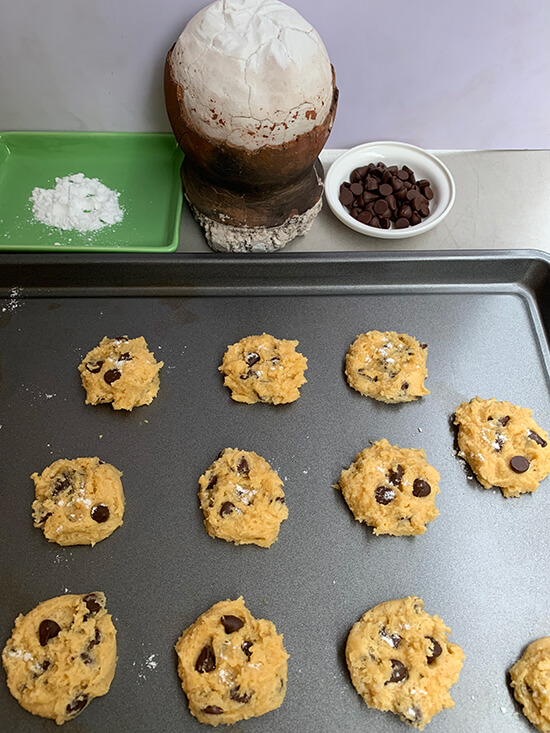
I myself lost no time tasting and experimenting with asin tibuok as soon as I got back from Bohol. It has a mellow, earthy taste, not as sharp as other salt varieties and, when grated, has a delicate, powdery texture. I found it ideal for salting the meat in adobo, and as a finishing salt to dust chocolate chip cookies and to top scoops of ice cream. Here’s a recipe for using asin tibuok as well as some suggestions for its uses.
Adobong asin tibuok
(Note: To grind the salt, you can use a box grater or a microplane citrus zester. When grating the asin tibuok, be careful to grate only the white salt on top—do not grate the underlying clay pot. As a precaution, peel off the clay as you grate the salt.)
Ingredients:
For marinating and first simmering:
- 1 kilo pork liempo, cut into medium-sized cubes
- 1 whole clove garlic, chopped
- 2 ½ cups rice vinegar, divided (you can also use white vinegar or cane vinegar)
- 2 Tbsps. freshly ground asin tibuok
- 1 cup water
- 2 bay leaves
- For the second simmering:
- 1/2 cup rice vinegar
- 1 cup water
Procedure:
In a large stainless steel or enamel or glass bowl (do not use aluminum), mash the garlic with the liempo. Pour in one-and-a-half cups of the rice vinegar and marinate for eight hours or overnight in the refrigerator. (If in a hurry, even two hours of marinating will do.) When ready to cook, sprinkle asin tibuok all over the meat then transfer the meat into a cooking pan (again, do not use aluminum, which reacts with the vinegar). Pour in the remaining one cup vinegar and the water. Toss in the bay leaves. Bring to a boil without stirring, then lower heat to a simmer. Simmer for 45 minutes to one hour, or until the meat is tender and almost all the liquid has evaporated.
At this point, there will be some residual oil in the pan. Brown the meat in the residual oil. In a small mixing bowl, combine the one-half cup vinegar and the one cup water for the second simmering. Pour into the meat and do not stir until the mixture boils. Then lower the heat to a simmer and stir to mix. Simmer for 10 to 15 minutes. Remove the bay leaves. Transfer to a serving dish and serve with rice and the tomato side dish.
Tomato side dish:
- 2–3 large, ripe tomatoes, diced
- 1 bunch wansuy leaves, cut into bite-sized pieces
- 1 medium-size cucumber, diced
- 1 Tbsp. asin tibuok
- 2 Tbsps. lime or calamansi juice
- 1 Tbsp. sugar, or to taste
Procedure:
Toss together the tomatoes, wansuy, and cucumber in a salad bowl. In a separate bowl, whisk together the asin tibuok, lime or calamansi juice, and sugar. Pour into the tomato mixture. Serve with the adobo.
Other uses for asin tibuok:
- Use asin tibuok as a finishing salt for leche flan (as done by the chefs in the award-winning restaurant Toyo). Sprinkle a few flakes of salt on top of leche flan right after it’s cooked or just before serving.
- Sprinkle asin tibuokon top of caramel frosting to create your own salted caramel cake.
- Before baking chocolate chip cookies, sprinkle the top of each cookie with a few flakes of asin tibuok. Then bake as usual. Because of its delicate texture, the salt will melt when the cookies are baked, but it will still impart its salty sweetness on the cookies. For a more pronounced salty flavor, sprinkle additional salt on the baked cookies right after you take them out of the oven. The cookies will have an intriguing, lip-smacking salty-sweet taste.
- When making fruit salad, add half a teaspoon of asin tibuok to the dressing. It can enhance the sweetness of the fruits.

WATCH: Discovering Vietnam in three days
June 9, 2026
WATCH: Pixar Summer Fest adventure at Hong Kong Disneyland
August 10, 2026
WATCH: Is OPM still as good as it used to be? (Generations Ep. 20)
September 9, 2026