

Places I will never visit
There are cities I will never know, not because I haven’t managed to book a flight or find the time to visit, but because they belong to another time. I will never walk through the streets of ancient Alexandria, stand before the walls of Babylon, or wander through Rome at the height of its empire. I will never see Port Royal before the sea claimed much of it, or discover whether Atlantis was ever anything more than a beautiful legend. These places exist now in ruins, archaeological discoveries, historical accounts and the imagination. I find myself wondering what it must have been like to live in them, to go about an ordinary day in a place that we now regard as extraordinary. How astonishing it must have been to call such a city home without knowing that, centuries later, someone would wish desperately to see it.
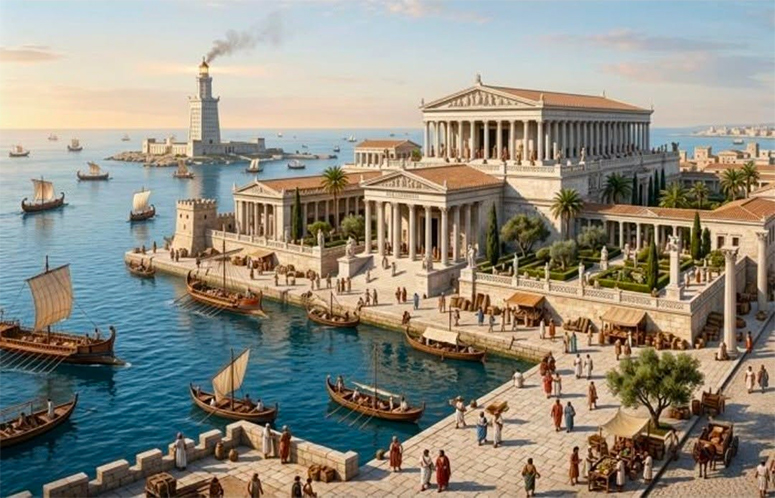
Alexandria would probably be near the top of my list. I would want to see the Great Library, naturally, and the Lighthouse of Alexandria, one of the Seven Wonders of the Ancient World. I would want to walk through its streets and imagine the scholars, philosophers, merchants, and travelers who once passed through it. This was a city where ideas traveled as freely as goods, where knowledge from different corners of the known world could meet and mingle. I would love to have seen what was collected in that library, what was discussed in its halls, and what might have survived had history been kinder to it. The Colossus, unfortunately, would have to wait for another stop: that magnificent statue stood in Rhodes, not Alexandria. Apparently, even my imaginary itinerary needs a little geographical correction.
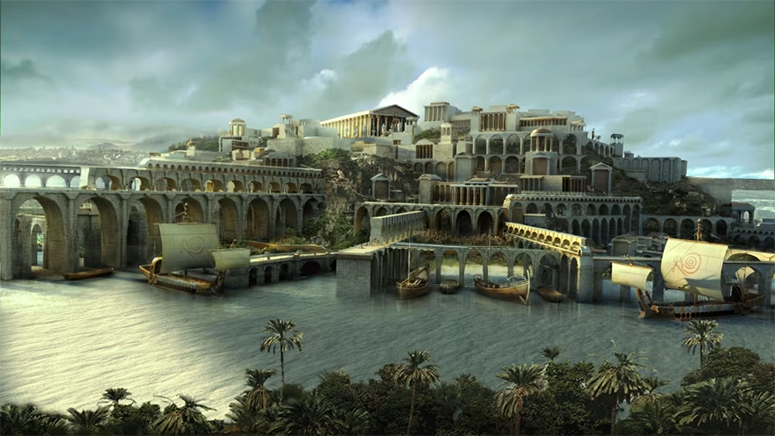
Then there is Atlantis. A mythical city, perhaps, but what a wonderful thing to imagine. First described by a favorite of mine, Plato, Atlantis has inspired centuries of speculation about a civilization swallowed by the sea. Was it simply a philosophical story, an illustration of the dangers of power and arrogance, or was there some distant historical event behind the legend? We may never know. I know that there is a similar one closer to home, in Ilocos Norte, and that my dad would say there was a cross in the full moon’s reflection on Paoay Lake which was the steeple of their church. But I would happily spend an afternoon wandering through an imagined Atlantis (or the one in Paoay Lake, as the trip there would be much easier), admiring its architecture and wondering what its inhabitants thought of their own extraordinary city before it disappeared.
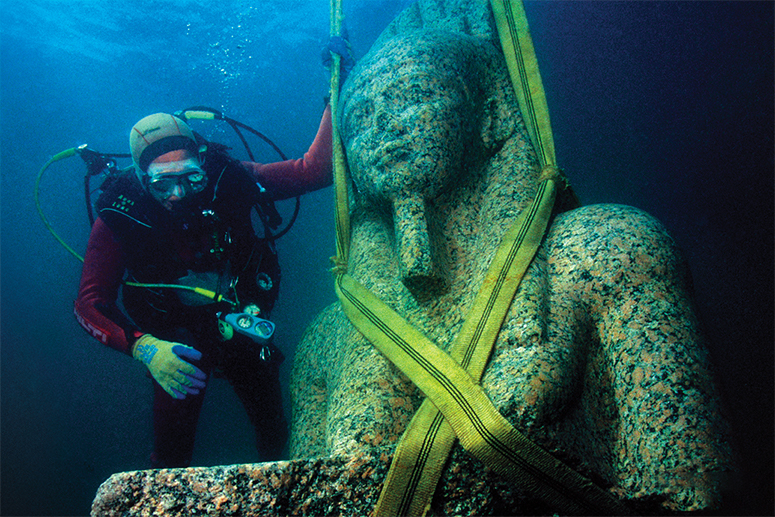
Egypt offers another mystery in Heracleion, an ancient port city that lay submerged beneath the Mediterranean for centuries. Unlike Atlantis, Heracleion is no legend. Its remains have been discovered underwater, revealing temples, statues, ships and traces of a once-thriving trading center. There is something particularly moving about a city preserved beneath the sea, as though time had simply folded over it. I would love to see it as it once was, busy with merchants, sailors and travelers arriving from distant shores. I would love to see Egypt in general, at present (it is a Bucket List entry of mine, especially after reading endless Egyptology studies and that book series Ramses), as well as ancient.
CONTINUE READING BELOW

Port Royal, Jamaica, is another matter entirely. Because: pirates! Once notorious as a haven for pirates, privateers and merchants, Port Royal was one of the Caribbean’s busiest and most infamous ports. Then, in 1692, an earthquake devastated much of the settlement, sending sections of it into the sea. I imagine taverns, ships, questionable characters, and stories that would probably make today’s travel advisories look rather tame. It must have been a fascinating, unruly place to witness, although perhaps not the safest place to call home. I have read a couple of books on the history of pirates and, yes, they are outlaws, but for people who are portrayed as vagabonds and cowards and whatnot, they seem to have extremely sophisticated hierarchy systems in place. That code of honor was no joke, however much else they f**ked over others.
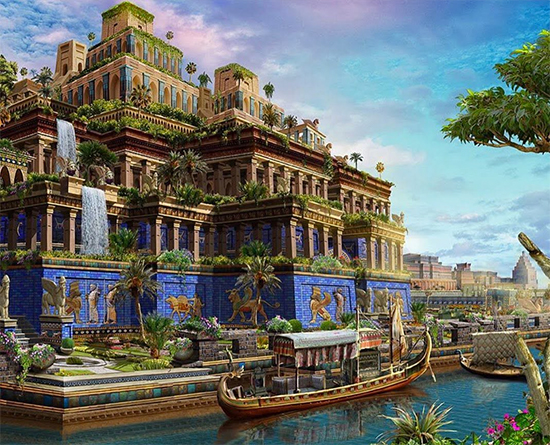
Babylon would be another must. The old city, with its immense walls, monumental gates and palaces, represents the kind of grandeur that is difficult to comprehend from photographs and archaeological remains alone. And, of course, there are the Hanging Gardens, traditionally associated with Babylon and counted among the Seven Wonders of the Ancient World. Their existence and exact location remain debated, which somehow makes them even more intriguing. I would love to know whether they really existed as described, and what it would have felt like to stand beneath their terraces of greenery in the middle of an ancient landscape.
Rome, at the height of its empire, would be an entirely different experience. I would want to see the Forum alive with political arguments, merchants, citizens, and public life. I would want to witness the scale of its buildings, its roads and its aqueducts, and understand how an empire of such reach operated from one city. We tend to look at Rome through the grandeur of its surviving monuments, but I suspect its ordinary streets would be just as fascinating. What did people eat? What did they complain about? Where did they go to gossip? Even the most powerful civilization in history must have had its share of mundane inconveniences. The book 24 Hours in Ancient Rome was an awesome bite into it; it would be amazing to see more.
Carthage, in present-day Tunisia, would be equally compelling. A great Phoenician city and formidable rival of Rome, it was a center of trade and maritime power before its destruction by the Romans in 146 BCE. I would love to have seen its harbors and bustling commercial life before the city was razed. We know Carthage largely through the accounts of its enemies and the remains that survived. How different might our understanding of its people and achievements be if more of their own voices had endured?
Then I would travel further east, to China during the Zhou Dynasty. This was an extraordinarily long period of Chinese history, and its later centuries saw the emergence of some of the philosophical traditions that would shape Chinese thought for generations. Confucius lived during the Spring and Autumn period, when competing states and political uncertainty provided the backdrop to his ideas about ethics, society, education, and good government. I would love to witness the intellectual conversations of that time, when questions about how people should live and how societies should be governed were being explored in ways that would echo for thousands of years.
And finally, I would bring the journey closer to home, to the Kingdom of Tondo. Long before Manila became the city we know today, Tondo was an important precolonial polity in the Manila Bay region, connected to wider Southeast Asian trading networks. I would love to see its settlements, its waterways and its markets, and witness the movement of people and goods that made this part of the archipelago an important center of exchange. We sometimes look so far away for great historical places that we forget there were remarkable worlds unfolding right here, long before the arrival of the Spanish.
I suppose this is another reminder that there are limits to how much of the world one lifetime can hold. Some cities I will never visit because they are too far away; others because they no longer exist, and some because they disappeared long before I was ever born. I can read about them, look at their ruins, study their maps and imagine their streets, but I will never know what it was like to stand in their markets, hear their languages or watch their people go about their lives. Perhaps that is what makes history so endlessly fascinating: behind every ruin was once a living, breathing city, full of people who had no idea that one day they would become someone else’s distant curiosity. I may never know these cities, but I am grateful that I can still wonder about them, and that I can continue to live in their stories through the endless books I read. We know so little of the future, just as we can never fully recover the past. It is a humbling thought, and perhaps one of the more tangible reminders of memento mori: we are here for a while, the world is vast, and so much of it will remain beyond our reach.

WATCH: Do you still believe in marriage? (Generations Ep. 17)
August 19, 2026
WATCH: Good parent ka ba? (Generations Ep. 28)
November 4, 2026
WATCH: Pixar Summer Fest adventure at Hong Kong Disneyland
August 10, 2026