

Agri journalists swoon over Vietnam’s tourism boom
Other than lavishing family funds on binges around Europe or bucket-list destinations, Filipinos indulge in a more accommodating pattern: brief tours of neighboring countries. Hong Kong, Singapore and Bangkok are the initial stops, with Tokyo and Seoul not far behind. Taipei became popular for cheaper flights, quality food and pleasant hospitality. Bali, Borobudur, Angkor Wat, Ho Chi Minh and Hanoi followed suit.
Of late, Da Nang in Central Vietnam has been drawing in Pinoys owing to word-of-mouth, with nearby Hoi An as a particularly enticing attraction, while Hue and Sapa farther north are calling.
A couple of weeks ago, our tour group of BrightLeaf Agri Journ Awards winners and judges could only agree that Vietnam’s tourism boom has become entirely enviable. While our country had six million tourists last year (down from eight million), Vietnam recorded another significant rise, to 21 million visitors.

The reasons became immediately evident. Upon arrival in Da Nang, our welcome lunch was at the Vit Quay Gia Truyen Madame Lan, a Michelin Select restaurant for the past two years. Popular for its Signature Roast Duck, it also nourished us with many other savory dishes, all awash with green stuff led by coriander, cilantro and parsley.
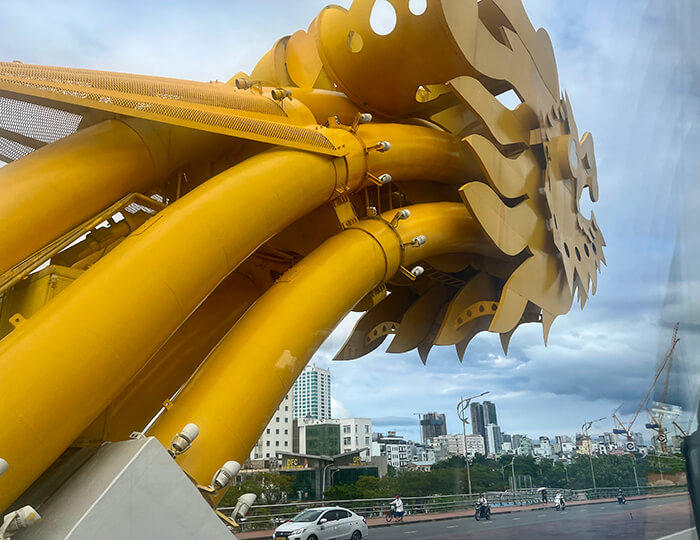
We only had time to drop off our luggage at the five-star The Courtyard by Marriott Danang Han River, before our first city tour had us crossing the uniquely designed Dragon Bridge again. Monkey Mountain beckoned with its immaculate Lady Buddha surrounded by bonsai gardens. The forested viewpoint also satisfied with constant cool breezes and a panoramic ocean view.
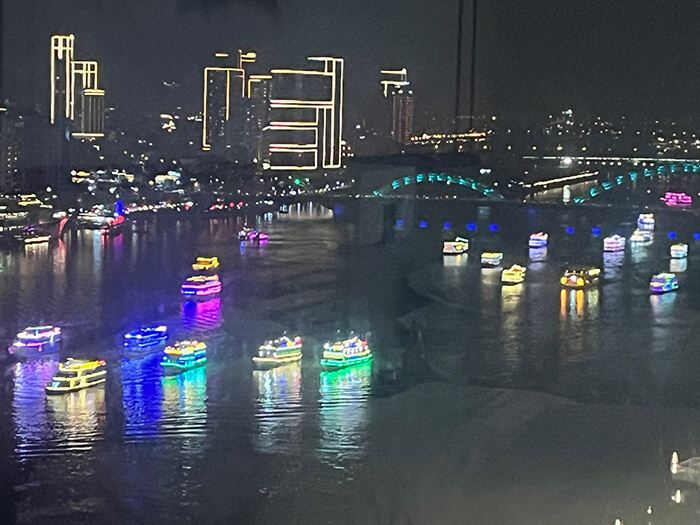
A quick check-in had the group scrambling for re-assembly for early dinner and shopping at the Le Duan Street Night Market. Save for this octogenarian who settled for his usual room service of a cheeseburger, with gratifying sorties to the smoking area outside the hotel lobby, and an even more inviting haunt on the al fresco top deck on the 45th floor, with its pool, bar, and terrific views.

Much as I’ve refrained from airline travel despite wheelchair privileges at airports, I make an exception of these annual tours that are bonus awards for the BrightLeaf contest winners, since I’ve chaired the judging for the past several years. On condition that I won’t have to join all the city tours that require much walking and climbing up for viewpoints.
The 18th BrightLeaf Awards given out last November also feted the winners with substantial cash prizes and MacBook Air laptops. Ten of them joined the tour: Jasper Arcalas of The Philippine Star, Kara David of GMA’s Kara Docs, Rosette Caballero of GMA’s The Atom Araullo Specials, John Ted Cordero of GMA News Online, Derco Rosal of Manila Bulletin, Marian Abalayan of SunStar Davao, Welmer Estrada of 91.1 FM Jelexie Radio, Willie Lomibao of Sunday Punch, Junep Ocampo of Agriculture Monthly, and Yolanda Sotelo-Fuertes of The Regional Examiner.
Three other chaperone judges were Tin Bersamina of Philstar.com, Corrie Narisma of the Inquirer, and J. Albert Araneta Gamboa of FINEX, who writes on finance for several publications. Representing PMFTC Inc. as the organizers were Inna Plijter, Didet Danguilan, Cor Rener, and Kim Ng.
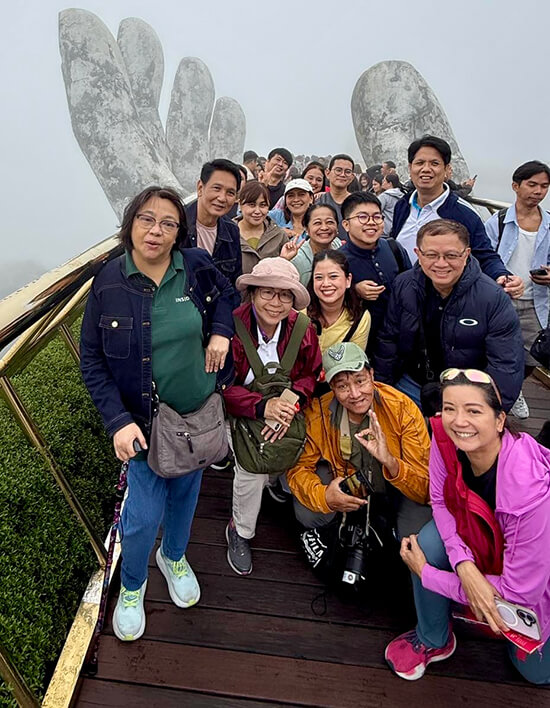
I cut out from the Day 2 tour, content to sun myself at the top deck poolside and work a bit in my room. It turned out that I missed quite an enjoyable day, with the group taken to Ba Na Hills, where the longest single-track cable car system in the world, opened in 2013, stretched 5,801 meters through the clouds. The 30-minute ride offered 360-degree views until it reached the Golden Bridge at 1,400 meters above sea level. Photos shared by the group showed everyone posing happily, fog-embraced, on the bridge that has become a symbolic image for Da Nang with its supportive enormous hands.
On our Viber group thread, Kara David commented on another stop: “(T)his ‘French village’ is actually a theme park filled with replicas and made-up buildings. The structures look medieval but they’re actually built in 2007.”
Willie Lomibao busied himself with shots of the flower gardens of Le Jardin D'Amour, while Junep Ocampo did the same with the caves and every tempting angle—for selfies, groupies, and whatnot.
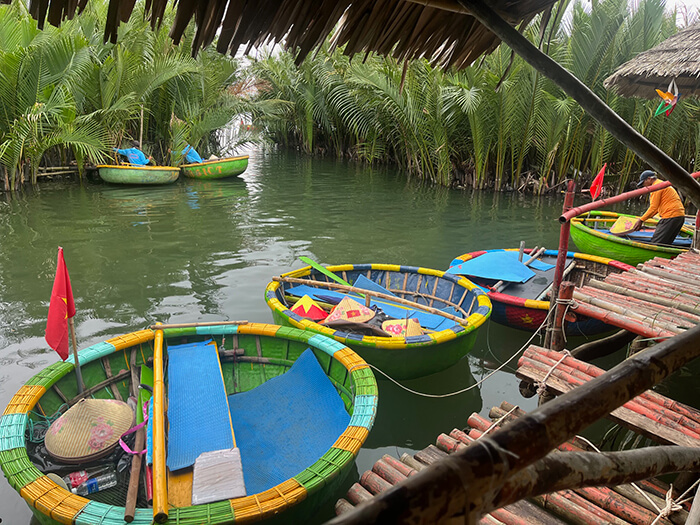
I joined up for Day 3. The tour bus took us to the Marble Mountain, where tourists can choose to take 300 steps up, or settle for lifts. 19th-century pagodas, marble Buddhas, and several caves were points of interest. Next stop was the Cam Thanh Coconut Village, where we had a country-style lunch before most engaged in river frolics on round bamboo basket boats.
Our last, climactic stop was at Hoi An Old Town. A sudden downpour didn’t stop us from skipping on watery streets while bearing large umbrellas, and through a silk weaving factory, to get to the popular Tri Long café with its venturesome coffee brewing methods. These produced such delights as Egg Coffee, Salted Egg Coffee, Avocado Coffee et al. These items are now widely recommended by Pinoy visitors.
The group toured the Frenchified old town by foot. Corrie and I rested with yet another Durian Smoothie and Ginger Candies until we were fetched by our tour guide. Everyone else was waiting for our boating schedule by the river. Here was where a legion of foreign tourists congregated, waiting for their turns to experience a favorite ritual in Hoi An.
Groups of five board a boat steered by a boatman through the placid river. Each one lights up a candle in a paper lantern, makes a silent wish, and gently casts these down to float around. It’s a picturesque spectacle developed only in the past decade, as with most other attractions in and around Da Nang.
As we sat down for our final dinner at another Michelin favorite, the Morning Glory resto that overlooked a crowded night market, our table group came to the conclusion that Vietnam’s capitalist re-orientation was complemented well by its Communist Party leadership, which alone selected all officials country-wide. Thus, unlike democratically elected mayors or governors such as ours, they cannot undo whatever directions are started by predecessors.
This allows Da Nang to establish continuous orderly projects such as what we had seen. Remarkable are the neat stretches of a coastal highway that borders wide creamy beaches, while across are high-rises with hotels, residential condos, restaurants, galleries and sundry parlors.
These simulate modest versions of Rio de Janeiro or Miami’s South Beach—everything pleasant for kilometers on end, until it even features five-star resorts hugging the coastline. We don’t see these in Mactan, Palawan, Panay, or Negros. Not in Bicol, Zambales, Romblon, Masbate. Not in Mindanao. Our islands are blessed, but the short-termers that govern them are not—with decades of continuity.
Agriculture is yet another matter. Which country produces more and better rice, fruits, and vegetables? Who needs more policing? Such sad questions, not only for Pinoy tourists.

WATCH: Is Gen Z too soft? (Generations Ep. 23)
September 30, 2026
WATCH: LGBTQIA+ people with unlikely professions
June 28, 2026