

In defense of the fruitcake
I never thought I’d be glad to find that a shop I frequent has run out of fruitcakes. “All sold out, Ma’am,” the clerk at the counter of The French Baker told me. While I was disappointed, since I had wanted to buy a fruitcake, I was also delighted. After all, this meant that people were still buying fruitcakes—the cake that has been getting a bad rap these past several years, the cake that’s been the butt of old jokes, vilified and ridiculed, the cake that’s said to be re-gifted so often that, as one comedian put it, “there’s only one fruitcake making the rounds all over the world.” And yet it’s also the cake that I, and many others, have loved since childhood.
That the day’s supply of fruitcakes had run out confirmed what I’ve felt all along—that despite all the bad jokes and mockery surrounding the fruitcake, I wasn’t alone in my fondness for this beloved symbol of the Christmas season. It was proof that the fruitcake, with its centuries-old history, still has staying power.
Some food historians trace the beginning of the fruitcake to the Sumerians, an ancient civilization dating back to 4500 BC. They’re believed to have made dense, sweet cakes packed with fruits, nuts and honey—precursor of the fruitcake as we know it today. Others trace the fruitcake’s origin to the Egyptians, who would bake the cake as a way of preserving fruits and nuts. On the other hand, during the Roman Empire, bakers would mix fruits, nuts, and barley with honey and serve the cake at weddings and as an offering to the gods.
Fast forward to the Middle Ages. By this time, the cake had morphed into one baked with expensive ingredients such as figs and dates as well as exotic spices like cinnamon and nutmeg. This anointed the cake with an aura of exclusivity and for a time, fruitcakes became associated with wealth and abundance.
Much, much later, the use of sugar and butter made the fruitcake even more indulgent. It was considered a luxury and a prized gift in Victorian England. Fruitcakes also reached the American colonies. During the American civil war in the 19th century, anxious wives and mothers would send fruitcakes to soldiers on the warfront. Not only was it considered a prized delicacy, giving the soldiers much-needed sustenance, it was also a practical treat, as it could withstand shipping across the miles and would remain fresh for several months.
This storied history should give the fruitcake the respect it deserves, instead of being scorned and ridiculed. Not only does it symbolize the festive season, it’s also a symbol of survival, of sturdiness and tradition, of love and thoughtfulness, of fond memories and of the continuity of life.
CONTINUE READING BELOW

Moreover the fruitcake and its distant cousin, the plum pudding, have been immortalized in literary works. Charles Dickens prominently mentioned the plum pudding in his classic tale A Christmas Carol. Likewise it played a starring role in Truman Capote’s ‘‘A Christmas Memory,’’ where his best friend and much older cousin gloriously proclaims: “It’s fruitcake weather!” Whereupon they set out to gather nuts and fruits in the nearby woods. Even Agatha Christie, the queen of mysteries, glorified the plum pudding in her novel The Adventure of the Christmas Pudding. (After I read that book, I craved plum pudding so much that I baked one myself and served it at a Christmas party.)
When I was growing up, Christmas wouldn’t be complete without a fruitcake. It was the centerpiece of our holiday table, to be admired first before being sliced and savored bite by scrumptious bite. My siblings and I especially loved the glazed cherries on top, the shimmering walnuts and pecans, the occasional candied apricots, and the faint traces of brandy or rum that enveloped the taste buds ever so subtly.
Alas that isn’t what it’s like at home today. My children’s regard for fruitcakes is at best indifferent. My husband, while professing to like fruitcakes, eats only a slice or two of it, due to digestive issues.
Nevertheless, I soldier on. I take comfort in knowing that many of my friends also love this confection which brings back many happy memories. As soon as the Christmas season rolls along, I’d scout for my favorite fruitcakes, though I knew in my heart that at home I’d be the one who’d eat most of it. Sometimes, I’d send a few slices to my friends, and to my brother Tony, who shares the same nostalgia for the fruitcakes of our childhood. Because fruitcakes have a long shelf life, I’d tuck some slices in the freezer, so I could enjoy this treat long after the holiday season. (Fruitcakes are best eaten well chilled.)
The other day, in search of a fruitcake, I went to a bigger branch of the French Baker, wondering if one would be available. This time, several boxes of fruitcakes were sitting on the counter. ‘‘They’ve been moving fast,’’ said the saleslady, but we still have some stocks today. I lost no time in purchasing a box.
Here are three of my favorite fruitcakes which I eagerly look forward to year after year:
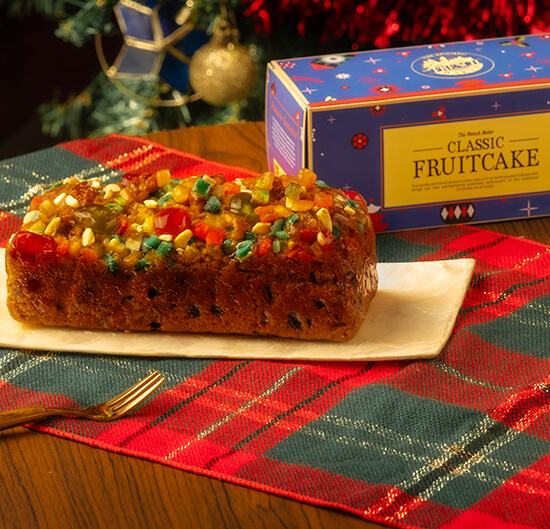
The French Baker. As soon as you open a package of French Baker’s fruitcake, you inhale the intoxicating aroma of rum, cognac and French brandy. Then you see a constellation of glazed cherries, raisins, and walnuts adorning the top of the cake, promising deliciousness and the tantalizing flavors of years gone by. Inspired by French celebration cakes, the French Baker fruitcake is enhanced with butter, sugar, spices and molasses, and lovingly brushed with the aforementioned rum, cognac and French brandy. It best resembles the fruitcakes of long ago.
“We prepare them as early as three months before the Christmas season,” says founder and CEO Johnlu Koa, so they’re properly aged before they hit the stores. Long shelf life is ensured by glazing the cakes periodically with alcohol and sugar syrup.
The fruitcakes are sold in all 88 branches of the French Baker nationwide (including six outlets in Davao) for P700. Koa says he himself is a big fan of their fruitcake. “It’s a very versatile product that can be eaten as a snack and dessert,” he says. “It can also be kept at room temperature for half a year and up to two years when frozen.”
Other Christmas products at French Baker include: Bûche de Nöel (a Christmas log cake); gingerbread character cookies, Danish butter cookies and sourdough panettone fruit bread.
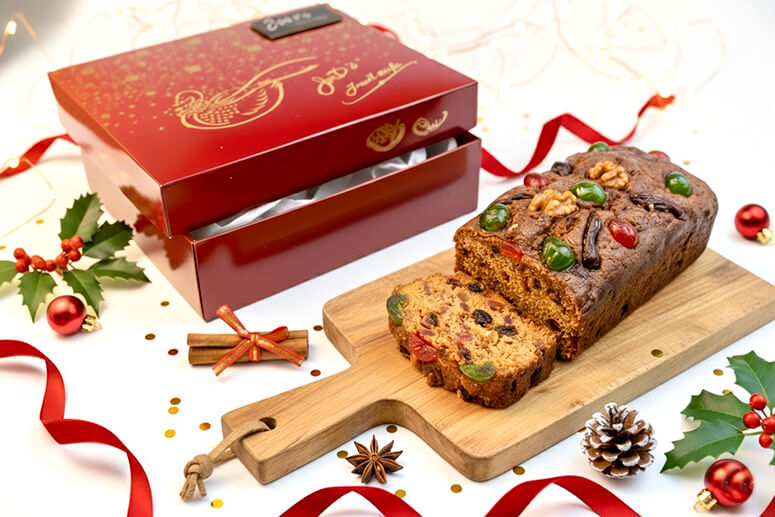
JuD’s Fruitcakes. Started by Judy Lao 50 years ago, JuD’s fruitcakes best combine tradition and innovation. At first, she says, “not a lot of people knew about fruitcakes and I was basically selling to friends or friends of friends. Nowadays, I’ve seen children of my former clients buying from me as if it has become a family tradition for a lot of them.”
Judy starts baking the cakes as early as September, making sure to age them with cherry brandy. Her fruitcakes are generously studded with raisins, dates, glazed cherries and walnuts. More than just following tradition, Judy has also reinvented the fruitcake—by turning them into fruity cookies. These cookies taste very much like fruitcakes, but they’re handier to eat as they can be easily grabbed and munched per piece.
Making the fruitcakes even more enticing is the attractive packaging. The fruitcakes and cookies are all encased in bright glossy red, green, blue, violet and gold boxes embossed with shiny gold letters and art work—which makes them quite impressive gifts.
Another of Judy’s innovation is the Jubilee cake, which she developed in honor of their 50 years in business. “We really wanted to do something different,” she says. “We figured there should be the inclusion of healthy ingredients like honey, cranberries, prunes and of course walnuts.” They’ve also included fresh oranges.
For Judy, this represents what the company went through the past 50 years. “There was happiness as well as sadness/challenges in every step we took. All these emotions are included in the sweetness and a bit of tanginess blended in the Jubilee fruitcake.”
Other variations on the fruitcake include coffee fruitcake, apricot/cranberry and coffee/prune cake. All fruitcakes are at P1,950 a box, while the chewkies and butter ginger cookies cost P500 for a box of 12.
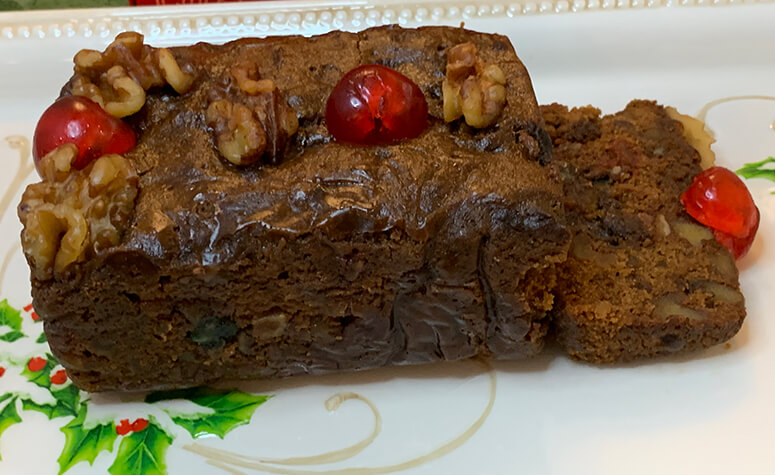
Judy’s products are available in their home base at 50 Greenmeadows Ave., Quezon City, and in Salcedo Market, Makati, on Saturdays. For orders, call 863-31188.
Mary Grace Café: This café started out modestly by selling ensaymadas and cheese rolls in kiosks and Christmas bazaars. When the products became a hit, Mary Grace decided to put up one café, and then another, and then another. Today, branches of the café have sprouted all over the country—and a branch in Singapore will open soon.
But though famous for their ensaymadas and cheese rolls, Mary Grace should also be noted for their classic fruitcake. The moist cake holds treasures of candied citrus fruits, cherries, walnuts and raisins, baked with butter and aged with brandy. Best of all, the fruitcakes (at P700) are available all year round—and are also sold in single serving slices, so customers can always satisfy their craving for fruitcake.

WATCH: Save for retirement or enjoy life now? (Generations Ep. 21)
September 16, 2026