The small worlds of Derek Tumala’s dioramas
There is a charm to the small worlds of nature dioramas: They unveil an impossible view of the earth’s topography and the hidden workings of the universe—all too vast, all too entangled for the naked eye to grasp all at once. Often, it is a cross-section or a piece of the earth, an ecosystem stilled in time, a microcosm of an entire world that becomes graspable in one’s hands.
The nature diorama is nothing alien to Derek Tumala’s art practice. Last year, his work Kayamanan ng Pilipinas (Treasures of the Philippines), a digital environment simulated according to real-time atmospheric data at the Dipidio mines in Kasibu, Nueva Ecija, was presented at the Potter Museum of Art in Melbourne. In 2023, he exhibited a set of papier-mâché dioramas depicting the slow death of an agricultural landscape for Adaptation: A Reconnected Earth at the Museum of Contemporary Art and Design (MCAD). This same set of papier-mâché models was initially rendered digitally for Tumala’s online sandbox project entitled Tropical Climate Forensics (2021-2026), which recently culminated this April in the release of its final digital biome called Komunidad.
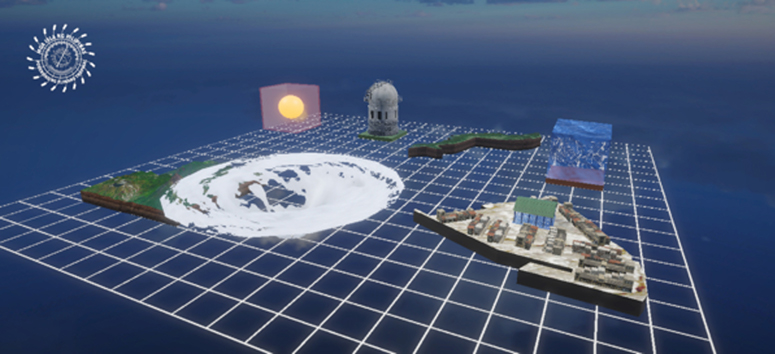
Derek Tumala’s Tropical Climate Forensics is an exploratory web diorama that illustrates the impact of the climate crisis throughout seven digitally interactive biomes: Init (Heat), Tubig (Water), Bagyo (Typhoon), Bulkan (Volcano), Gubat (Forest), Obserbatoryo (Observatory), and Komunidad (Community). In each biome or diorama, the user is able to move around and explore a different environment where point-and-click interactions yield texts that each build towards a narrative evolution of the ongoing climate crisis as experienced in the Philippines. Commissioned by the Museum of Contemporary Art and Design for the World Weather Network, the project draws from Tumala’s research during a residency at the Manila Observatory.
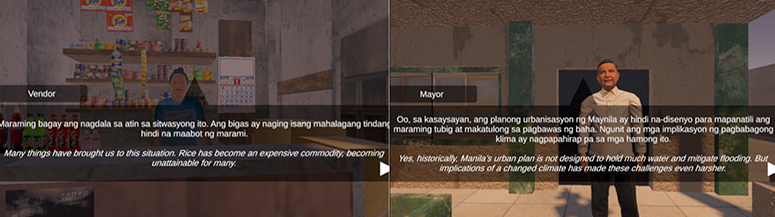
In Tropical Climate Forensics, Komunidad departs from the previous biomes by situating the user in a virtual urban topography instead of a natural one. The environment is based off of the Baseco Compound in Tondo, Manila, an artificial river island often devastated by flooding, high tides, and pollution from the heavy accumulation of waste. Originally built as a shipyard for Manila’s port area, Baseco eventually became a settlement site for those displaced by the city government’s clearing operations in pursuit of its neoliberal development projects.
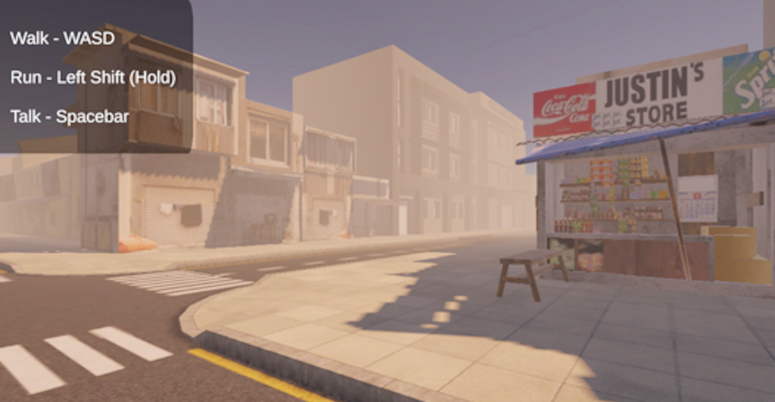
Here in Komunidad, you walk amidst Baseco’s adjoining makeshift concrete infrastructures and interact with locals like the tindera, the mayor, the community doctor, and the local teacher. Drawing from their roles in the community, the characters impart respective understandings of their immediate social and material conditions by situating these within the wider phenomena of environmental degradation and climate change.
It becomes apparent through this series of virtual interactions how blatantly intertwined everyday life actually is within a greater social and environmental matrix: As the locals relate the compounded problems of climate change, food insecurity, and inflation to the mass machinery of capitalist greed for accumulating power, this same greed is echoed in a reference to the corruption-laden flood control projects which have left city drainages unequipped for heavy typhoons. Extreme temperatures and fluctuating weather conditions that pose detrimental health risks are also linked to normative ways of dwelling stripped of genuine empathy and care, giving precedence to money and power at the expense of nature and human life.
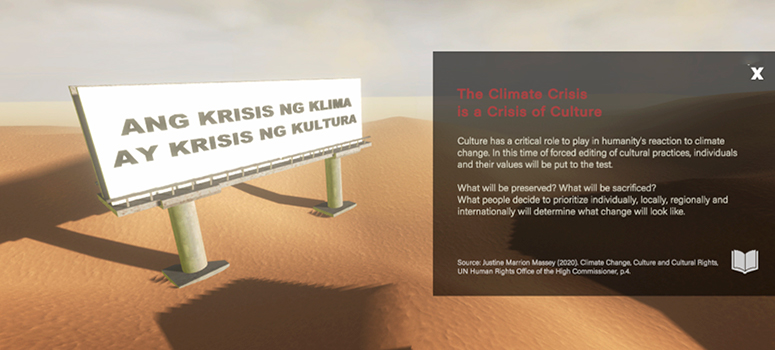
To echo the words of novelist Amitav Ghosh, “...the climate crisis is also a crisis of culture, and thus of the imagination.”
While the man-made topography of Komunidad departs curiously from the previous biomes, what ultimately emerges here is still an ecology. It is a diorama of lived realities, of microcosmic lives intertwining. By allowing us to see this entangled matrix of reality in a virtually interactive space that thrives on code and connections, Komunidad shatters the illusion of our lives as small worlds in isolation, like dioramas stilled in time and enclosed in glass. It remarks on this myopic way of looking at our present conditions that prevents us from seeing our lives as a part of something socially, historically, and cosmically larger.
Although it is admittedly not always easy to see this totality when the struggle of getting by every day is a reality for many Filipinos, Komunidad shows that the simple practice of empathy in the ways we dwell goes a long way. The mere act of care entails a mindfulness of something outside of ourselves—be it things, people, nature, or the universe as a whole, and so to understand that our being-in-the-world is always a being-with-others.
“To decode the network of living things as world-making,” then, as the project concludes, is to understand this complex ecology of the social, political, cultural, environmental, as well as past, present, and future. The small worlds of Derek Tumala’s dioramic space are larger than they seem, if not just as grand as the desire to transform this very ecology into a world more just and more caring.
* * *
Visit the site porensiko.ph/komunidad to explore.