

Heroes and mothers: ‘Forgive me,’ said Emilio Jacinto in a newly-discovered poem to his mother
Our heroes—who were always on the brink of throwing their lives away for a greater cause—would always have a complicated relationship with the women who gave them that life.
While Jose Rizal grew up happily at the knee of Teodoro Alonzo, reading books from the family’s thousand-volume library and learning precocious parables from his mother, there were also men like Andres Bonifacio and Emilio Jacinto who were nurtured by the memories of their mothers. All three of them were prepared to risk it all.
Bonifacio had an upbringing straight out of Charles Dickens’ Oliver Twist. He was the oldest of a brood born to a struggling gobernadorcillo (little mayor) of Tondo and a mother who worked in a cigar factory (approximately where the Chinatown Museum now stands). Both parents died one after the other, bringing calamity to the entire family.
Bonifacio was forced to leave school to eke out a living on the streets, supporting his brothers and one sister by fashioning canes and paper fans and hawking them on the busy streets of Tutuban. He would teach himself how to read and write—in Spanish and French, and one suspects, even German, since he wound up working for the Sta. Mesa Cement Tile Company, owned by Carlos Fressel, as a record-keeper. Bonifacio would moonlight as an actor, appearing in moro-moros, those Christian-Infidel passion plays. No doubt this is where he learned the charismatic ways—for he had no mother to guide him—that served him in good stead as a leader of the Katipunan. Would he have been even more daring if he had a mother to say otherwise?
He would cross swords with Emilio Aguinaldo, who was more consiglieri than mother. Doña Trinidad would reportedly sit in a hidden room during Cabinet meetings, eavesdropping on the proceedings. She was an iron-willed schoolteacher and had money of her own, so when her husband died while Aguinaldo was in his teens, she stepped in seamlessly as head of the family.
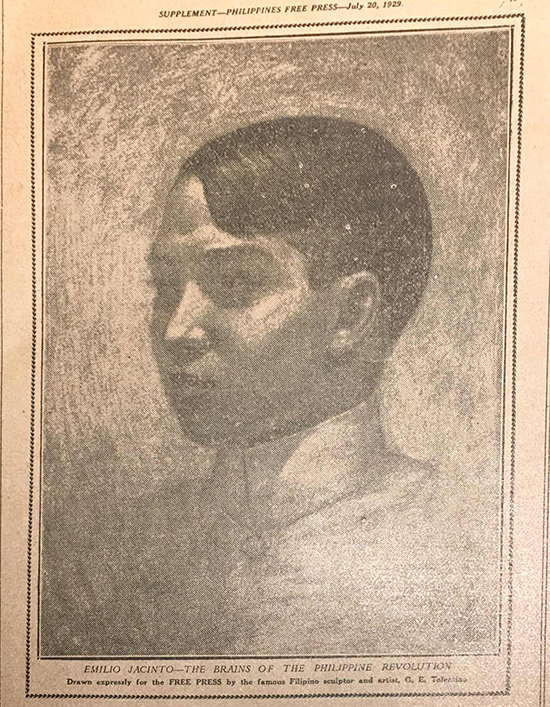
Emilio Jacinto, the boy-genius of the Katipunan, may be considered a kind of orphan, since his father never married his mother, Josefa Dizon—and thanks to original research by Katipunan scholar Jim Richardson—his parents did not live together under one roof.
CONTINUE READING BELOW

Richardson reveals, “Emilio Jacinto was an ‘anak sa labas’ (or born out of wedlock). In the Catholic parlance of the time, he was an ‘hijo natural,’ meaning that his parents, Josefa Dizon and Mariano Jacinto, were not married when he was conceived, either to each other or to anyone else.”
Throwing light on one of Philippine history’s most enigmatic characters, he continues, “Josefa, it seems, raised Emilio in his early years (between 1875 to 1880) in her family home in Binondo, where they lived with her mother Antonia Matanza, her brother José Dizon (who was martyred at Bagumbayan in 1897), and her other siblings. Mariano, meanwhile, is listed as living on the Calzada de Iris, between Santa Cruz and Sampaloc.”
Mariano did marry in 1878, although it was to someone else. “As recorded in the Binondo church register,” Richardson says, “Don Mariano Jacinto y Amorin, single, a native of Binondo and a resident of the capital, was joined in matrimony on Nov. 23, 1878 with Doña Carmen Mañalac, single, a native and resident of Binondo.”
For Jacinto, none of that mattered one bit, and he was a devoted, loving son to his mother. Richardson records that “Josefa Dizon died in 1903, four years after her famous son. The announcement of her death was placed in the Manila paper El Renacimiento by her grieving “children, nephews, and grandchildren.”
It’s a pity that Josefa did not live long enough to care for Jacinto’s own son—Josefa’s grandson. (There is a photograph of a pregnant woman, sitting sadly by Emilio’s bier, and it has always been surmised that this was his wife.) Richardson has identified the boy as Perfecto Jacinto, as he was known in later life. According to records found by Melissa Galauran, Perfecto was married in Caloocan in 1918, but sadly died not long afterward.
One of the most powerful testimonies of a son’s love for his mother is Emilio Jacinto’s tribute to his own mother, written while he was in prison in Laguna. It is a treasure, previously unpublished, discovered and translated by Jim Richardson.
Richardson provides important insight into the work. It’s one of the few times we can see into one of our heroes’ souls and pick out the regret over the path he had chosen to take—and the pain that choice would bring to his mother. Richardson explains, “When Jacinto wrote the poem, his spirits were low, and he foresaw his life might be short. He begs his mother first to allow his soul a brief moment of solace, an elegiac return to the blissful days of his childhood. He remembers the tenderness and ardor of her love. Very soon, though, his mood turns solemn.”
Jacinto’s poem becomes autobiographical, following the hero’s journey from school to the battlefield, always with his mother’s thoughts by his side. Richardson continues, “He seeks his mother’s forgiveness for the fact that his patriotic duty, the fulfillment of the oath he had sworn when still so young, had stolen from him ‘the golden moments of my life’. His upbringing and education, he realizes, had given him the prospect of a ‘future that smiled,’ which he had spurned. ‘Never once,’ Jacinto says emphatically, had he repented his pledge. But honoring his vow had brought suffering and tears (to her). It had been his ‘cruel misfortune’ to feel the anguish of the land, ‘a sorrow both noble and tragic.’ His mother, he knows, had shared his woes and had endured ‘privations and torments’ for him. She had even searched for him amid the fire of battle. She was, he tells her, ‘the peace of my heart.’”
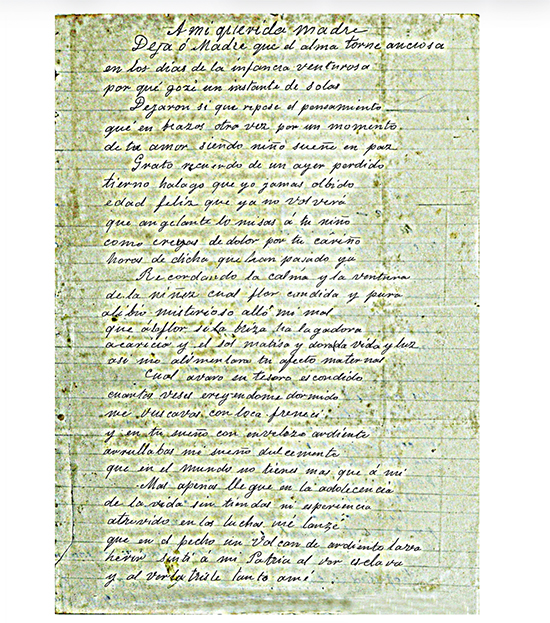
The poem itself would have a long, adventurous history of its own. Richardson relates that “perhaps departing in haste (from prison), Jacinto left behind some of his belongings, among which was a copy of ‘A mi querida Madre.” Somebody then copied the copy, and inscribed these words after the final stanza: “Propiedad de Emilio Jasinto y Dizon, Santa Cruz de la Laguna, Carcel Publica, 26 de Diciembre de 1897, es copia” (all sic). Inexplicably, this copy of a copy later reached Jacinto’s own hands.”
Here are some excerpts of Jacinto’s long-lost poem titled “To My Beloved Mother,” which speak of what Richardson calls the hero’s two greatest loves—his mother and his mother-country.
“Pleasing memories of a lost yesterday,
a tender fondness I shall never forget,
a happy age that will not return;
how yearningly you cradled your little son,
how your love deepened, aching as it grew,
blissful hours that now have passed…
“Like a miser with his hidden treasure,
how many times, though knowing I was asleep,
did you frantically come to make sure I was safe;
and in your dream, with ardent longing,
you sweetly lulled me to sleep,
believing you had no one else in the world but me…
“But scarcely had I reached adolescence,
without knowledge or experience of life,
I dared to throw myself into the struggles,
for in my chest a volcano blazed
when I saw my Motherland wounded and enslaved,
and when I saw her sorrow, I took up arms.
“Forgive me, forgive me, if the sacred,
inescapable duty in my breast,
tore me in its fervor from your loving arms
and stole from me the golden moments of my life;
my troubles and sorrows, only you, beloved Mother,
chose to share my woes.”
To illustrate these heroes’ tales are paintings by one of the art world’s most famous orphans—Fernando Amorsolo—raised completely by his mother, Bonifacio Cueto, a bordadora (embroiderer).
It was his mother who nurtured his talent and who brought him home to Manila to be mentored by his uncle, the famous Fabian de la Rosa. Fabian himself had been raised by his uncles, and he, too, had eked out a living selling sketches on the sidewalks. Amorsolo’s paintings would capture the imagination of an entire generation, spinning tales of happy families, prayerful while working the fields. There can be no better accompaniment to the stories of our heroes raised by the love of their mothers. (These two masterpieces will be part of an Independence Day auction, alongside other historical treasures, on June 13 at Leon Gallery.)
Today, a tempest is brewing over the further diminution of history in college courses—the Rizal Course (founded by law) is set to be wiped out and replaced by AI-based courses and fuzzy technology subjects. To do so would deprive this and future generations of such wonderful touchstones as Jacinto and Bonifacio—and make us all orphans.

WATCH: Do you still believe in marriage? (Generations Ep. 17)
August 19, 2026