

'anthropology': Hope, love, loss, obsession & AI
Grief, though it gnaws on one’s strength, is an ally. It helps in discovering the truth, hence grief becomes a catalyst for healing—even if it’s aided by AI.
In anthropology, a play by American playwright Lauren Gunderson that made its Asian premiere at Barefoot Theater Collaborative production, Merril uses her heart and brain to uncover the truth about the disappearance and perceived death of her younger sister Angie. It is a sci-fi drama and a psychological thriller that has in its fulcrum two elements: sisterly love and obsession to technology. That AI can be both a comforting ally and an unnerving collaborator is well fleshed out on the sleek and unsettling staging of the play at Doreen Black Box, Arete in Quezon City.

Gunderson is exacting in her script when she writes about the viability of hope and mourning coexisting in equal measure.
With her heart, Merril is unyielding in ferreting out the truth that surrounds the fate of Angie. She uses rhyme and reason to navigate her complex anguish. She finds armor in her pain. She nurtures it—hoping that something good will happen if she banks on memory that lilts with love and longing.
With her brain that is unaccepting of Angie’s disappearance, Merril, an expert AI programmer, uses her uncanny skills to uncover the mystery. Hidden and obscured facts are brought to the fore because Merrill created an Artificial Intelligence version of Angie. Her search for closure opens a web of obsession—uncontrollable, exacting, defying of human mores.
CONTINUE READING BELOW

The play puts morality at the center table, its core dissected and interrogated. When AI is used to convey love, where does one draw the line to stop when the search engines give answers that are both comforting and disconcerting at the same time?
anthropology presents that anything digital humans leave on earth becomes their digital ghosts in the future. Angie’s patterns and behaviors that are identifiable though the digital footprints she left behind—in her cellphone, in her tablet, in her e-mails, in her social media apps, in her videos and photographs—are the eerie fodder in crafting her digital ghost.
Loss, deception, fixation take center stage in anthropology. In their shadow is love and hope. And when the digital ghost of Angie—because her Artificial Intelligence version is also privy to an amalgam of cyber data—becomes a conduit to rectification and reconciliation, the moral fiber of the soul of anthropology is bared. It is a soul that is softened by the tenderness of human nature.
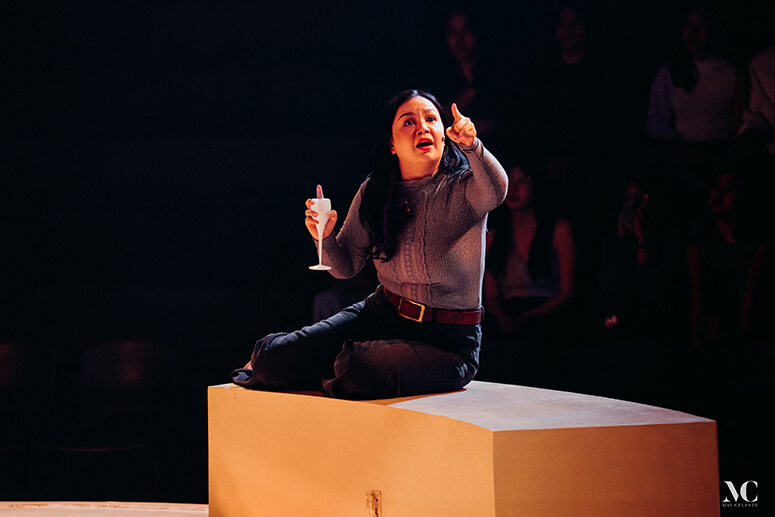
And it is the tenderness—though it is a chilling idea because an AI is activating it—that leads her sister and mother to reconcile; and for Merril to see again her girlfriend. (Imagine this: the digital ghost of Angie is capable of sending a message to people close to her sister’s heart.)
The technical staging of anthropology is as gripping as its narrative. The lighting direction takes its own riveting, absorbing life. Its sound design is appropriate for the digital theme that at times a cyborg seemed to speak from nowhere. And the stage design is a deceptively plain orb that hides from floor to ceiling the many secrets of life. The circular stage depicts the cycle of life, no beginning, no ending. The round roof that tilts here and there both hides and exposes the truth of life and living—a masterpiece.
At the heart of the Philippine production of anthropology is its director Caisa Borromeo. How Caisa sustains the gripping nature of the play— purely American in ways and means and norms—is characteristic of how well invested she is in the material. She makes sure her characters are all seen and heard—even long after the curtain call. Caisa’s direction is sensitive as it is sensible. She places quiet courage on stage. In the many a silent gap in anthropology, she injects her biases on the pros and cons of AI.
The all-female cast of anthropology is top billed by Jenny Jamora as Merril and Maronne Cruz as Angie. Both dynamos of the performing stage, Jenny and Maronne give explosive performances pierced many times by their introspective essaying of their roles.
Jenny gives dignity to grief the way bamboo sways to the rhythm of the storm. She’s pliant. The unconquerable disposition of Merril is in Jenny’s eyes. The feel of the drama is many times in her hands that scroll up and down a gadget—navigating the path of truth that leads to obsession. Jenny’s simple attack on the nature of her character—that she can act as a god to know the truth or a semblance of it through AI—is a volatile component of anthropology. Watch Jenny on stage as her character begins to question the reach of AI and be mesmerized at how she can give complexity a soul, a spirit, a name all its own.
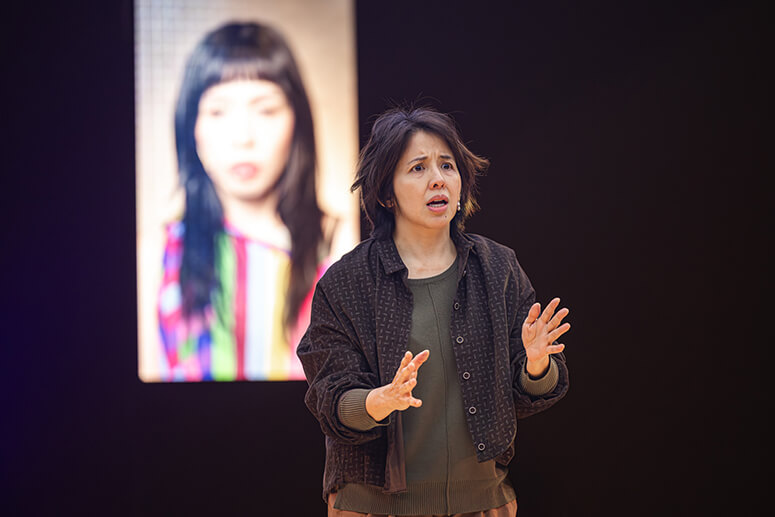
On the other hand, Maronne’s Angie is pure emotional precision even if her appearance in anthropology is mostly confined in the four screens around the circular stage. Maronne is a smorgasbord of emotions—delightful when she’s in a banter and a seeming menace when she wants to control. And how controlling she can be. How Maronne can lend warmth to the complex digital character of Angie is spellbinding.
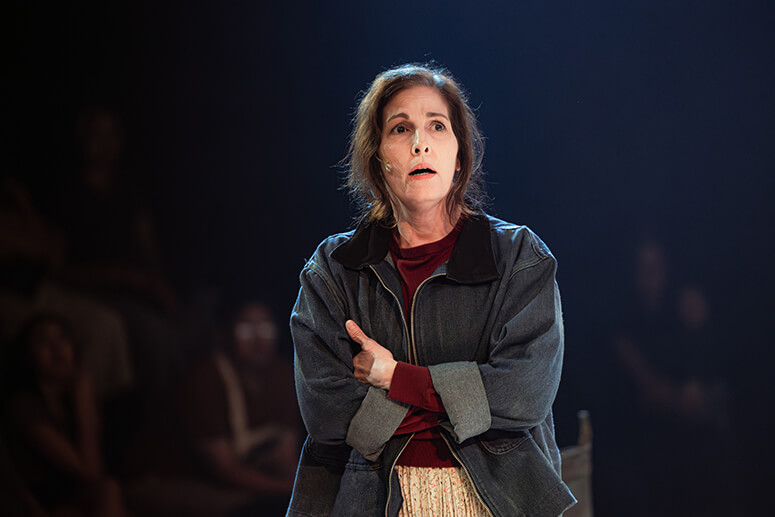
Providing support to the cast are Jackie Lou Blanco and Mikkie Bradshaw-Volante, whose characters are both conduits to truth and voices of the past.
Jackie Lou is Brin, a recovering alcoholic and estranged mother of Merril and Angie. Jackie Lou proves that she has a veteran actor residing in her. She has a powerful presence on stage even if her character is being dismissed at that—an estranged mother. But Jackie Lou has a way of holding on to the turf and making sure her Brin, though seemingly irrelevant in the lives of her daughters, will be relevant again, somehow. She is relatable and she made sure the audience can anchor their emotions on her, too. Wait for her “I’m sorry” scene and weep. There’s something that moves the soul when a mother apologizes to her children.
Mikkie displays love, devotion, hope and warmth in her portrayal of Raquel, the ex-girlfriend of Merril. She’s rational in every turn because that’s what her character necessitates from her: a balanced mind, the voice of reason. Mikkie, too, is a commanding addition to the cast.
anthropology, in the advent of AI and ChatGPT, zeroes in on the ethics of technology. If memories are a sacred domain, how far can technology tamper on them so as to dethrone the grief lounging in one’s heart?
The answer is simulated in anthropology that runs until March 29 at the Doreen Black Box in Arete, Quezon City.
