

REVIEW: Lav Diaz’s ‘Magellan’ is a painterly deconstruction of the eponymous Portuguese conquistador
This review features some spoilers.
Just when you reckon that it might not be possible for Filipino auteur and arthouse giant Lav Diaz to release another movie shot in color since 2013’s Norte, Hangganan ng Kasaysayan, along comes his latest opus Magellan, which, like Norte, had its world premiere at this year’s Cannes Film Festival, and is now primed to represent the Philippines for a shot at the elusive Best International Feature Academy Award.
This vision from the speed-busting director is among his most “accessible” features as of late, clocking in at around 160 minutes, though Diaz intended to release a nine-hour cut. It’s likely a concession to the current terrain of arthouse distribution and the limits of the international film festival circuit, which is to say that, by these metrics, Magellan is an instant megamovie.
The picture is a five-country production, top-billed by international star Gael García Bernal, whose previous credits include Y Tu Mamá También (2001) and Bad Education (2004). It is also handled by Paris-based sales house Luxbox Films and North American distributor Janus Films, and its Oscar campaign is backed by Cinetic Marketing, which is responsible for the international feature success of Parasite (2019) and Drive My Car (2021). After its Cannes bow, Magellan is set to screen at the world’s top film festivals, including the Toronto International Film Festival, New York Film Festival, and the BFI London Film Festival, among others.
Magellan plays as an off-kilter biopic and a characteristically pensive historical saga, spanning over a decade of colonial conquest and existential erosion in the life of the eponymous Portuguese navigator. It is a departure from the thematic infrastructure that chiefly shaped Diaz’s oeuvre, from the legacy of the drug war to the atrocities of martial law, though it sustains the maladies, physical or otherwise, present in his recent projects, from 2022’s Kapag Wala Nang Mga Alon to his forthcoming Japanese occupation drama Kawalan, now in post-production.
The film’s introduction is sort of a parallel to the opening frame of Phantosmia, once again exploring his idea of Eden: a pristine and prosperous terrain with waterways and tropical vegetation that works in sync with Indigenous systems. This Eden is the Philippines in the early 16th century, a paradise soon ruined by colonial greed. The local Malay people, who have long prayed for peace, chant "The promise of the gods of our ancestors is upon us!" upon seeing the white man, believing he is a god.
CONTINUE READING BELOW

Once the title card drops, Diaz's anti-colonial message becomes clear, picturing the horrors of the 1511 Capture of Malacca. The unsettling scene is an artful tableau of lifeless bodies splayed ashore. Diaz clones such stark compositions, using his signature fixed camera and subdued visual palette. From the dreary sight emerged Ferdinand Magellan, bruised and barely mobile. He was under the command of Portuguese conquistador Afonso de Albuquerque at the time. Magellan, who dreams of greatness, forces him to pivot to the Spanish Crown after Portugal’s King Manuel I rejects his voyage to the Spice Islands.
In Malacca, Magellan acquired Enrique (played with mournful spirit by Amado Arjay Babon), a Malay slave turned into the explorer’s “civilized” right-hand man and translator in his relentless search for glory—a fraught experience that eventually left the latter fractured by complicity and a sense of liberation. (Enrique, in a rather surprising move late in the movie, becomes the de facto narrator, though the viewer could question whether or not his screentime, at least in this cut, warrants such a shift in perspective.)
Diaz’s unflinching take on the story of the Portuguese conquistador and the first circumnavigation of the globe (which some historians attribute to Enrique instead of Magellan) is one that refuses an exhaustive account, which may be a function of a more digestible cut. Magellan is less a blow-by-blow recollection of what has unfolded in history than a series of extended snapshots of it, with the time aboard the Trinidad (shot in the reconstructed Victoria, now a museum ship) being the centerpiece. The dialogue is minimal, and intertitles only serve to locate the viewer in the milieu in which the events take place, but not to recall them in great detail. (Had that been the case, we might as well read an entire book or a Wikipedia page on the topic.)
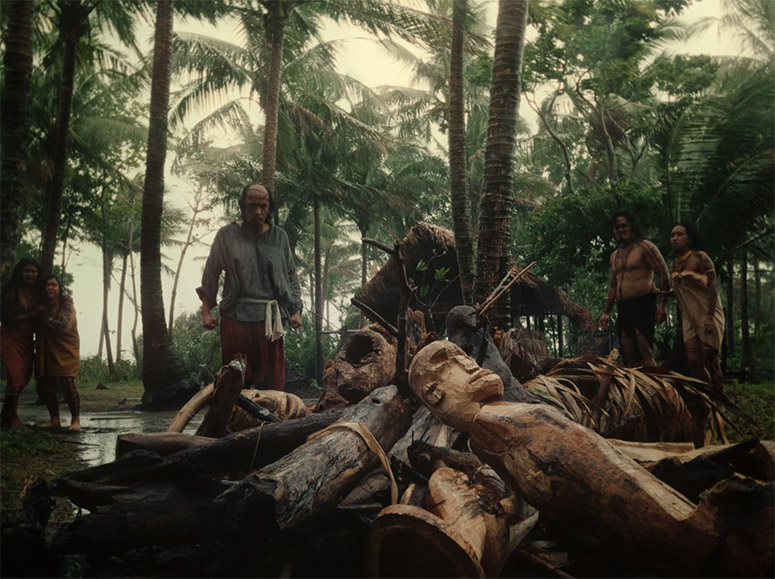
Whereas the narrative favors a chronological plot, Diaz’s examination of our colonial past is far from linear. The director isn’t bent on the particulars of the “conquests” (if we were to assume the colonialist lens); he’s more concerned with the shrapnels of the sweeping violence. From his perspective, the colonial project is one that readily necessitates ethnic cleansing and genocide, unless the Indigenous assimilates into the ways of the empire, into total corrosion of their identity. The movie isn’t so much about the “discovery” of the Philippines, or the rest of the so-called Other, by the Western imagination. It’s more to do with affording the audience a new lens with which to make sense of the empire’s machinery of erasure and exploitation, and how it inevitably hacks into present-day contexts, from Palestine to Sudan.
The thing about Diaz’s marathon cinema is that his response to gargantuan preoccupations is often the opposite: mundane, anti-grandeur. Which is to say that Magellan is not a historical epic akin to Ridley Scott’s Gladiator II or Edward Berger’s All Quiet on the Western Front. In the movie, we are hardly given onscreen access to the spectacle of the cruel acts done in pursuit of wealth and power. Rather, Diaz draws our focus to the aftermath: Blood and mangled flesh scattered across alleyways or rain-soaked ground, men enslaved and women defiled, sacred totems set aflame and destroyed, an entire culture ravaged.
What results, visually, is a strikingly still pictorial fresco in which the shaft of light penetrates every visceral frame like divinity, articulating the tension of how one’s glory is achieved at the expense of another’s humanity. Diaz, alongside co-cinematographer and co-editor Artur Tort, trades his monochromatic default for a painterly blend of muted green, ash blue, and sodden brown, reaping a visual grammar that transfixingly shifts between pastoral and mystical.
The production design, courtesy of Isabel Garcia and Allen Alzola, heightens the textures of existence—from Europe’s concrete corners to the Malayan archipelago’s foliage-heavy communities—that the movie is keen on stretching as well as the unease built into the sights of carnage, shot from equally empathetic and distant vantage points. Indeed, ethnographic insight here allows for some deftly realized mise en scène.
The film also nearly forgoes music, save for a scene in Lisbon, where Magellan tries to earn the favor of the Portuguese king to no avail, before settling in Seville, where he marries Beatriz (Ângela Azevedo), the title character in Diaz’s original nine-hour vision. (Curiously, the romance between the couple that Diaz intended to toy with in his first script takes a backseat in this abridged version, with the director later opting to invoke Beatriz via spectral, prophetic visions.)
Instead of the music motoring the film’s dramatic specifics, Diaz resorts to the work of sound designers Emmanuel Bonnat and Cecil Buban, who steep the film in a kind of wistful and elegiac atmosphere, immersing us in the constant howling of the weather, the tremulous groan of the mighty galleon on harsh waters, and the sorrowful sobs of widows left adrift, mothers losing their children to a fatal scurvy outbreak, or sailors on the brink of physical and spiritual collapse. It is so aptly wielded that you could almost absorb the delirium at the movie’s center.
Bernal brings the titular conquistador to life with a tacitly shifting psyche and an ambition that he doesn’t wear lightly. His Magellan isn’t exactly muscular, but, as the narrative progresses, turns into an imposing, neurotic commander—swift to dole out discipline and ruthlessly anxious of possible mutinies. Nowhere in the film does Diaz project Magellan as a heroic ideal, but he also doesn’t relegate him neatly to the role of a power-hungry colonizer. Once the explorer reaches the Philippines (with Sampaloc, Quezon serving as a proxy for Cebu), we witness an intimate side of him: Profoundly moved, Magellan offers a fruit remedy to the ailing child of Reyna Juana (Hazel Orencio) and Rajah Humabon (Ronnie Lazaro), the fierce chieftain who slyly orchestrates his eventual demise.
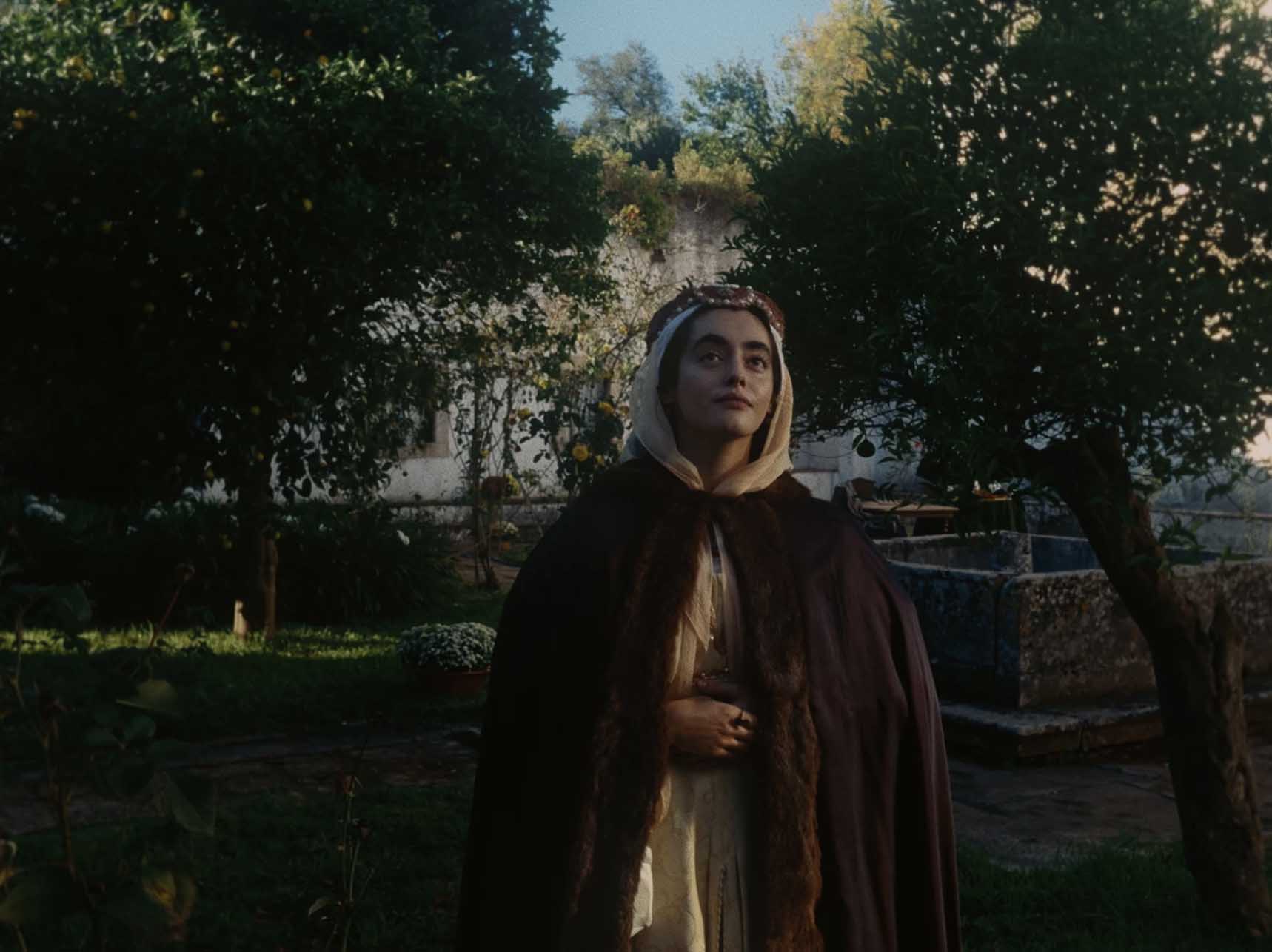
Admittedly, the movie could still benefit from further digression, as the director is wont to do, training the lens on the backstories of the supporting characters. I certainly would have wanted to gain more access to Enrique’s ideology or the liberties Diaz took in approaching the arc of Beatriz. Nevertheless, what’s crucial in Diaz’s deconstruction of the famed conquistador is that it moves past a morally absolute register, just as the director eschews crystalline answers. Diaz is a perceptive humanist as much as he is a cunning provocateur.
In its most daring conceit, Diaz’s vision leans on the revisionist, backed by his seven-year research. The omissions of the Venetian explorer Antonio Pigafetta and Mactan chieftain Lapulapu prove dramatically pivotal as they are historically significant. This narrative choice is strategic: The presence of the former serves to validate the existence of the latter, precisely because Pigafetta’s accounts counter Diaz’s claim that Lapulapu is a mythical figure. The director dismantles the myth of Magellan, only to manufacture his own. But the claim is not completely unfounded, considering the lack of primary sources about Lapulapu’s origins past Pigafetta. This curious sleight of hand allows for broader audience appeal and, most importantly, provocation under the guise of dramatic license. Even Cebuano actor Bong Cabrera, who plays Rajah Kulambo in the film, takes Diaz’s assertion “with a grain of salt.”
Diaz, once again, offers us a cardinal point, meaningfully complicating that which we claim to know for certain. Surely, there will be countless debates, Hot Takes no one asked for, and essays searching for ulterior motives, not least because Magellan is the country’s Oscar submission. Is artistic license a free pass to question history? We can imagine a critic or viewer asking Diaz. Is cinema’s default to educate or reflect historical accuracy? How do we ascertain the truth, anyway?, a filmmaker can retort. Where does art end, and where does history begin?
The point is not to discredit our historians, but to renegotiate the way we document and make sense of history, to explore the crevices ripe for critical interrogation. But the thing is, all this discourse could not properly function without seeing the movie itself. Magellan could only come from a filmmaker and thinker as singular as Diaz. And unfortunately, his vision is worthy of all the marvel and confusion, all the praise and pan. What’s the function of a great movie if it cannot foster dissenting opinions?
Magellan is now showing in theaters.

WATCH: Pixar Summer Fest adventure at Hong Kong Disneyland
August 10, 2026
WATCH: Can we talk about death and grief? (Generations Ep. 25)
October 14, 2026
WATCH: LGBTQIA+ people with unlikely professions
June 28, 2026