

Mother and daughter as art partners
Way back in 1970, the notable artist Ibarra Y. Dela Rosa, who led the Dimasalang Group at the time, visited Dumaguete with my close buddy Johnny Altomonte. Teaching at Silliman University that semester, I shared my modest apartment with both artists and took them to significant spots around the city where they could commit some scenes to canvas with oil and acrylic. Their week’s stay led to a lifelong friendship with Ibarra. Unfortunately, it didn’t last all that long as he left us rather early, in 1998.
The bond was inherited by his widow, Ethel Dimacuha, and their daughter Camille, who took to painting at such a young age, despite not being pushed into it by her dad. It was actually Mom Ethel, then an art educator, who served as Camille’s first mentor. As an adolescent, she won her first distinctions, top prizes at art contests in schools in 1994 and 1995.
On the year her father passed on, the 16-year-old Camille had her first solo show, “The Legacy,” at Ad Infinitum Gallery. The following year, she had solo exhibits, at Heritage Art Gallery in SM Megamall and Heritage Art Venue in Shangri-La Mall. The shows’ titles, “Flores de Mayo” and “Floral Inspiration,” easily established her as an impressionist, with gardens, trees and flowers as her favored subjects.
She says she chose oil on canvas as her regular medium since it had “so much more body and richness to it, allowing detailed works or building up thick impasto strokes.” She adds: “I also like its slow drying process because it gives me the time to work on intricate details. Plus, it lasts much longer compared to other mediums.”
While she continued her impressionistic style, by 2000 she had attracted several patrons. Among them was Mrs. Tess Suplico, her longest-standing art collector before she passed on. Another significant collector was former Secretary of Education Butch Abad, who commissioned several paintings of Batanes. Her landscapes, churches, portraits, nudes and people in their various endeavors outdoors had the premier art critic Cid Reyes labeling Camille as the “youngest impressionist painter in the Philippines.” In 2005, she gained an Honorable Mention at the Art Association of the Philippines Competition.
CONTINUE READING BELOW

In 2009, Camille suddenly shifted to surrealism, displaying 5x5-foot surreal works at Rico Manlapaz’s ArtisCorpus Gallery in Mandaluyong City, with then Mayor Benhur Abalos as guest of honor. She still says this 16th solo show “Aenigma” has been her most memorable among the 23 solo exhibits she’s had so far. The following year, “Aenigma Unveiled” opened at The Picasso Art Gallery and ArtisCorpus Gallery in Salcedo Village, Makati City.
She bravely explored the morbid, the mechanical and the unknown, her works now dominated by proto-human skulls and skeletons—in anatomical veracity of detail. In this cycle, Camille earned such distinctions as Top 40 Philippine Art Awards and 2nd place at the Pagalingan Pinay Art Competition, both in 2009.
In 2017, Camille’s steampunk painting became the official CD & DVD album cover of the international rock band Sepultura’s “Machine Messiah.” Her work was also included in the Phantastische Venus 2015 (Viechtach, Germany) book that featured “70 Surrealism Female Artists Around the World.”
Participation in group shows in Europe was also such an enriching experience. She recollects: “Being able to visit places like The National Gallery in London, Louvre in Paris and Van Gogh Museum in Netherlands meant so much to me. Seeing the real brushstrokes, textures, and massive sizes up close gave me so much inspiration.”
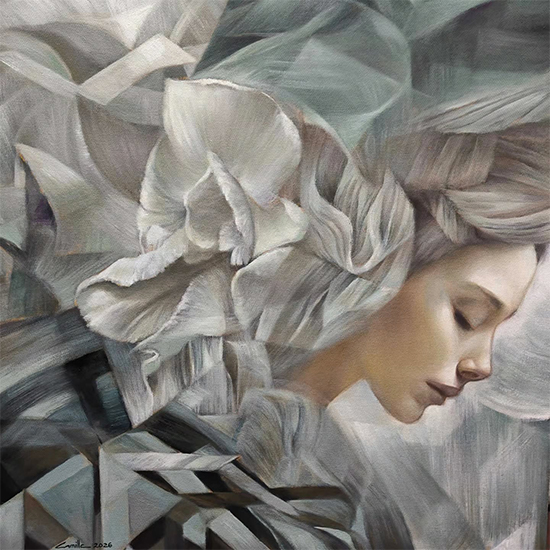
Her mom had first immersed her in singing, acting and dancing lessons, hoping to have it lead into a showbiz career. But Ibarra’s demise in 1998 made Camille resolve to turn to painting as her central focus and commit to a career as a visual artist. Ethel had taught her the basics and introduced her to oil pastels, while advising her to master one medium and subject first before shifting to another.
For her part, Ethel only had time to create art on Sundays, as she was a full-time Humanities professor at the Lyceum of the Philippines and also taught Art History at the Technological University of the Philippines. But she had also started with a solo show as early as 1981, at the Rear Room Gallery on Mabini Street in Ermita, with almost all of her works being sold. When her painting “Makiling Treescape” won third prize at the AAP National Competition in 1987, she surprisingly decided to quit painting.
Ethel says now that she never evolved from her originally chosen subjects, style and medium: naturalistic flowers, landscapes and treescapes done in oil on canvas. “Yes,” she asserts, “I am indeed a modernist—a radical and an unapologetic artist. I am very happy to have found the courage to release myself from the spell of Ibarra’s artistic influence.”
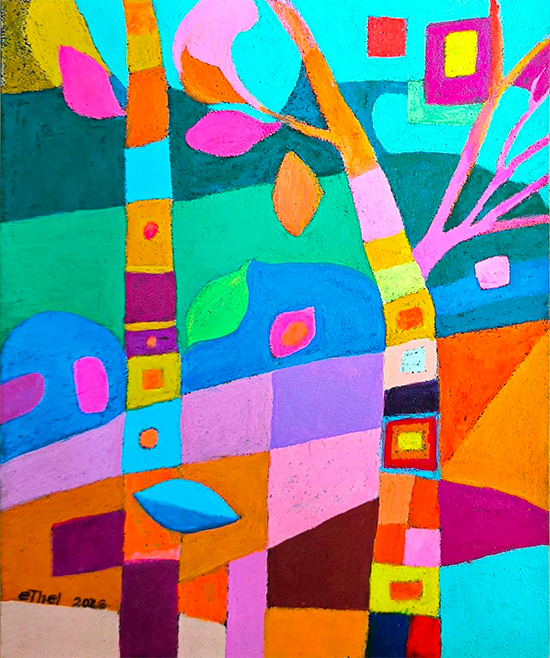
Among group shows, her favorite has been an exhibit at the Kapitolyo Art Space in Pasig City in 2024, as a reunion with former students from TUP. “It also served as my breakthrough in re-entering the art world. That group exhibit rekindled my passion for painting, allowing me to join the arena of contemporary artists armed with a new shield: the explosive energy of radical colors.”
Late last year, the mother-and-daughter team decided to partner for an exhibit as a tribute to Mother’s Day. This was rescheduled, so that “Interwoven” will now start with an artist reception at 5 p.m. on Tuesday, Sept. 8 until Sept. 20 at Nami Art Gallery, Pioneer Center, Kapitolyo, Pasig City.
Ethel Dimacuha will be showing 25 oil pastel and acrylic works on sandpaper, seven 24” x 18” acrylics on canvas, and four 18” x 24” mixed media collages with acrylic on canvas. Camille Dela Rosa will present seven oil on canvas paintings, which have shifted back to impressionism.
The artists agree that they chose the title “Interwoven” because they both believe “that nothing in nature exists on its own, everything is connected.”
Ethel adds: “It just felt like the perfect way to describe our relationship. We kept our own individual styles, but our subjects naturally go together. I paint vibrant trees, which represent deep roots, strength and foundation. Camille paints flowers, representing her blossoming into her own light. Just like a tree anchors the ground, so flowers can thrive in the same soil, our artworks speak to each other on the walls. It’s a beautiful reflection of our shared roots and our bond as mother and daughter.”

WATCH: Is Philippine cinema still thriving? (Generations Ep. 19)
September 2, 2026
WATCH: Is OPM still as good as it used to be? (Generations Ep. 20)
September 9, 2026
WATCH: LGBTQIA+ people with unlikely professions
June 28, 2026